
Context:
In the global order of the 21st century, the measure of economic power is no longer limited to industrial or service production alone. Instead, digital platforms, cultural influence, and the velocity of ideas, shaped by imagination, innovation, and intellectual property have emerged as crucial determinants of economic strength. In this context, the concept of the Orange Economy has gained prominence, where creativity is viewed as a key driver of economic development.
-
- For a culturally rich and diverse country like India, the Orange Economy is not merely an engine of growth but also a strategic means to strengthen its soft power at the global level. Recognizing this significance, the Government of India, in the Union Budget 2026–27, placed the country’s creative industries at the centre of its service-led growth strategy. This marks the first time that the government has explicitly indicated its intent to mainstream the Orange Economy, also referred to as the Creative Economy.
- For a culturally rich and diverse country like India, the Orange Economy is not merely an engine of growth but also a strategic means to strengthen its soft power at the global level. Recognizing this significance, the Government of India, in the Union Budget 2026–27, placed the country’s creative industries at the centre of its service-led growth strategy. This marks the first time that the government has explicitly indicated its intent to mainstream the Orange Economy, also referred to as the Creative Economy.
Orange Economy
The Orange Economy, commonly known as the “Creative Economy,” encompasses economic activities that are based on ideas, knowledge, cultural capital, and intellectual property rights. It includes sectors such as film and music industries, animation, visual effects, gaming and comics (AVGC), digital content creation, design and fashion, advertising and publishing, cultural tourism, and live entertainment and media. In these sectors, the source of economic value is not a physical product but “creative expression.” In other words, this is an idea-driven economy, where imagination and innovation become the primary factors of economic production. Globally, creative industries have now become a part of the economic mainstream, contributing between 0.5% and 7% to the GDP of various countries. The term “Orange Economy” was first coined by former Colombian President Iván Duque Márquez and Culture Minister Felipe Buitrago. They elaborated on this concept in their 2013 book The Orange Economy: An Infinite Opportunity. The colour orange is widely regarded worldwide as a symbol of creativity, culture, and transformation, which is why it was chosen to represent this economy. |
Significance of Orange Economy in the Indian Context:
India’s Orange Economy holds special importance for several reasons:
-
- A New Avenue for Employment Generation: Creative industries such as film production, gaming, design, digital marketing, and handicrafts provide direct and indirect employment to millions of people. This sector offers new employment opportunities, particularly for youth and women.
- Service Sector-Led Development: The Orange Economy accelerates growth in the service sector, thereby increasing economic activities in allied sectors such as hospitality, tourism, advertising, logistics, and media.
- Expansion of Soft Power: Indian cinema, yoga, cuisine, classical music, and cultural festivals strengthen India’s global identity. Thus, this economy enhances not only economic growth but also diplomatic influence.
- Export Promotion: Through digital platforms and OTT services, Indian content is reaching global markets, leading to increased exports of cultural products.
- A New Avenue for Employment Generation: Creative industries such as film production, gaming, design, digital marketing, and handicrafts provide direct and indirect employment to millions of people. This sector offers new employment opportunities, particularly for youth and women.
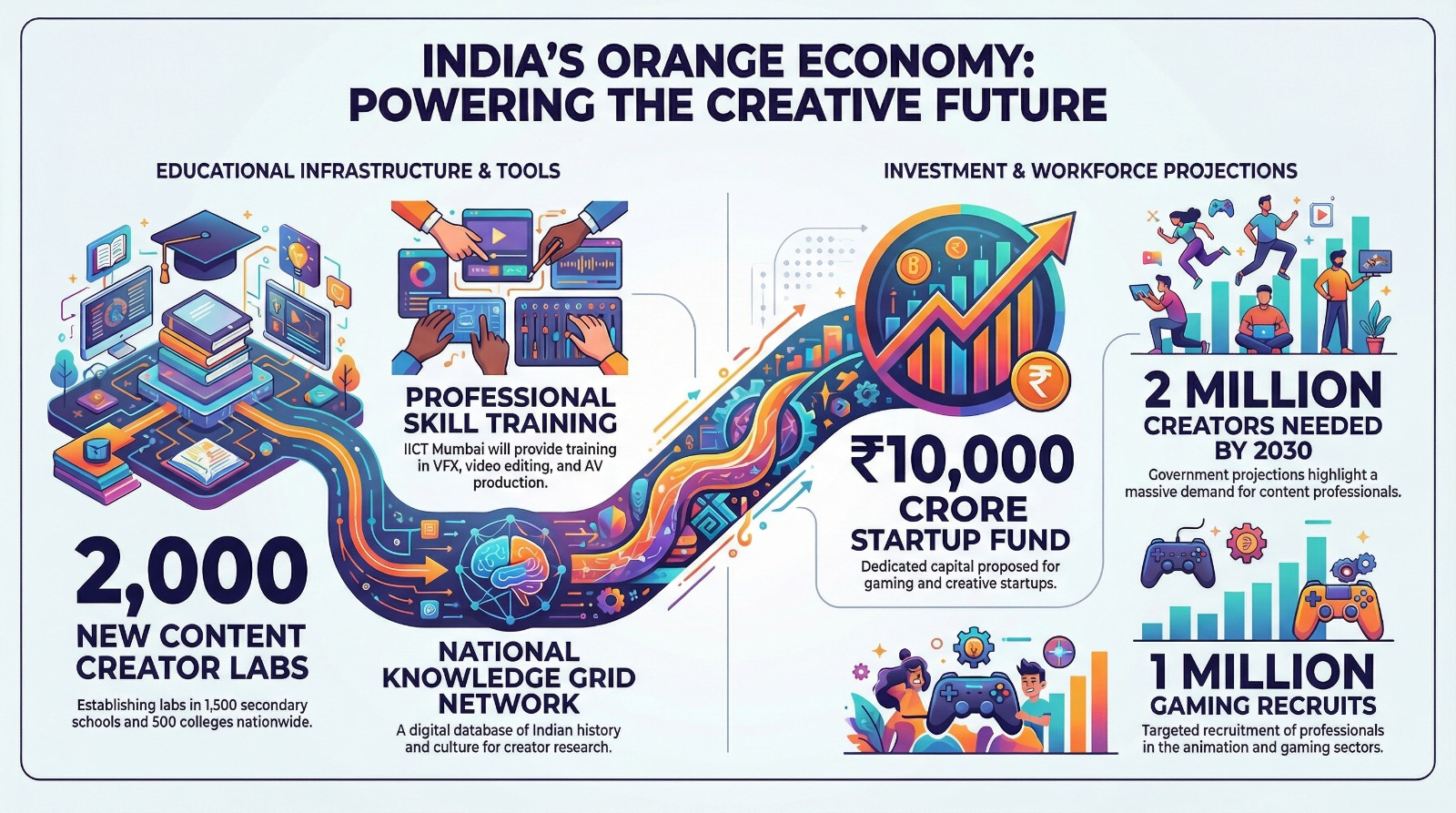
According to major industry reports such as the FICCI-EY report and government estimates, the Indian media and entertainment sector was valued at approximately ₹2.5 trillion in 2024 and is expected to reach ₹3.067 trillion by 2027. The sector provides direct and indirect employment to more than 10 million people. Nearly one-third of the total revenue comes from digital media, which is transforming production and distribution models. Significant growth has been observed in online gaming (₹232 billion), animation and VFX (₹103 billion), and live events (₹100+ billion).
These figures indicate that creativity is no longer merely a means of entertainment but has evolved into a strategic capability.
Key Pillars of Orange Economy:
The most technological and dynamic component of the Orange Economy is AVGC-XR (Animation, Visual Effects, Gaming, Comics, and Extended Reality).
-
- Animation and VFX: India has emerged as a global production base for these services. Indian teams are increasingly contributing to international films, streaming content, and advertisements. Indian artists and engineers are now part of complex global workflows, demonstrating the country’s technological depth.
- Gaming Industry: India has become one of the largest gaming markets in the world. Gaming is no longer just a pastime but a social space. The accessibility of mobile devices has expanded gaming into smaller towns and rural areas, creating a vast consumer base.
- Animation and VFX: India has emerged as a global production base for these services. Indian teams are increasingly contributing to international films, streaming content, and advertisements. Indian artists and engineers are now part of complex global workflows, demonstrating the country’s technological depth.
Government Initiatives and Institutional Framework:
Recognizing the potential of the Orange Economy, the Government of India has undertaken several significant initiatives:
-
- Indian Institute of Creative Technologies (IICT): Established as a National Centre of Excellence, it aims to bridge the gap between training, infrastructure, and industry.
- Education and Skill Development: To meet future demand, there are plans to establish AVGC Content Creator Labs in 15,000 secondary schools and 500 colleges, with the objective of preparing a workforce of 2 million professionals for this sector by 2030.
- WAVES (World Audio Visual and Entertainment Summit): This platform brings together creators, startups, and policymakers, enabling the exchange of ideas and investment opportunities.
- Create in India Challenge: This initiative aims to identify local talent and provide them with a global platform.
- Indian Institute of Creative Technologies (IICT): Established as a National Centre of Excellence, it aims to bridge the gap between training, infrastructure, and industry.
Challenges:
Despite rapid growth, India’s Orange Economy faces several structural challenges:
-
- Intellectual Property Protection: Creative industries such as film, music, animation, gaming, and digital content rely heavily on intellectual property. However, piracy, unauthorized duplication, and copyright violations remain widespread in India, discouraging innovation and investment. A robust legal framework and effective enforcement mechanisms are required.
- Skill Gap: The expansion of the Orange Economy increasingly depends on emerging technologies such as Artificial Intelligence (AI), Machine Learning, Augmented Reality (AR), and Virtual Reality (VR). However, the current education and training systems are not sufficiently aligned with these technological advancements, resulting in a mismatch between industry requirements and workforce capabilities.
- Infrastructure Deficit: The growth of creative industries requires high-speed internet, digital production tools, recording studios, post-production facilities, and design labs. Such infrastructure is largely limited to metropolitan areas, creating regional disparities and underutilizing talent in rural and semi-urban regions.
- Limited Access to Capital: Creative startups primarily invest in intellectual property and innovative ideas rather than traditional physical assets. This often discourages banks and financial institutions from extending credit, limiting access to financial resources for innovation-driven enterprises.
- Intellectual Property Protection: Creative industries such as film, music, animation, gaming, and digital content rely heavily on intellectual property. However, piracy, unauthorized duplication, and copyright violations remain widespread in India, discouraging innovation and investment. A robust legal framework and effective enforcement mechanisms are required.
Way Forward:
-
- For the sustainable and inclusive growth of the Orange Economy, it is essential to adopt a collaborative model involving the government, industry, and academic institutions to create a robust ecosystem that supports innovation, skill development, and entrepreneurship.
- In addition to established creative hubs such as Bengaluru, Hyderabad, and Mumbai, it is necessary to develop creative clusters in Tier-2 and Tier-3 cities to integrate local talent into the formal economy and reduce regional imbalances.
- From an inclusive development perspective, it is also important to incorporate rural art, crafts, and cultural traditions into the creative economy to give global recognition to the “Vocal for Local” initiative and provide international platforms for local creativity.
- Furthermore, emerging technologies such as Artificial Intelligence (AI) should be used to enhance the creative capacities of artists rather than replace them, thereby maintaining a balance between technological progress and human creativity.
- For the sustainable and inclusive growth of the Orange Economy, it is essential to adopt a collaborative model involving the government, industry, and academic institutions to create a robust ecosystem that supports innovation, skill development, and entrepreneurship.
Conclusion:
The Orange Economy is an indispensable pillar in realizing the vision of Viksit Bharat @ 2047. It is an economy based on the inexhaustible resource of human imagination. For India, the Orange Economy is not merely a source of revenue but also a powerful means to enhance its soft power. When Indian films, music, yoga, and cultural heritage reach global audiences through digital platforms, they create a positive image of India. This represents a modern form of cultural diplomacy that strengthens India’s influence in trade and bilateral relations.
| UPSC/PCS Mains Practice Questions: What is the concept of the Orange Economy? Evaluate the policy measures taken by the government to develop the Orange Economy in India. |



