
Context:
In response to the devastation caused by Cyclone Ditwah in Sri Lanka, India launched Operation Sagar Bandhu, a humanitarian assistance and disaster relief (HADR) mission. The operation aimed to provide critical aid and support to the affected population, reflecting India's commitment to its Neighbourhood First policy and Vision MAHASAGAR.
Background:
-
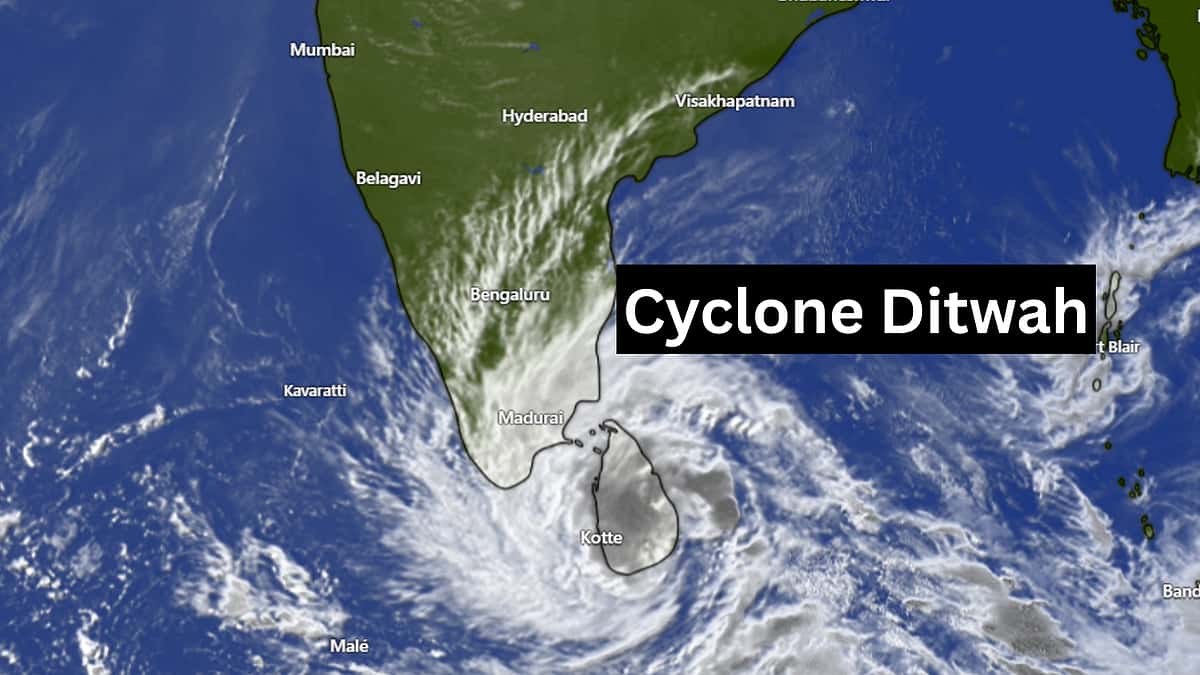
- Cyclone Ditwah, a tropical cyclone, struck Sri Lanka with violent winds, heavy rainfall, and storm surges, causing loss of life, property damage, and displacement.
- India’s response aimed at rapid humanitarian aid, leveraging both military and civilian resources to mitigate human suffering.
- Cyclone Ditwah, a tropical cyclone, struck Sri Lanka with violent winds, heavy rainfall, and storm surges, causing loss of life, property damage, and displacement.
Components of Operation Sagar Bandhu:
|
Component |
Details |
|
Humanitarian Aid |
Deployment of tonnes of relief material, including dry rations, fresh food, tents, tarpaulins, blankets, hygiene kits |
|
Naval Deployment |
INS Vikrant and INS Udaygiri transported relief supplies and assisted in logistics support |
|
Air Deployment |
C-130J and IL-76 aircraft were used to move personnel and supplies efficiently |
|
NDRF Deployment |
80+ personnel, four sniffer dogs, and specialized equipment assisted in rescue and recovery operations |
Significance
-
- Humanitarian Assistance & Disaster Relief (HADR): Demonstrated India’s ability to provide rapid, coordinated disaster response to neighboring countries.
- Strategic Diplomacy: Reinforced India’s Neighbourhood First Policy, enhancing bilateral ties with Sri Lanka.
- Maritime & Air Power Utility: Showcased versatility of Indian Navy and Air Force in humanitarian missions, beyond combat roles.
- Regional Leadership: Strengthened India’s image as a responsible and capable regional actor in the Indian Ocean Region (IOR).
- Humanitarian Assistance & Disaster Relief (HADR): Demonstrated India’s ability to provide rapid, coordinated disaster response to neighboring countries.
About Cyclones:
|
Aspect |
Details |
|
Rotation |
Northern Hemisphere → anticlockwise; Southern Hemisphere → clockwise |
|
Origin of Term |
Greek “Cyclos” meaning “coils of a snake”; coined by Henry Piddington |
|
Types |
1. Tropical Cyclones: Between Tropics of Cancer & Capricorn; winds > 63 km/h |
|
Stages of Formation (Tropical Cyclones) |
1. Formation: Warm Ocean heat & moisture, convection, cumulus clouds |
|
Naming (North Indian Ocean) |
Assigned by 8 countries (India, Bangladesh, Maldives, Myanmar, Oman, Pakistan, Sri Lanka, Thailand); examples: Hudhud, Amphan, Fani, Vayu |
|
Global Terminology |
Hurricane (Atlantic/Caribbean), Typhoon (Western Pacific/China Sea), Willy-willies (Australia), Tornado (USA/West Africa) |
Conclusion
Operation Sagar Bandhu exemplifies India’s strategic approach to HADR, combining military logistics, disaster management expertise, and regional diplomacy. It also demonstrates the importance of preparedness for climate-induced disasters and the role of India as a humanitarian power in the Indian Ocean region.



