
Why in News?
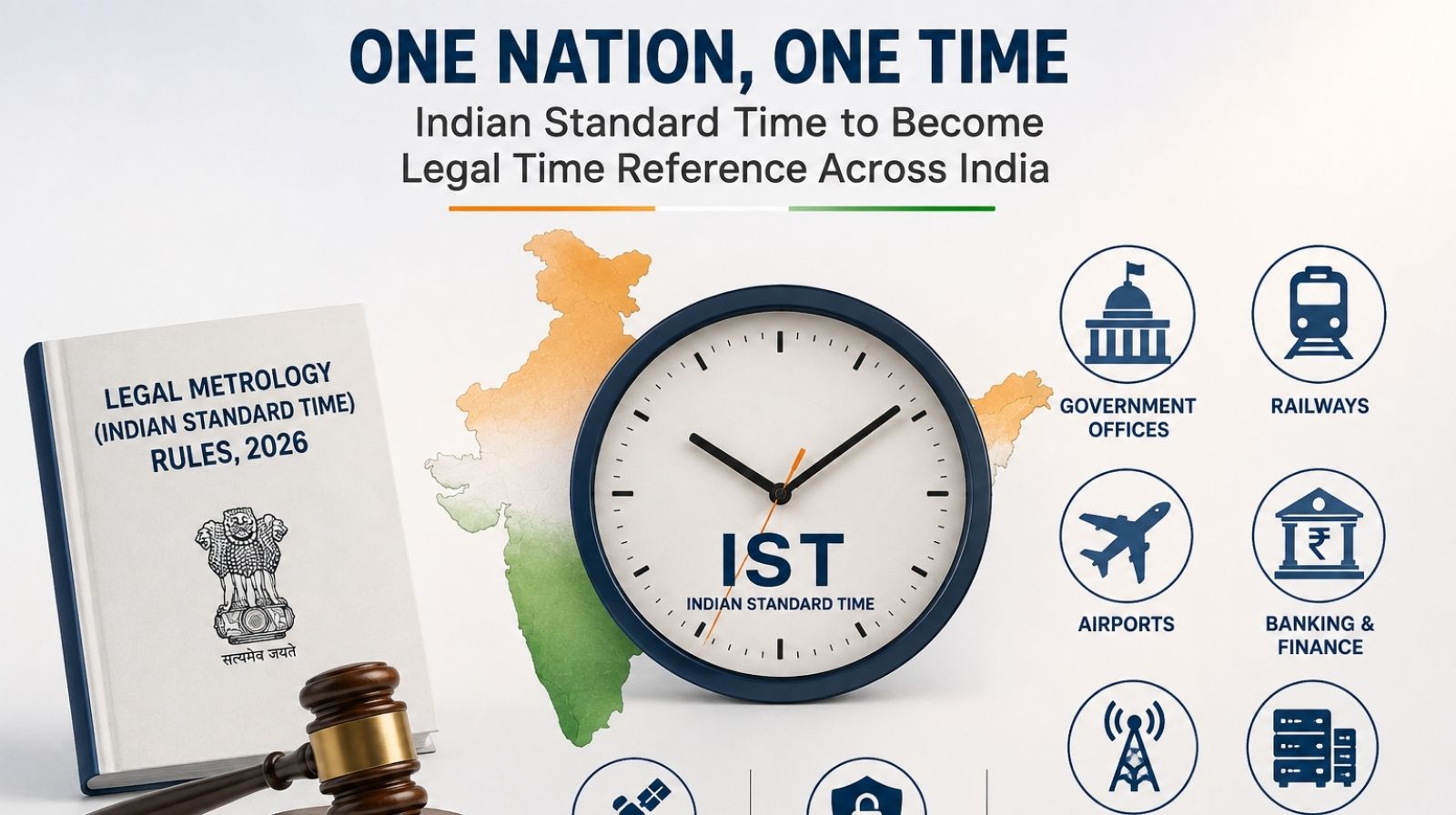
Recently, the Central Government has taken steps towards establishing Indian Standard Time (IST) as a uniform and reliable national time reference across the country. This initiative is being viewed as ‘One Nation, One Time’. The objective is not merely to bring clocks across the country to the same time, but also to synchronize critical systems such as banking, telecommunications, digital payments, power grids, railways, stock markets, and other essential infrastructure with an accurate and reliable time source.
What is ‘One Nation, One Time’?
-
-
- India already has a single official time zone, and IST is 5 hours and 30 minutes ahead of UTC. Therefore, this initiative does not seek to introduce a new time zone.
- Instead, it focuses on making IST the sole reference time for official and legal purposes in the country while improving the accuracy and reliability of its dissemination.
- In the modern digital economy, time has become an important component of critical digital infrastructure. Therefore, reducing dependence on different and potentially inconsistent time sources across various systems has become essential.
- India already has a single official time zone, and IST is 5 hours and 30 minutes ahead of UTC. Therefore, this initiative does not seek to introduce a new time zone.
-
)
How Will It Work?
-
-
- India’s official time is determined and maintained by the CSIR-National Physical Laboratory (CSIR-NPL) with the help of highly precise atomic clocks.
- To make this time available across the country, modern technologies such as the Precision Time Protocol (PTP) and White Rabbit Technology (WRT) are being used.
- White Rabbit Technology (WRT) primarily uses fibre-optic networks to help synchronize different systems with a common time source at extremely high levels of precision.
- Alongside this, India can leverage its indigenous satellite-based capabilities, particularly NavIC (Navigation with Indian Constellation), to reduce dependence on external time sources.
- India’s official time is determined and maintained by the CSIR-National Physical Laboratory (CSIR-NPL) with the help of highly precise atomic clocks.
-
Why Does India Need It?
-
-
- Reliability of the Digital Economy: Digital payments, banking and online transactions require accurate timestamps for every transaction. Even a small discrepancy in time can affect the sequencing and verification of transactions.
- Efficiency of Financial Markets: Stock markets and high-frequency trading involve thousands of transactions within extremely short time intervals. A common and accurate time reference can improve transparency, traceability and fairness in financial markets.
- Synchronization of Critical Infrastructure: Systems such as power grids, telecommunications networks, railway signalling and aviation require precise time synchronization between different devices and operational systems.
- Cybersecurity: During the investigation of cyber incidents, timestamps from different servers and network devices have to be correlated. An accurate and common time reference makes digital forensics more effective.
- Strategic Autonomy: At present, many systems depend on time signals obtained from Global Navigation Satellite Systems (GNSS). Excessive dependence on external systems creates risks related to signal disruption, spoofing and manipulation.
- Therefore, developing an indigenous and secure national time reference is important for both digital sovereignty and national security.
- Reliability of the Digital Economy: Digital payments, banking and online transactions require accurate timestamps for every transaction. Even a small discrepancy in time can affect the sequencing and verification of transactions.
-
Major Challenges:
-
-
- Expanding a high-precision Time Dissemination Network across the country.
- Upgrading legacy digital and industrial equipment to comply with new standards.
- Ensuring coordination among various government and private institutions.
- Managing the cost of technological upgrades, particularly for smaller institutions.
- Transitioning from GNSS-based systems towards the national time reference.
- Ensuring the cybersecurity of time-synchronization infrastructure.
- Expanding a high-precision Time Dissemination Network across the country.
-
Way Forward:
-
-
- India should develop a multi-layered and secure national time dissemination network. This can be achieved through the integrated use of fibre-optic networks, atomic clocks, satellite-based systems and indigenous capabilities such as NavIC.
- At the same time, it is necessary to develop backup time sources, regular calibration mechanisms and robust cybersecurity protocols for critical infrastructure.
- India should develop a multi-layered and secure national time dissemination network. This can be achieved through the integrated use of fibre-optic networks, atomic clocks, satellite-based systems and indigenous capabilities such as NavIC.
-
Conclusion:
‘One Nation, One Time’ is a much broader initiative than simply ensuring uniformity in time across India. It represents an important step towards strengthening the digital economy, critical infrastructure, cybersecurity and strategic autonomy of the country.
In the future data-driven economy, accurate time will no longer be merely an administrative requirement; it will become a foundational infrastructure for digital governance and national security.



