
Context
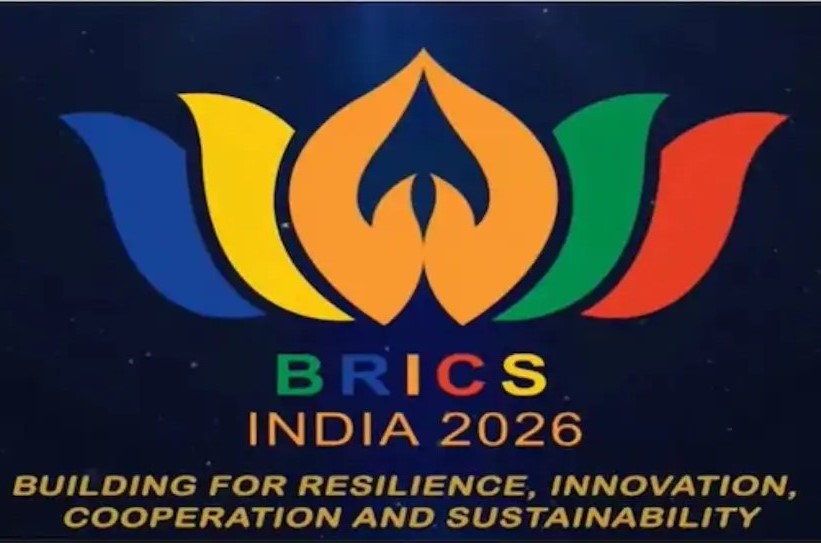
Recently, External Affairs Minister Dr. S. Jaishankar launched the official logo, theme, and website for the BRICS Summit 2026 as part of India’s BRICS Chairship. India assumed the BRICS Chairmanship on 1 January 2026, succeeding Brazil, which hosted the 17th BRICS Summit in 2025.
About BRICS
BRICS is an international grouping of emerging economies originally comprising Brazil, Russia, India, and China (BRIC)—a term coined in 2001 by a British economist to highlight their rapid economic growth potential. The grouping was formalised in 2006, with the first BRIC Summit held in 2009. In 2010, South Africa joined the bloc, transforming it into BRICS.
In recent years, the grouping has expanded its membership:
- 2024: Egypt, Ethiopia, Iran, and the United Arab Emirates became full members.
- 2025: Indonesia joined the grouping.
India’s Chairship: Theme and Priorities
Under India’s Chairship, the BRICS theme“Building for Resilience, Innovation, Cooperation and Sustainability” reflects the belief that enhanced cooperation among BRICS members can help address shared global challenges in a balanced, inclusive, and development-oriented manner.
The theme underscores the importance of capacity enhancement, innovation-led development, and sustainable growth pathways.
India’s Chairship will be guided by four core pillars:
1. Resilience: Strengthening institutional and structural capacities to withstand systemic shocks, particularly in sectors such as health, agriculture, energy, and disaster management.
2. Innovation: Promoting collaboration in technology, startups, MSMEs, and emerging technologies to address socio-economic challenges in a people-centric manner.
3. Cooperation: Enhancing cooperation among member states across political, economic, and cultural domains, including people-to-people exchanges.
4. Sustainability: Advancing climate action, clean energy transitions, and sustainable development pathways that is equitable and sensitive to national contexts.
Growing Relevance of BRICS
BRICS has acquired enhanced global significance due to several factors:
- Demographic weight: The grouping now represents nearly half of the world’s population, strengthening its influence in global deliberations.
- Energy influence: The inclusion of major oil-producing economies enhances BRICS’ impact on global energy markets.
- Balancing role: BRICS offers emerging economies opportunities to form coalitions that promote more equitable and representative global agendas.
This growing relevance positions BRICS as a critical platform for emerging economies to collectively assert their voice in global governance while addressing challenges related to development, trade, and climate change.
Diversity and Contradictions within BRICS
Despite its expanding footprint, BRICS remains an unusual and complex coalition due to significant internal differences:
- Political and economic diversity: Members range from liberal democracies such as India and Brazil to authoritarian systems such as China and Russia, reflecting divergent strategic priorities.
- Regional rivalries: Persistent tensions, notably the India–China border dispute, continue to influence intra-bloc dynamics.
- Middle Eastern complexities: While Iran is a BRICS member, countries like Saudi Arabia and the UAE have distinct geopolitical concerns regarding Iran’s nuclear programme and regional posture.
- Divergent geopolitical narratives: Some members emphasise anti-Western rhetoric, whereas others pursue pragmatic engagement with Western economies.
These contradictions pose challenges to BRICS’ ability to present a unified stance on strategic and global issues, even as the grouping continues to expand its influence.
Conclusion
India’s BRICS Chairship in 2026, guided by a humanity-first and people-centric vision, seeks to make the grouping more practical, responsive, and inclusive. By prioritising resilience, innovation, cooperation, and sustainability, India aims to deepen South–South cooperation, strengthen global governance, and promote inclusive development in an increasingly complex and multipolar world.



