
Context:
Recently, the Bihar Raj Bhavan raised questions regarding the dual roles of Bihar Food and Consumer Protection Minister and Legislative Council Member (MLC) Ashok Choudhary. He also holds the position of Assistant Professor of Political Science at A.N. College, Patna. The Raj Bhavan expressed concerns that holding the teaching position could constitute an 'Office of Profit', potentially raising questions about his disqualification as an MLC.
Background of the Issue:
-
-
- Ashok Choudhary joined A.N. College as an Assistant Professor on February 17, 2026, and proceeded on leave the following day due to his political responsibilities. The university Syndicate discussed the matter on August 19, 2026, following which the Vice-Chancellor referred it to the Governor's Secretariat.
- The Raj Bhavan questioned his eligibility for lien during the probation period and the legality of holding both positions simultaneously. The opinion of the state's Advocate General has also been sought in this regard.
- Ashok Choudhary joined A.N. College as an Assistant Professor on February 17, 2026, and proceeded on leave the following day due to his political responsibilities. The university Syndicate discussed the matter on August 19, 2026, following which the Vice-Chancellor referred it to the Governor's Secretariat.
-
Key Legal Issues:
-
-
- Office of Profit: According to the Raj Bhavan, the post of Assistant Professor may constitute an Office of Profit, even if the concerned individual does not receive a salary, because the position may carry a legal entitlement to financial benefits.
- Probation and Lien: Lien refers to the legal right of a permanent employee to retain their substantive post while serving elsewhere. The Raj Bhavan argues that a probationary employee is not entitled to lien under university rules. The legality of granting leave during the probation period has also been questioned.
- Section 68(2) of the Bihar State Universities Act, 1976: According to the Raj Bhavan, this provision relates to granting special leave to university employees who are subsequently elected to Parliament or State Legislatures. It does not apply to existing legislators who join a university at a later stage.
- Office of Profit: According to the Raj Bhavan, the post of Assistant Professor may constitute an Office of Profit, even if the concerned individual does not receive a salary, because the position may carry a legal entitlement to financial benefits.
-
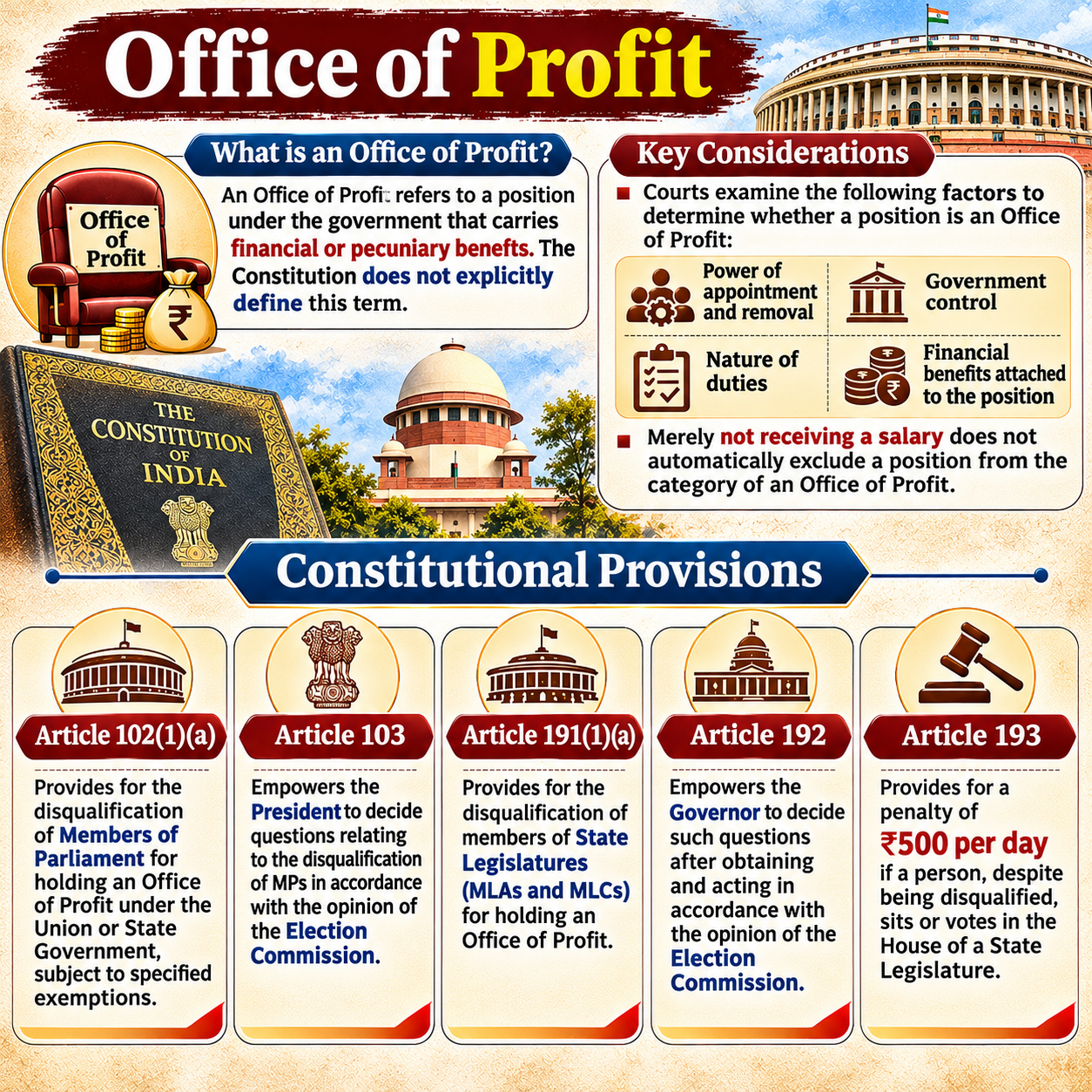
What is an Office of Profit?
An Office of Profit refers to a position under the government that carries financial or pecuniary benefits. The Constitution does not explicitly define this term. Courts examine factors such as the power of appointment and removal, government control, the nature of duties and financial benefits attached to the position. Merely not receiving a salary does not automatically exclude a position from the category of an Office of Profit.
Constitutional Provisions:
-
-
- Article 102(1)(a): Provides for the disqualification of Members of Parliament for holding an Office of Profit under the Union or State Government, subject to specified exemptions.
- Article 103: Empowers the President to decide questions relating to the disqualification of MPs in accordance with the opinion of the Election Commission.
- Article 191(1)(a): Provides for the disqualification of members of State Legislatures (MLAs and MLCs) for holding an Office of Profit.
- Article 192: Empowers the Governor to decide such questions after obtaining and acting in accordance with the opinion of the Election Commission.
- Article 193: Provides for a penalty of ₹500 per day if a person, despite being disqualified, sits or votes in the House of a State Legislature.
- Article 102(1)(a): Provides for the disqualification of Members of Parliament for holding an Office of Profit under the Union or State Government, subject to specified exemptions.
-
Key Judicial Judgements:
-
-
- Guru Gobind Basu v. Sankari Prasad Ghosal (1964): The Supreme Court identified factors such as appointment, removal, remuneration and government control as important considerations in determining an Office of Profit.
- Satrucharla Chandrasekhar Raju Case (1992): The Court emphasised the examination of government control and the actual nature of the position in determining whether it constitutes an Office of Profit.
- Jaya Bachchan v. Union of India (2006): The Court clarified that actual receipt of financial benefits is not necessary; the legal entitlement to receive such benefits is also relevant.
- Guru Gobind Basu v. Sankari Prasad Ghosal (1964): The Supreme Court identified factors such as appointment, removal, remuneration and government control as important considerations in determining an Office of Profit.
-
Constitutional and Ethical Dimensions:
Simultaneously holding political and academic positions may create a conflict between private interests and public responsibilities. Such situations can affect legislative independence, the impartiality of public offices, institutional autonomy and accountability. Therefore, public representatives are expected to prioritise constitutional morality and public interest.
Conclusion:
The constitutional provisions relating to the Office of Profit safeguard legislative independence and democratic accountability. The case of Ashok Choudhary highlights the importance of adhering to constitutional rules and ethical standards for individuals holding public positions. Such matters should be resolved through impartial legal scrutiny, transparency and adherence to constitutional morality.