
Context:
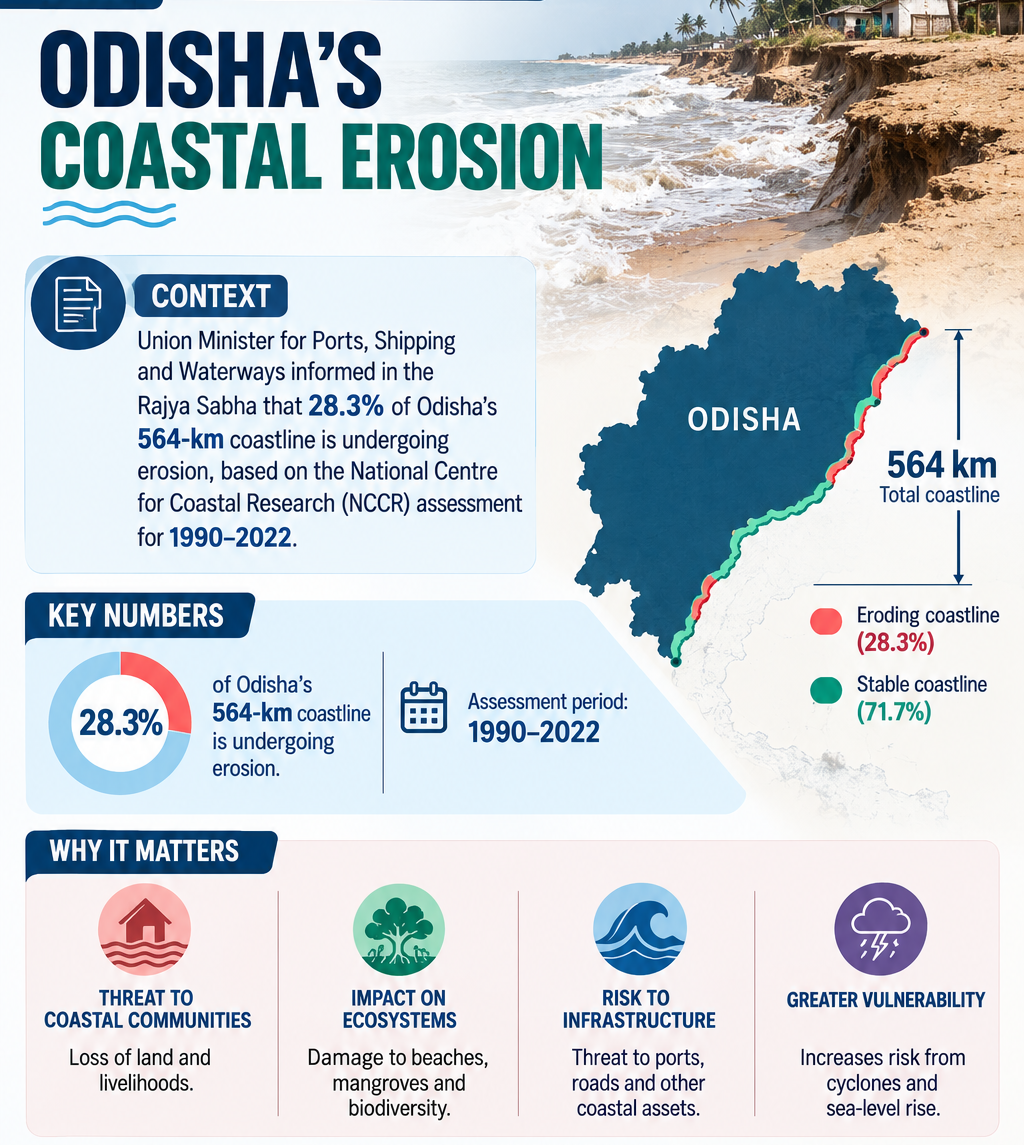
Recently, Union Minister for Ports, Shipping and Waterways informed in the Rajya Sabha that 28.3% of Odisha’s 564-km coastline is undergoing erosion, based on the National Centre for Coastal Research (NCCR) assessment for 1990–2022.
What is Erosion?
Erosion is the geological and geomorphological process in which soil, rock and other earth materials are worn away and transported by natural agents such as running water, wind, glaciers and waves.
it is important to distinguish erosion from weathering:
-
- Weathering: In-situ breakdown of rocks without transportation.
- Erosion: Removal and transportation of weathered material by an active agent.
- Weathering: In-situ breakdown of rocks without transportation.
Erosion may be:
-
- Geological erosion: Slow, natural erosion occurring at a rate broadly compatible with soil formation.
- Accelerated erosion: Rapid erosion caused or intensified by human activities such as deforestation, overgrazing and faulty agricultural practices.
- Geological erosion: Slow, natural erosion occurring at a rate broadly compatible with soil formation.
Types of Soil and Water Erosion:
1. Splash/Raindrop erosion: Raindrops dislodge soil particles from exposed surfaces.
2. Sheet erosion: A relatively uniform layer of topsoil is removed by surface runoff.
3. Rill erosion: Concentrated runoff creates small, shallow channels.
4. Gully erosion: Rills develop into deeper channels, making land difficult to cultivate. The Chambal ravines are a classic example.
5. Coastal erosion: Waves, currents, tides and storm surges remove coastal sediments, causing shoreline retreat.
Extent of Coastal Erosion:
The NCCR assessment shows that 17.6% of Odisha’s coastline is stable, while 54.1% is experiencing accretion. Among coastal districts, Jagatsinghpur is the most erosion-prone, with 47.6% of its coastline affected, followed by Ganjam (45.7%) and Kendrapara (45%).
Other affected districts include Balasore, Puri and Bhadrak.
Major Causes:
Coastal erosion is driven by both natural and anthropogenic factors:
-
-
- Rising sea levels due to climate change
- Cyclones, storm surges, waves and tidal action
- Construction of ports, harbours, seawalls and breakwaters, which can alter sediment movement
- Sand mining and unplanned coastal infrastructure
- Changes in coastal sediment dynamics
- Rising sea levels due to climate change
-
Odisha is particularly vulnerable because of its exposure to Bay of Bengal cyclones and storm surges.
Impact on People:
-
-
- Coastal erosion has emerged as a major livelihood and displacement challenge. Government officials have reported that sea-level rise and erosion have already submerged 16 villages in Kendrapara, displacing several hundred people.
- In Ganjam, Podampeta, once inhabited by nearly 500 households, has been deserted as the sea advanced inland. Such displacement affects not only housing but also fishing, agriculture and other sources of livelihood.
- Coastal erosion has emerged as a major livelihood and displacement challenge. Government officials have reported that sea-level rise and erosion have already submerged 16 villages in Kendrapara, displacing several hundred people.
-
Government Measures:
-
-
- Geotextile tube embankment: At Pentha in Kendrapara, geotextile tubes filled with sand slurry are being used as coastal defence structures to absorb wave energy and reduce erosion.
- Sea wall-cum-service roads: Such structures are being developed at vulnerable stretches in Balasore and Ganjam. They combine coastal protection with transportation and public access.
- Climate-resettlement: Odisha has established a resettlement colony for people displaced by coastal erosion in Kendrapara, highlighting the importance of planned climate adaptation.
- Geotextile tube embankment: At Pentha in Kendrapara, geotextile tubes filled with sand slurry are being used as coastal defence structures to absorb wave energy and reduce erosion.
-
Way Forward:
A long-term strategy should combine hard engineering with ecosystem-based approaches such as mangrove restoration, dune conservation and protection of natural sediment flows. Scientific shoreline monitoring, regulation of sand mining, climate-resilient infrastructure, early-warning systems and participatory coastal-zone management are also essential.
Conclusion:
Odisha’s coastal erosion demonstrates that climate change is increasingly becoming a human security and livelihood issue. Effective coastal management must therefore balance development with ecological resilience while ensuring safe and dignified adaptation for vulnerable communities.



