
Context:
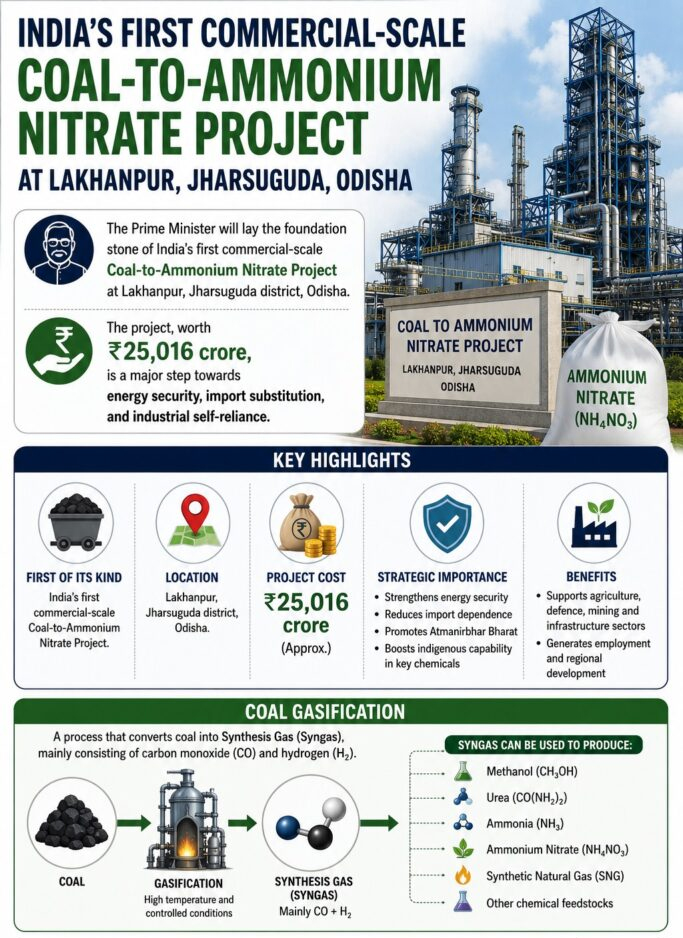
Recently, Prime Minister Narendra Modi virtually laid the foundation stone of a ₹25,000 crore Coal-to-Ammonium Nitrate project at Lakhanpur, Jharsuguda in Odisha. The project is being developed by Bharat Coal Gasification and Chemicals Limited (BCGCL), a joint venture of Coal India Limited (CIL) and Bharat Heavy Electricals Limited (BHEL). It is considered India’s first large-scale industrial coal gasification-based chemical project.
About the Project:
-
-
- The project is a commercial coal gasification plant that converts domestic coal into ammonium nitrate, a key industrial chemical used primarily in:
- Mining explosives
- Infrastructure development
- Civil engineering activities
- Mining explosives
- The facility is designed to produce around 2,000 tonnes per day (TPD) of ammonium nitrate, with annual production of about 6.6 lakh tonnes.
- It will use indigenously developed Pressurised Fluidised Bed Gasification (PFBG) technology provided by BHEL, making it a milestone in domestic technological capability.
- The project is a commercial coal gasification plant that converts domestic coal into ammonium nitrate, a key industrial chemical used primarily in:
-

How Does Coal Gasification Work in This Project?
Coal gasification converts solid coal into syngas (carbon monoxide + hydrogen) instead of burning it directly. This syngas is then processed into:
-
-
- Ammonia (NH₃) via the Haber-Bosch process
- Nitric acid (HNO₃) via the Ostwald process
- Finally, ammonium nitrate (NH₄NO₃)
- Ammonia (NH₃) via the Haber-Bosch process
-
Thus, coal acts as a feedstock for chemical production rather than just a fuel, enabling higher value addition.
What is Coal Gasification?
Coal gasification is a process in which coal is converted into syngas (synthetic gas), a mixture of hydrogen, carbon monoxide, and carbon dioxide. This syngas can then be used to produce chemicals, fertilisers, fuels, and other industrial products.
Compared to direct coal burning, gasification:
-
-
- Improves efficiency of coal utilisation
- Enables production of high-value chemicals
- Reduces environmental footprint when combined with cleaner technologies
- Improves efficiency of coal utilisation
-
Significance of the Project:
-
-
- Energy and Import Security: India imports large quantities of ammonia and related chemicals. This project reduces dependency by using abundant domestic coal.
- Value Addition to Coal Economy: Instead of burning coal for electricity, it is converted into high-value chemicals, improving resource efficiency.
- Boost to Aatmanirbhar Bharat: Indigenous technology from BHEL and public sector collaboration strengthens self-reliance in strategic chemical production.
- Industrial Growth: Ammonium nitrate is crucial for mining, infrastructure, and construction, supporting India’s core sectors.
- Energy and Import Security: India imports large quantities of ammonia and related chemicals. This project reduces dependency by using abundant domestic coal.
-
Challenges:
-
-
- High capital and operational costs
- Environmental concerns (CO₂ emissions from gasification)
- Technology scaling risks
- Need for strict safety norms due to explosive nature of ammonium nitrate
- High capital and operational costs
-
Conclusion:
The Coal-to-Ammonium Nitrate Project represents a strategic shift in India’s coal policy—from mere energy generation to value-added chemical production and industrial self-reliance. It also highlights how coal gasification can play a critical role in India’s energy transition while balancing economic growth and import substitution.



