
Context:
Recently, India successfully conducted a test of its nuclear-capable K-4 submarine-launched ballistic missile (SLBM) from the nuclear-powered submarine INS Arighaat in the Bay of Bengal, off the coast of Visakhapatnam.
About the K-4 Missile:
-
-
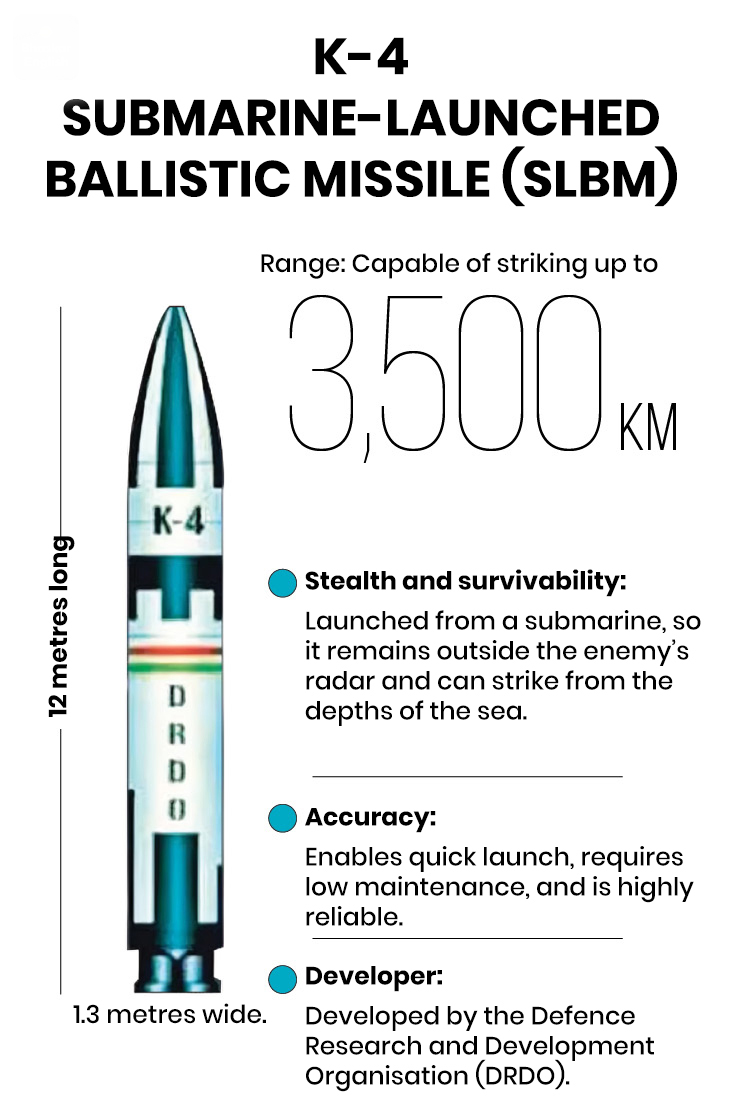
- Type: Submarine-launched ballistic missile (SLBM)
- Developer: Defence Research and Development Organisation (DRDO)
- Range: Approximately 3,500 km
- Propulsion: Two-stage solid-fuel rocket
- Warhead Capability: Capable of carrying a nuclear payload (approximately 2.5 tonnes)
- Launch Platform: Arihant-class nuclear-powered ballistic missile submarines (SSBNs), such as INS Arighaat
- Type: Submarine-launched ballistic missile (SLBM)
-
Strategic Significance:
-
-
- The test significantly strengthens India’s nuclear triad, the capability to deliver nuclear weapons from land, air, and sea:
- Land: Agni-series ballistic missiles
- Air: Nuclear-capable strategic aircraft
- Sea: SLBMs deployed on SSBNs
- Land: Agni-series ballistic missiles
- SSBNs can remain concealed underwater for extended periods, making them extremely difficult to detect or neutralise pre-emptively.
- The test significantly strengthens India’s nuclear triad, the capability to deliver nuclear weapons from land, air, and sea:
-
About INS Arighaat:
-
-
-
- Type: Nuclear-powered ballistic missile submarine (SSBN)
- Commissioned: August 29, 2024
- Role: Deployment of K-4 missiles and strengthening India’s sea-based nuclear deterrent
- Significance: Enhances the depth, survivability, and credibility of India’s nuclear deterrence posture
- Type: Nuclear-powered ballistic missile submarine (SSBN)
- INS Arighaat is the second SSBN in the Arihant class, succeeding INS Arihant, which is equipped with shorter-range K-15 SLBMs. The extended range of the K-4 missile allows submarines to strike deep inland targets from safer patrol zones in the Indian Ocean.
-
-
Geopolitical Implications:
-
-
- Credible Minimum Deterrence: India’s declared nuclear doctrine is based on credible minimum deterrence, under which strategic forces are maintained at levels sufficient to inflict unacceptable damage in retaliation to a nuclear attack. A sea-based delivery system enhances this credibility by ensuring a concealed and resilient retaliatory capability.
- Regional Security Environment: In the context of South Asia’s complex security landscape, marked by the presence of two nuclear-armed neighbours the operationalisation of long-range SLBMs acts as a deterrent against coercion. It contributes to strategic stability by raising the threshold for nuclear escalation.
- Technological and Strategic Autonomy: The successful test underscores India’s growing self-reliance in strategic weapons technology, achieved through indigenous research, development, and integrated defence production led by domestic institutions.
- Credible Minimum Deterrence: India’s declared nuclear doctrine is based on credible minimum deterrence, under which strategic forces are maintained at levels sufficient to inflict unacceptable damage in retaliation to a nuclear attack. A sea-based delivery system enhances this credibility by ensuring a concealed and resilient retaliatory capability.
-
Conclusion:
The successful test of the nuclear-capable K-4 SLBM from INS Arighaat represents a major advancement in India’s strategic deterrence architecture. It strengthens the sea-based leg of the nuclear triad, enhances second-strike capability, and highlights India’s progress in advanced defence technologies. In an era of heightened geopolitical uncertainty, such capabilities reinforce strategic stability and reaffirm India’s commitment to credible minimum deterrence under its nuclear doctrine.



