
Why in News?
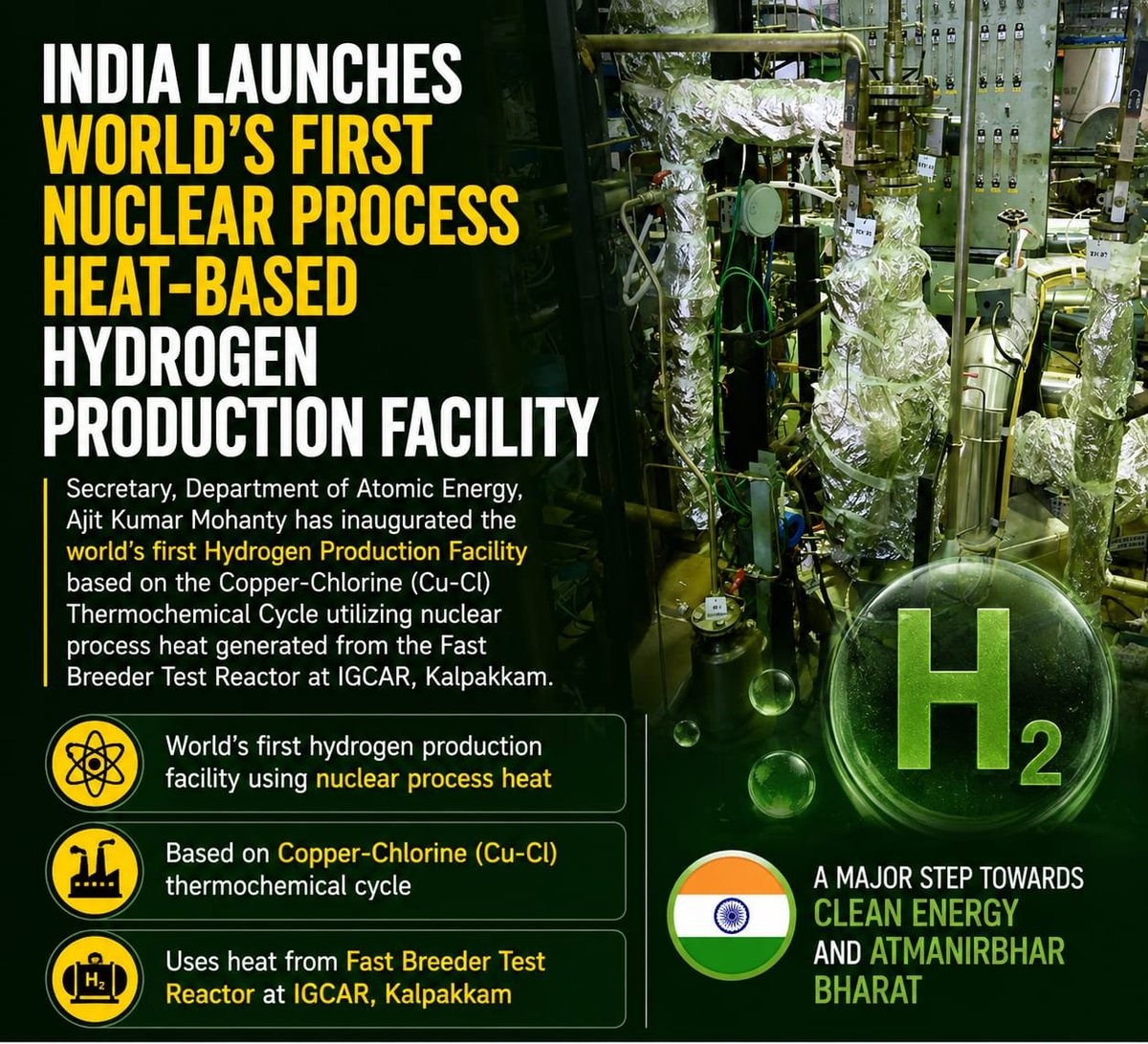
Recently, India has inaugurated the world's first Hydrogen Production Facility based on the Copper–Chlorine (Cu–Cl) Thermochemical Cycle using nuclear process heat generated from the Fast Breeder Test Reactor (FBTR) at the Indira Gandhi Centre for Atomic Research (IGCAR), Kalpakkam.
About the project:
-
- This project is World's first hydrogen production facility using the Copper–Chlorine (Cu–Cl) Thermochemical Cycle powered by nuclear heat.
- Located at IGCAR, Kalpakkam, Tamil Nadu.
- Developed jointly by the Department of Atomic Energy (DAE), Bhabha Atomic Research Centre (BARC), and IGCAR, the project marks a major breakthrough in clean hydrogen production and advanced nuclear technology.
- The facility serves as a technology demonstrator to validate large-scale hydrogen production using nuclear energy.
- Supports India's transition towards low-carbon energy systems and enhances long-term energy security.
- This project is World's first hydrogen production facility using the Copper–Chlorine (Cu–Cl) Thermochemical Cycle powered by nuclear heat.
What is the Copper–Chlorine (Cu–Cl) Thermochemical Cycle?
The Copper–Chlorine (Cu–Cl) Thermochemical Cycle is an advanced method for producing hydrogen by splitting water into hydrogen and oxygen through a series of chemical reactions.
Features
-
-
- Requires relatively lower temperatures (around 500°C) compared to other thermochemical cycles.
- Utilizes both heat and electricity.
- Produces green hydrogen without carbon emissions.
- Highly suitable for integration with advanced nuclear reactors.
- Requires relatively lower temperatures (around 500°C) compared to other thermochemical cycles.
-
Why is Nuclear Heat Used?
Conventional hydrogen production relies on fossil fuels, resulting in significant carbon emissions. Nuclear reactors provide:
-
-
- Continuous carbon-free electricity.
- High-temperature process heat.
- Reliable 24×7 operation.
- Large-scale hydrogen production capability.
- Continuous carbon-free electricity.
-
This makes nuclear energy an attractive option for producing clean hydrogen economically.
What is the Fast Breeder Test Reactor (FBTR)?
The FBTR is India's experimental fast breeder reactor operated by IGCAR.
Key Facts
-
-
- Located at Kalpakkam, Tamil Nadu.
- Commissioned in 1985.
- Uses mixed plutonium-uranium carbide fuel.
- Employs liquid sodium as coolant.
- Acts as a testing platform for future Fast Breeder Reactors (FBRs).
- Located at Kalpakkam, Tamil Nadu.
-
Significance for India:
Supports National Green Hydrogen Mission
-
-
- Enables clean hydrogen production.
- Reduces dependence on imported fossil fuels.
- Promotes energy independence.
- Enables clean hydrogen production.
-
Advances Decarbonisation
-
-
- Produces hydrogen without carbon dioxide emissions.
- Helps industries transition to cleaner energy.
- Produces hydrogen without carbon dioxide emissions.
-
Strengthens Energy Security
-
-
- Utilizes indigenous nuclear technology.
- Diversifies India's clean energy portfolio.
- Utilizes indigenous nuclear technology.
-
Global Technological Leadership
-
-
- India becomes the first country to demonstrate this technology.
- Enhances India's reputation in advanced nuclear and hydrogen technologies.
- India becomes the first country to demonstrate this technology.
-
Supports Net-Zero Goals
The technology aligns with India's commitments to:
-
-
- Reduce carbon intensity.
- Expand non-fossil energy capacity.
- Achieve Net Zero by 2070.
- Reduce carbon intensity.
-
Challenges:
-
- High initial capital costs.
- Public concerns regarding nuclear energy.
- Need for advanced hydrogen storage and transportation infrastructure.
- Scaling up from demonstration to commercial production.
- Regulatory and safety requirements.
- High initial capital costs.
Conclusion:
Nuclear-assisted hydrogen production combines the reliability of nuclear energy with the sustainability of clean hydrogen, offering a viable pathway for India's low-carbon future. The successful demonstration of the Cu–Cl Thermochemical Hydrogen Production Facility represents a landmark achievement that strengthens energy security, accelerates decarbonisation, and positions India at the forefront of next-generation clean energy technologies.



