
Context:
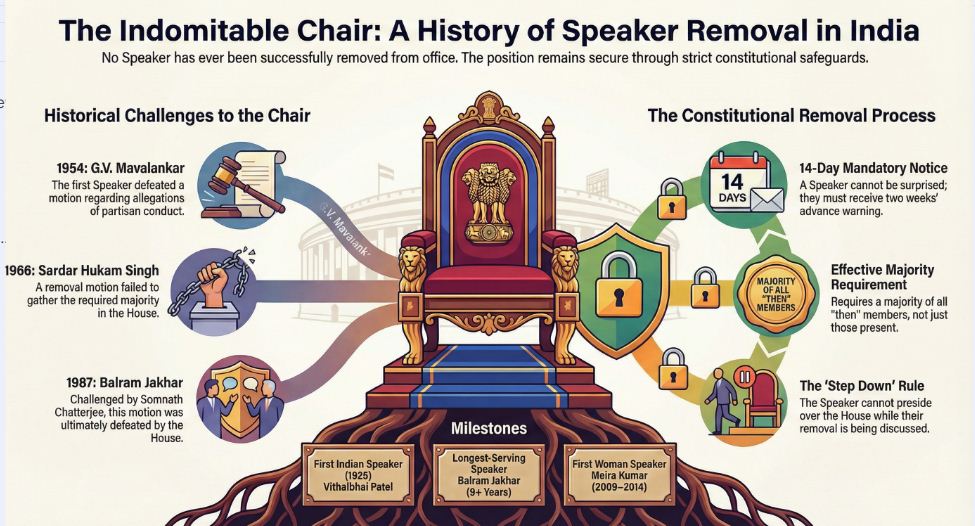
Recently, Opposition parties, led by the Congress-led INDIA bloc, submitted a notice of no-confidence against Speaker Om Birla. The motion, signed by 118 MPs, alleges partisan conduct by the Speaker during the Budget Session. This event marks only the fourth instance in Indian parliamentary history where a no-confidence motion has been moved against the Speaker.
Constitutional Basis for Removal:
-
-
- The Speaker of the Lok Sabha holds a pivotal constitutional office under Article 93, entrusted with presiding impartially over House proceedings. The Constitution provides for their removal under Article 94(c):
- The Speaker or Deputy Speaker may be removed by a resolution of the Lok Sabha.
- The resolution requires the support of a majority of all then members of the House (absolute majority).
- This applies only to the Lok Sabha, not the Rajya Sabha.
- The Speaker or Deputy Speaker may be removed by a resolution of the Lok Sabha.
- Additionally, under Article 94, a Speaker vacates office if they:
- Cease to be a member of the House (94(a))
- Resign in writing to the Deputy Speaker (94(b))
- Are removed via a House resolution (94(c))
- Cease to be a member of the House (94(a))
- The Speaker of the Lok Sabha holds a pivotal constitutional office under Article 93, entrusted with presiding impartially over House proceedings. The Constitution provides for their removal under Article 94(c):
-
Procedure for Removal:
-
-
- The process is guided by Rules 200–203 of the Lok Sabha Rules of Procedure:
- Notice: Written notice submitted to the Secretary-General, backed by at least two members, with a minimum 14-day notice.
- Listing in Business: Motion for leave is listed only after the notice period.
- Minimum Support: At least 50 members must rise in support; otherwise, the motion lapses.
- Debate and Voting: If admitted, the motion is taken up within 10 days, discussion is confined to charges, the mover can speak up to 15 minutes, and removal requires an absolute majority.
- Notice: Written notice submitted to the Secretary-General, backed by at least two members, with a minimum 14-day notice.
- The process is guided by Rules 200–203 of the Lok Sabha Rules of Procedure:
-
Conditions and Role of the Speaker:
Under Rule 200A, the motion must be precise, specific, and free of defamatory or ironical statements. No speech is allowed when seeking leave. During discussions, the Speaker may defend themselves but traditionally steps aside from presiding to maintain impartiality, as done by Om Birla. Voting rights are limited to the first instance of the resolution.
Conclusion:
No-confidence motions against Lok Sabha Speakers are rare: G.V. Mavalankar (1954), Hukam Singh (1966), Balram Jakhar (1987) — none led to removal. The current motion is a watershed moment, highlighting the tension between institutional authority and democratic accountability. Its outcome will shape parliamentary norms for the Speaker’s conduct and political oversight in the years to come.



