
NITI Aayog Report on the School Education System in India
Context:
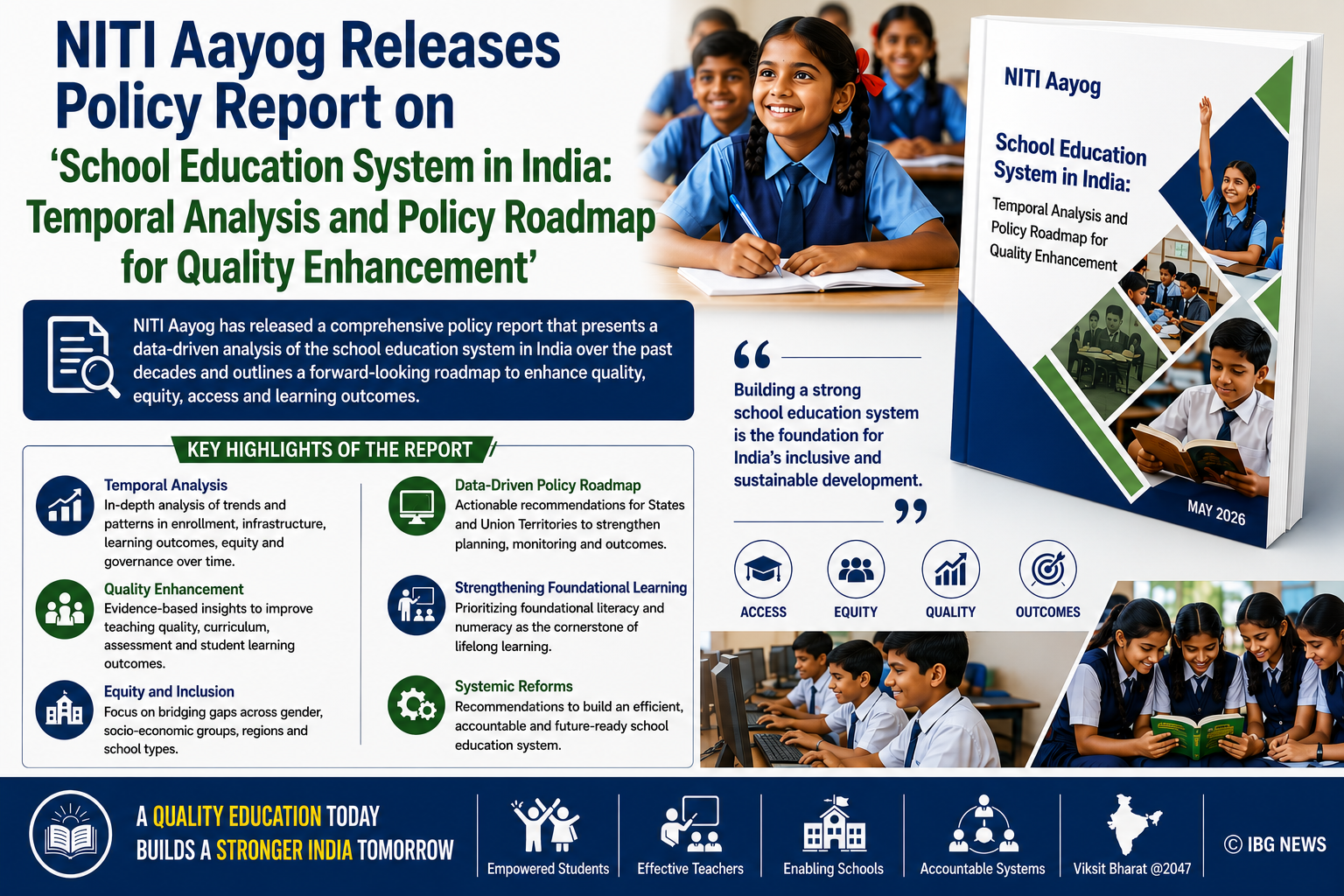
Recently, NITI Aayog has released a report titled “School Education System in India: Temporal Analysis and Policy Roadmap for Quality Enhancement”.
About the report:
The report analyses the progress of India’s school education system from 2014-15 to 2024-25 and provides recommendations to improve quality, equity, and learning outcomes in line with the vision of Viksit Bharat @2047. The study is based on data from UDISE+, PARAKH, NAS, and ASER surveys covering all States and Union Territories.
Major Achievements in School Education:
-
-
- India currently manages the world’s largest school education system with 14.71 lakh schools, over 24.69 crore students, and 1.01 crore teachers. The report highlights that elementary education has achieved near-universal access, with Gross Enrolment Ratio (GER) standing at 90.9% at the primary level and 90.3% at the upper primary stage.
- School infrastructure has improved considerably during the last decade. Functional electricity coverage increased from 55.96% in 2014-15 to 91.9% in 2024-25. Digital access has also expanded rapidly, with internet facilities rising from 8.05% to 63.5% of schools. Learning outcomes, especially in foundational literacy and numeracy, are also showing gradual recovery after disruptions caused by the pandemic.
- India currently manages the world’s largest school education system with 14.71 lakh schools, over 24.69 crore students, and 1.01 crore teachers. The report highlights that elementary education has achieved near-universal access, with Gross Enrolment Ratio (GER) standing at 90.9% at the primary level and 90.3% at the upper primary stage.
-
Key Challenges Identified in the report:
-
-
- Despite progress, the report identifies several structural and learning-related challenges. The school system remains fragmented, with a large number of primary schools but limited higher secondary institutions. While there are 7.3 lakh primary schools, only 1.64 lakh higher secondary schools exist, creating transition difficulties for students.
- Secondary-level dropout remains a serious concern, with the dropout rate at 11.5%, compared to only 0.3% at the primary level. The report also notes that more than one-third of schools have fewer than 50 students, making resource allocation and teacher deployment inefficient.
- Learning quality continues to be uneven. According to ASER findings, nearly half of Grade 5 students in rural India cannot read a Grade 2 level text, reflecting persistent issues of rote learning and weak foundational skills.
- Despite progress, the report identifies several structural and learning-related challenges. The school system remains fragmented, with a large number of primary schools but limited higher secondary institutions. While there are 7.3 lakh primary schools, only 1.64 lakh higher secondary schools exist, creating transition difficulties for students.
-
Recommendations of NITI Aayog:
-
-
- The report recommends structural reforms through the development of Composite Schools covering Grades 1–12 and evidence-based school rationalization. It also suggests establishing independent State School Standards Authorities (SSSAs) for monitoring quality and safety standards.
- Further, the report emphasizes competency-based education, teacher training, digital inclusion, and support for children with disabilities and migrant students. Strengthening foundational literacy and numeracy remains a key priority.
- The report recommends structural reforms through the development of Composite Schools covering Grades 1–12 and evidence-based school rationalization. It also suggests establishing independent State School Standards Authorities (SSSAs) for monitoring quality and safety standards.
-
Conclusion:
India has made significant progress in expanding access and infrastructure in school education. However, improving learning outcomes, reducing secondary dropouts, and ensuring equitable digital access remain major challenges. The roadmap proposed by NITI Aayog aims to transform India’s school education system into a more inclusive, efficient, and quality-driven framework essential for achieving the goals of Viksit Bharat @2047.



