
Context:
Recently, NITI Aayog, in collaboration with CRISIL Intelligence, released the report “Key Sectors to Position India as a Global Manufacturing Hub (Volume-I)”. It provides an evidence-based roadmap to transform India from a consumption-driven economy into a globally competitive manufacturing powerhouse and support the vision of Viksit Bharat@2047.
Key Features of the Report:
Manufacturing and Demographic Dividend: Manufacturing contributes around 17.5% of India’s GVA. The report seeks to increase manufacturing value addition to support India’s vision of a USD 30 trillion economy by 2047. With a median age of around 28 years, India can leverage its demographic dividend by creating formal and productive industrial employment.
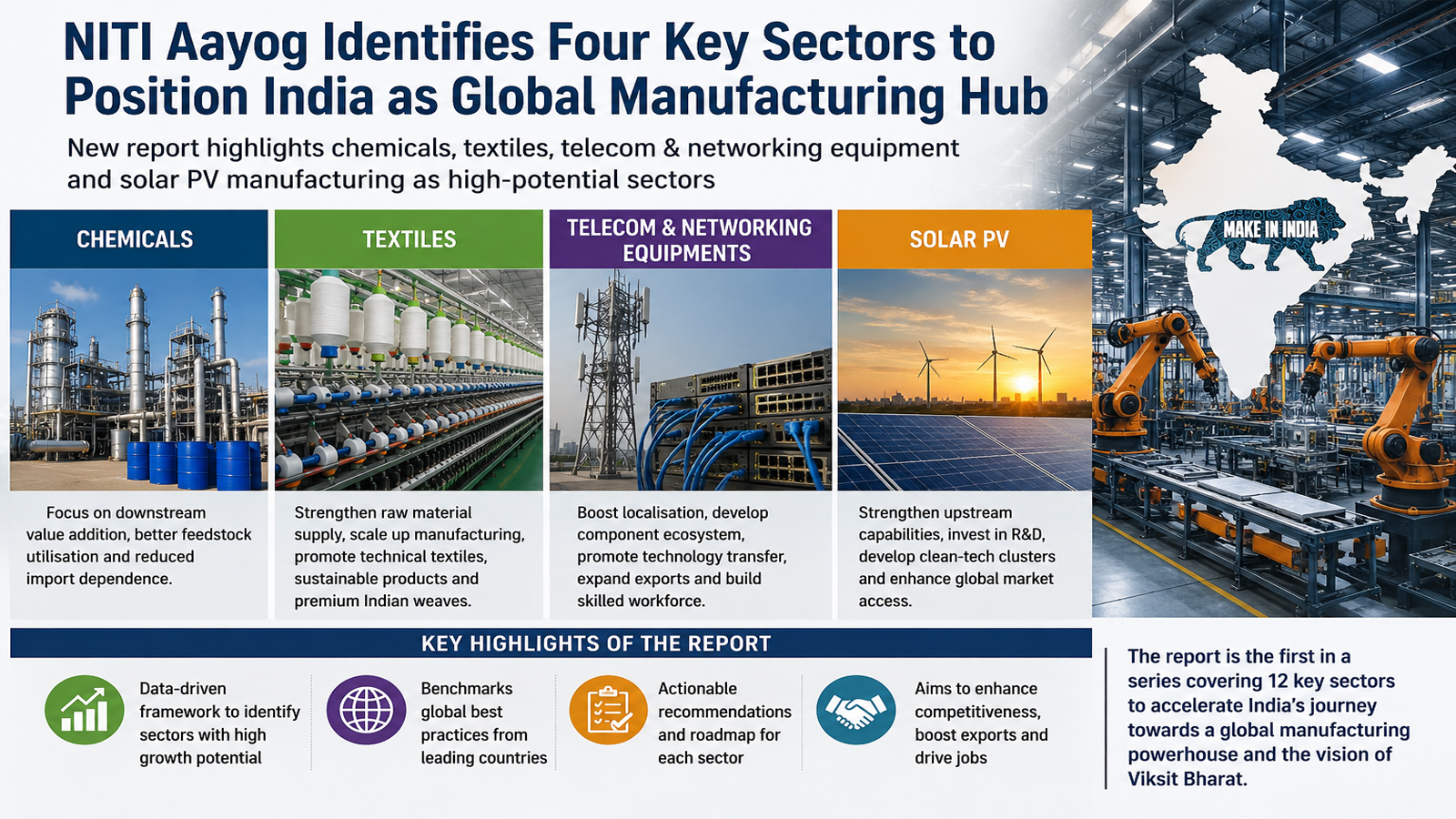
Identification of High-Potential Sectors: Out of 62 sectors, a four-phase evaluation framework identified 12 high-potential sectors. Volume-I focuses on:
-
-
- Chemicals
- Textiles and Apparel
- Telecom and Networking Equipment
- Solar PV Manufacturing
- Chemicals
-
The remaining sectors include electronics, automobiles, pharmaceuticals, capital goods, defence and drones, steel, food processing, and leather and footwear.
Sector-Specific Priorities:
-
-
- Chemicals
- The report targets expansion of the domestic chemical market from USD 200–220 billion in FY25 to USD 290–310 billion by FY30. It emphasizes specialty chemicals and reducing dependence on imported feedstocks such as methanol and acetic acid.
- The report targets expansion of the domestic chemical market from USD 200–220 billion in FY25 to USD 290–310 billion by FY30. It emphasizes specialty chemicals and reducing dependence on imported feedstocks such as methanol and acetic acid.
- Textiles and Apparel
- India aims to achieve a USD 350 billion textile industry with USD 100 billion exports by FY30. The focus is on man-made fibres (MMF), technical textiles, modernisation of MSMEs and improved cotton productivity.
- India aims to achieve a USD 350 billion textile industry with USD 100 billion exports by FY30. The focus is on man-made fibres (MMF), technical textiles, modernisation of MSMEs and improved cotton productivity.
- Telecom and Networking
- The report calls for deeper localisation of 5G/6G equipment, routers, GPON and optical systems, moving beyond basic assembly towards component manufacturing and higher domestic value addition.
- The report calls for deeper localisation of 5G/6G equipment, routers, GPON and optical systems, moving beyond basic assembly towards component manufacturing and higher domestic value addition.
- Solar PV
- India seeks an integrated solar value chain covering polysilicon, ingots, wafers, cells and modules, reducing import dependence and supporting the expansion of solar capacity towards the 280 GW target by 2030.
- India seeks an integrated solar value chain covering polysilicon, ingots, wafers, cells and modules, reducing import dependence and supporting the expansion of solar capacity towards the 280 GW target by 2030.
- Chemicals
-
Major Challenges:
-
- Import dependence: Critical chemical feedstocks, solar wafers and telecom components are heavily import-dependent.
- Inverted duty structures: Higher duties on inputs can make domestic production less competitive.
- MSME fragmentation: Small-scale units often suffer from outdated technology and limited access to finance.
- Logistics constraints: Port inefficiencies and inadequate multimodal connectivity raise costs.
- Low productivity and R&D: Technology gaps and limited private R&D constrain high-value manufacturing.
- Import dependence: Critical chemical feedstocks, solar wafers and telecom components are heavily import-dependent.
Key Recommendations:
-
-
- NITI Aayog recommends VGF and PLI support for critical upstream capabilities, rationalisation of GST and customs duties, and development of plug-and-play manufacturing hubs.
- It also proposes modernising ports and integrating them with PM Gati Shakti, strengthening R&D and technology transfers, and pursuing strategic FTAs to expand export markets.
- NITI Aayog recommends VGF and PLI support for critical upstream capabilities, rationalisation of GST and customs duties, and development of plug-and-play manufacturing hubs.
-
Significance:
The report seeks to shift India from low-end assembly to high-value manufacturing by strengthening entire value chains, from raw materials and components to technology, R&D and exports. This can boost employment, exports, import substitution and supply-chain resilience.
Conclusion:
NITI Aayog’s roadmap provides a strategic framework for building a globally competitive manufacturing ecosystem. Effective implementation, technological upgrading and stronger upstream capabilities can help India enhance its manufacturing share, create productive employment and realise the vision of Viksit Bharat@2047.



