
Context:
Recently, NITI Aayog has released a report titled “Impact Assessment of PLI Schemes”, evaluating the performance of Production Linked Incentive (PLI) schemes across 14 sectors. The report assesses their contribution to investment, production, exports, employment generation and domestic manufacturing.
What are PLI Schemes?
-
-
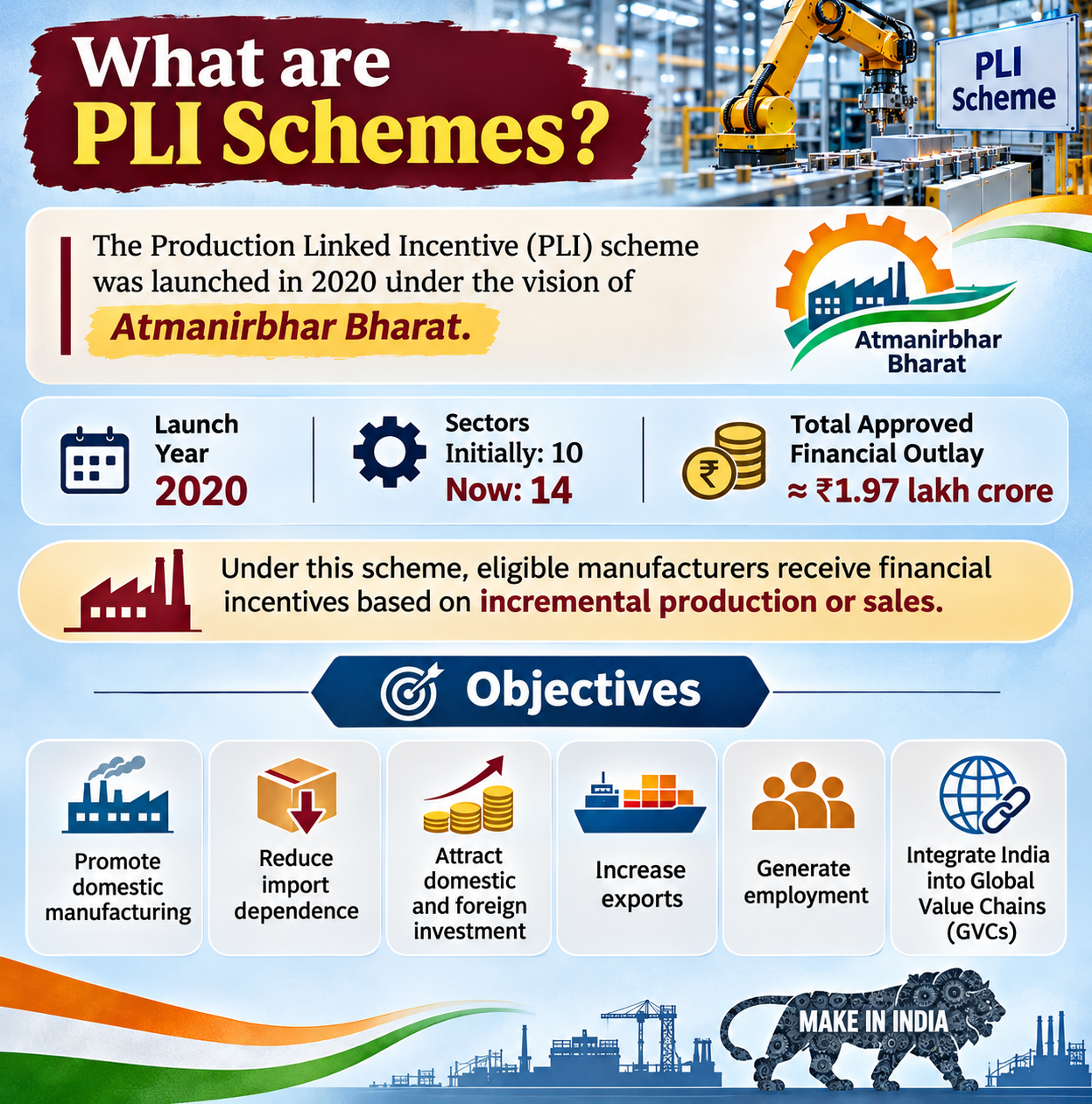
- The Production Linked Incentive (PLI) scheme was launched in 2020 under the vision of Atmanirbhar Bharat. Initially introduced for 10 sectors, it was subsequently expanded to 14 sectors with a total approved financial outlay of approximately ₹1.97 lakh crore. Under this scheme, eligible manufacturers receive financial incentives based on incremental production or sales.
- Its primary objectives are to promote domestic manufacturing, reduce import dependence, attract domestic and foreign investment, increase exports, generate employment and integrate India into Global Value Chains (GVCs).
- The Production Linked Incentive (PLI) scheme was launched in 2020 under the vision of Atmanirbhar Bharat. Initially introduced for 10 sectors, it was subsequently expanded to 14 sectors with a total approved financial outlay of approximately ₹1.97 lakh crore. Under this scheme, eligible manufacturers receive financial incentives based on incremental production or sales.
-
Key Findings of the Report:
-
-
- The report highlights significant achievements of PLI schemes. As of March 2026, the schemes have attracted investments worth approximately ₹2.40 lakh crore, generated production worth ₹22.66 lakh crore, created employment for 8.49 lakh persons and resulted in incentive disbursements of ₹35,354 crore.
- Against their full-tenure targets, investment achievement stands at 76%, production and sales at 64%, and employment at 28%. Nearly 70% of the targeted segments are broadly on track. Sectors such as pharmaceuticals, electronics, telecommunications, food processing, automobiles and drones have demonstrated encouraging performance.
- The report highlights significant achievements of PLI schemes. As of March 2026, the schemes have attracted investments worth approximately ₹2.40 lakh crore, generated production worth ₹22.66 lakh crore, created employment for 8.49 lakh persons and resulted in incentive disbursements of ₹35,354 crore.
-
Significance of PLI Schemes:
-
-
- PLI schemes strengthen India's manufacturing ecosystem by encouraging domestic production and reducing dependence on imported goods. They attract foreign and domestic investment, promote economies of scale and improve India's export competitiveness.
- Furthermore, they encourage technological advancement in emerging sectors such as electric vehicle batteries, drones, electronics and renewable energy. These schemes also support the objectives of Atmanirbhar Bharat by strengthening domestic industrial capabilities and integrating India into global supply chains.
- PLI schemes strengthen India's manufacturing ecosystem by encouraging domestic production and reducing dependence on imported goods. They attract foreign and domestic investment, promote economies of scale and improve India's export competitiveness.
-
Major Challenges:
-
-
- Despite their achievements, PLI schemes face several challenges. Employment generation remains relatively low compared to investment and production growth. Limited domestic value addition and dependence on imported components restrict the development of indigenous manufacturing capabilities.
- Moreover, uneven sectoral performance, inadequate MSME participation, technological constraints and long gestation periods in emerging industries affect the overall effectiveness of the schemes.
- Despite their achievements, PLI schemes face several challenges. Employment generation remains relatively low compared to investment and production growth. Limited domestic value addition and dependence on imported components restrict the development of indigenous manufacturing capabilities.
-
Way Forward:
-
-
- India needs to adopt sector-specific incentive mechanisms and strengthen domestic supply chains to improve the effectiveness of PLI schemes. Greater participation of MSMEs should be encouraged through improved access to finance, technology and infrastructure.
- Further emphasis should be placed on research and development, skill development, employment generation and domestic value addition. Transparent monitoring mechanisms and regular independent impact assessments are also essential to ensure accountability and better outcomes.
- India needs to adopt sector-specific incentive mechanisms and strengthen domestic supply chains to improve the effectiveness of PLI schemes. Greater participation of MSMEs should be encouraged through improved access to finance, technology and infrastructure.
-
Conclusion:
PLI schemes have emerged as an important instrument for strengthening India's manufacturing ecosystem. However, their success should not be measured merely through investment and production growth. India must focus on employment-intensive manufacturing, technological self-reliance, domestic value addition and global competitiveness to achieve the vision of Viksit Bharat@2047.