
Context:
The Ministry of Health and Family Welfare has reported that only two confirmed cases of Nipah virus (NiV) disease have been detected in West Bengal since December 2025.
How case reduced:
The Central and West Bengal governments coordinated a rapid public health response in accordance with established NCDC protocols. Measures included:
-
- Enhanced surveillance and active monitoring in affected areas.
- Laboratory testing of suspected cases and contacts.
- Field investigations to track possible chains of transmission.
- Containment and isolation of confirmed cases to prevent spread.
- Enhanced surveillance and active monitoring in affected areas.
About Nipah Virus:
-
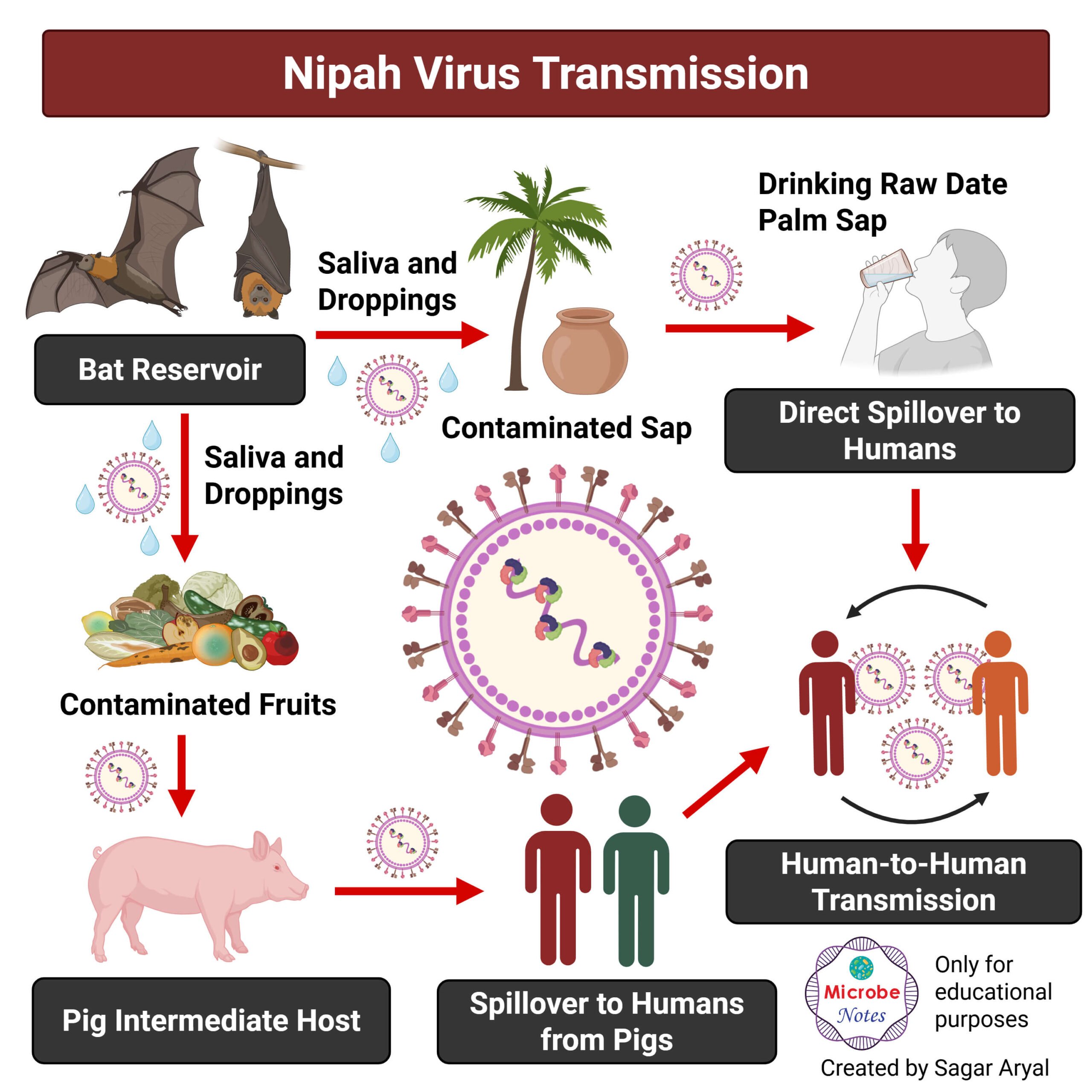
- Zoonotic Origin: First identified in 1998–99 in Kampung Sungai Nipah, Malaysia, NiV is transmitted from animals to humans. Fruit bats (Pteropodidae) are the natural reservoir, and pigs can act as intermediate hosts.
- Human-to-Human Transmission: Nipah can spread directly between humans, making it a serious public health concern.
- Virus Classification: It belongs to the Henipavirus genus in the Paramyxoviridae family and is a Biosafety Level-4 (BSL-4) pathogen.
- Zoonotic Origin: First identified in 1998–99 in Kampung Sungai Nipah, Malaysia, NiV is transmitted from animals to humans. Fruit bats (Pteropodidae) are the natural reservoir, and pigs can act as intermediate hosts.
Structure and Genome:
-
- Single-stranded, negative-sense RNA virus.
- Nucleocapsid protected by a matrix protein, with fusion proteins and glycoproteins enabling cell entry.
- Shows a distinct cytoplasmic structure near the endoplasmic reticulum.
- Single-stranded, negative-sense RNA virus.
Symptoms and Clinical Features:
-
- Initial symptoms resemble influenza, including fever, muscle pain, sore throat, and respiratory distress.
- Severe cases can progress to acute encephalitis, causing convulsions, disorientation, coma, and death.
- Asymptomatic infections are common, complicating surveillance and containment.
- Initial symptoms resemble influenza, including fever, muscle pain, sore throat, and respiratory distress.
Diagnosis and Treatment:
-
- Diagnosis: Confirmed through RT-PCR, ELISA, serum neutralisation tests, histopathology, and virus isolation in BSL-4 laboratories.
- Treatment: There is no approved vaccine for humans or animals. Treatment is primarily supportive care and isolation.
- Recent Advances: Use of monoclonal antibodies and antiviral drugs such as Remdesivir in India has improved survival rates, reducing mortality from 91% (2018) to around 33% (2023–25).
- Diagnosis: Confirmed through RT-PCR, ELISA, serum neutralisation tests, histopathology, and virus isolation in BSL-4 laboratories.
Nipah Outbreaks in India:
India has previously faced NiV outbreaks in:
-
- West Bengal (2007)
- Kerala (2018, 2023, 2025)
- West Bengal (2007)
These outbreaks underscore the importance of early detection, contact tracing, rapid medical response, and public health preparedness in controlling Nipah virus spread.
Conclusion:
The recent containment of NiV in West Bengal demonstrates effective coordination between state and central agencies, robust contact tracing, and timely surveillance, preventing a wider outbreak despite the virus’s high pathogenicity.



