
Nilgiri Tahr Survey & Western Ghats Biodiversity Explained
Context:
Recently, The Tamil Nadu Forest Department, in coordination with Kerala, has initiated the third synchronized survey of the Nilgiri Tahr, an endangered mountain ungulate endemic to the Western Ghats.
About Nilgiri Tahr:
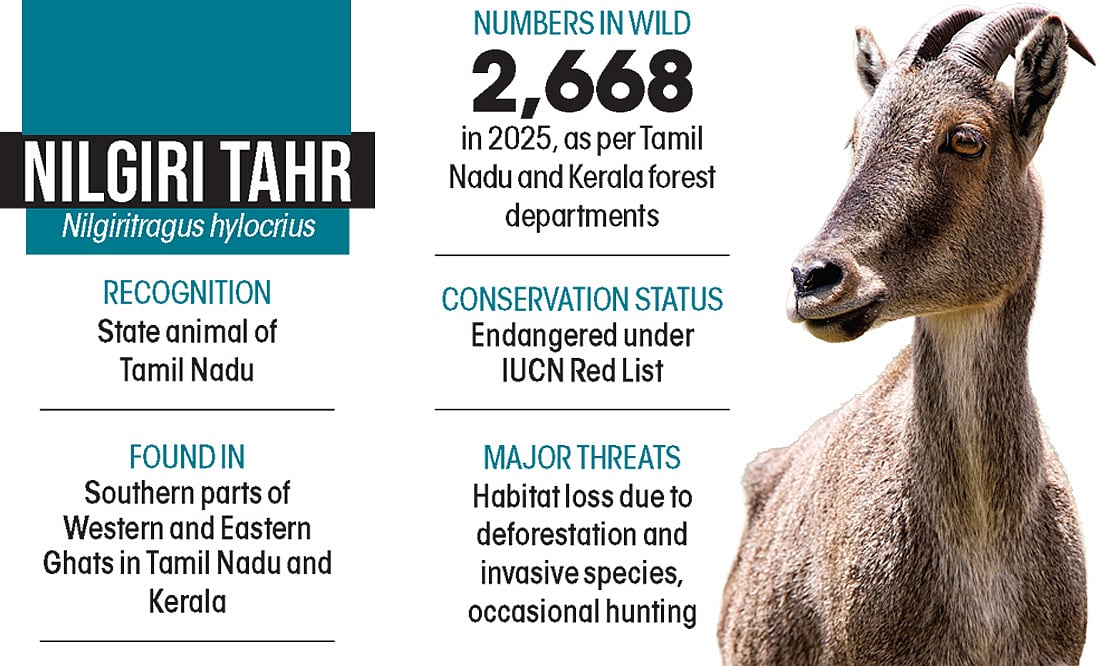
The Nilgiri Tahr is the only mountain ungulate species in southern India among the 12 found nationwide. It is considered a flagship and indicator species, reflecting the ecological health of high-altitude ecosystems.
Habitat and Distribution:
-
-
-
- Found in montane grasslands at altitudes of 1200–2600 meters
- Restricted to a narrow 400 km stretch from the Nilgiris to Kanyakumari
- Major populations located in Eravikulam National Park, along with the Nilgiri and Anamalai hills
- Present distribution is fragmented, unlike its earlier widespread presence
- Found in montane grasslands at altitudes of 1200–2600 meters
-
-
Conservation Status:
-
-
-
- Listed as Endangered by the International Union for Conservation of Nature
- Listed as Endangered by the International Union for Conservation of Nature
-
-
Key Ecological and Biological Features:
-
-
-
- Adaptation: Highly agile and sure-footed, suited to steep rocky terrain
- Social Structure: Lives in herds, aiding survival in harsh environments
- Reproduction: Winter calving ensures better survival of young
- Indicator Role: Population trends reflect ecosystem stability of the Western Ghats
- Adaptation: Highly agile and sure-footed, suited to steep rocky terrain
-
-
Conservation Efforts:
-
-
-
- Declaration of protected areas such as Eravikulam National Park
- Regular population surveys and habitat assessments
- Use of technology-driven monitoring tools
- Initiatives for genetic diversity conservation through translocation
- Additionally, the Nilgiri Tahr is the State Animal of Tamil Nadu, enhancing public awareness and political support for its protection.
- Declaration of protected areas such as Eravikulam National Park
-
-
About Western Ghats:
-
-
-
- The Western Ghats, also known as the Sahyadri Mountains, is a 1,600 km long mountain chain running parallel to India’s western coast across six states—Gujarat, Maharashtra, Goa, Karnataka, Tamil Nadu, and Kerala. Recognized as a UNESCO World Heritage Centre site, it comprises 39 protected areas of outstanding universal value.
- Older than the Himalayas, the Western Ghats cover approximately 140,000 sq. km and play a crucial role in influencing monsoon weather patterns by intercepting rain-bearing winds. It is one of the world’s eight “hottest hotspots” of biodiversity, with remarkable endemism.
- The Ghats act as a major watershed, giving rise to rivers such as the Godavari River, Krishna River, and Kaveri River. They also function as a carbon sink, absorbing millions of tonnes of carbon dioxide annually, thereby aiding climate regulation.
- Ecologically, the region hosts diverse habitats:
- Tropical evergreen forests
- Moist deciduous forests
- Shola-grassland systems
- Tropical evergreen forests
- It supports iconic species like the Lion-tailed macaque and Bengal tiger, along with nearly 30% of the world’s Asian elephant population.
- The Western Ghats, also known as the Sahyadri Mountains, is a 1,600 km long mountain chain running parallel to India’s western coast across six states—Gujarat, Maharashtra, Goa, Karnataka, Tamil Nadu, and Kerala. Recognized as a UNESCO World Heritage Centre site, it comprises 39 protected areas of outstanding universal value.
-
-
Conclusion:
The synchronized Nilgiri Tahr survey is a crucial step in conserving one of India’s most unique endemic species. Protecting the Nilgiri Tahr goes beyond species preservation—it is integral to safeguarding the fragile ecosystems of the Western Ghats, a global biodiversity hotspot. Sustained scientific monitoring and collaborative governance will be key to ensuring its long-term survival.



