
Context:
According to a new report prepared by the Pew Charitable Trusts, if ambitious global action is not taken, plastic pollution will double by 2040 to reach 280 million metric tons per year, which is equivalent to a garbage truck full of plastic waste being dumped every second.
Key Findings of the Report:
-
- 130 million metric tons of plastic pollute the environment in 2025, and this is projected to rise to 280 million metric tons by 2040 without urgent action.
- Plastic production, especially in packaging and textiles is growing far faster than waste management systems can handle.
- Microplastics already form 13% of total pollution, with major sources including tyre wear, paint, agriculture, and even recycling processes.
- Plastic-related greenhouse gas emissions are expected to increase 58%, reaching 4.2 GtCO₂e per year, comparable to emissions from one billion gasoline-powered cars.
- The health burden from plastic pollution and toxic chemicals is projected to rise, with global populations losing 5.6 million healthy years (2025) and 9.8 million healthy years (2040).
- By 2040, plastic production will rise 52%, while waste management capacity will increase only 26%, worsening environmental leakage and financial strain.
- Waste management costs will rise to US$140 billion annually, while uncollected plastic waste will nearly double from 19% to 34%.
- 130 million metric tons of plastic pollute the environment in 2025, and this is projected to rise to 280 million metric tons by 2040 without urgent action.
Recommended Measures:
If implemented effectively, global plastic pollution can be reduced by 83% by 2040.
A. Reduce Plastic Production
-
-
- 44% reduction possible by 2040.
- Eliminate unnecessary single-use plastics (SUPs).
- Promote reuse and refill systems.
- 44% reduction possible by 2040.
-
B. Redesign Chemicals & Products
-
-
- Use fewer and safer chemicals.
- Adopt circular design for reuse and recycling.
- Use fewer and safer chemicals.
-
C. Expand Waste Management
-
-
- Improve segregation and collection.
- Integrate informal waste pickers.
- Invest in localized recycling infrastructure.
- Improve segregation and collection.
-
D. Improve Supply Chain Transparency
-
-
- Mandate tracking of plastic flows, additives, and microplastics.
- Mandate tracking of plastic flows, additives, and microplastics.
-
Causes and Extent of Plastic Pollution:
|
Category |
Details |
|
A. Massive Production and Consumption |
· Global plastic production continues to rise. · Driven by cheap raw materials and high utility. |
|
B. Single-Use Plastics (SUPs) |
· Bags, bottles, cutlery, and packaging are major contributors to waste. · Promote a throwaway culture. |
|
C. Inadequate Waste Management |
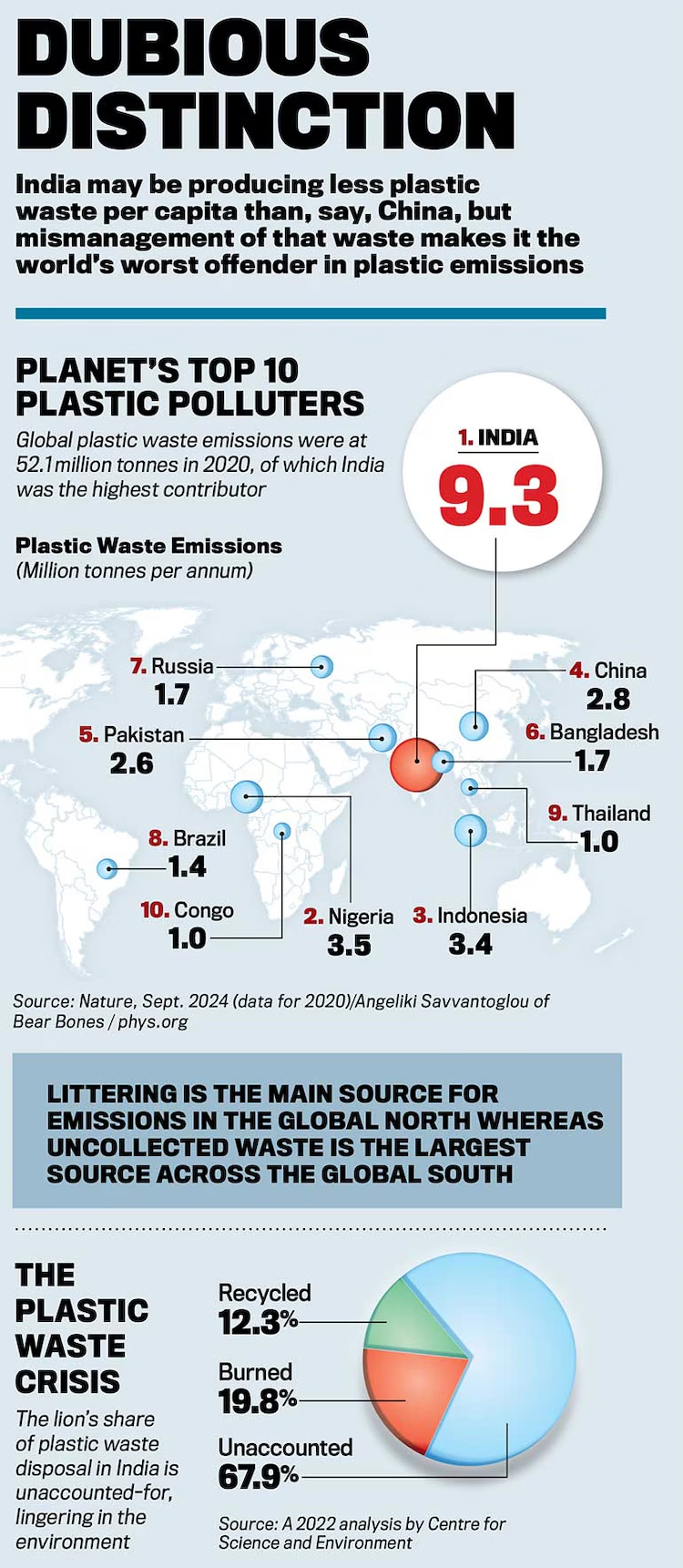
· India generates ~9.3 million tonnes of plastic waste annually. · A large share remains uncollected or openly dumped. · Poor segregation and weak infrastructure → higher environmental leakage. |
|
D. Non-biodegradability |
· Plastics persist for centuries. · Break down into microplastics (<5 mm) and nanoplastics—extremely difficult to remove. |
Impacts of Plastic Pollution:
|
Category |
Details |
|
A. Environmental Damage |
· Marine: ingestion, entanglement, habitat loss. · Terrestrial: clogged drains → urban flooding. · Plastics help spread invasive species. · Contribute to climate change through GHG emissions. |
|
B. Human Health |
· Toxic additives (BPA, phthalates) linked to endocrine disruption, cancers, reproductive issues. · Microplastics detected in human blood, lungs, and placenta. |
|
C. Economic Losses |
· Affects tourism, fisheries, and agriculture. · High clean-up costs. · Loss of valuable recyclable materials. |
India’s Policy and Regulatory Framework:
A. Plastic Waste Management (PWM) Rules 2016 & Amendments
-
-
- Minimum carry bag thickness: 120 microns.
- Nationwide ban on certain SUP items (2022).
- Extended Producer Responsibility (EPR): Producers and importers must collect and recycle their plastic packaging.
- Minimum carry bag thickness: 120 microns.
-
B. Supporting Initiatives
-
-
- Swachh Bharat Mission (SBM).
- India Plastics Pact (industry-led circular economy initiative).
- Use of plastic waste in road construction.
- Awareness and source segregation campaigns.
- Swachh Bharat Mission (SBM).
-
Conclusion:
Plastic pollution is escalating into a global environmental, health, and economic emergency. The Pew Report shows that without systemic change, plastic waste will more than double by 2040, overwhelming ecosystems and threatening human well-being. India and the world must adopt a multi-layered approach—cutting production, redesigning materials, strengthening waste systems, and building a robust circular economy—to prevent plastics from undermining sustainable development goals.



