
Context:
Recently, the Union Ministry of Health and Family Welfare notified amendments to the New Drugs and Clinical Trials (NDCT) Rules, 2019 to simplify regulatory processes, reduce approval timelines, and promote ease of doing business in India’s pharmaceutical and clinical research sector.
About the Amendments:
-
-
- Test Licence Requirement Relaxed
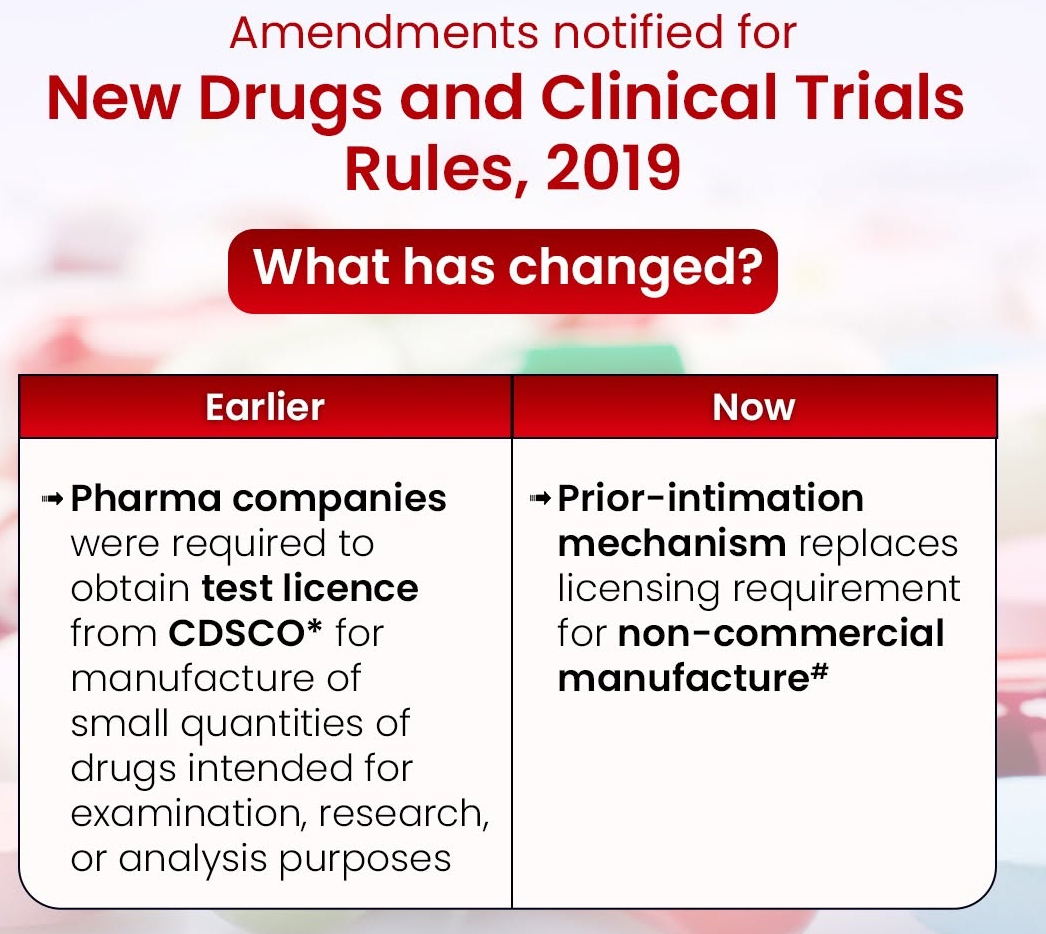
- Earlier, companies were required to obtain a test licence from the Central Drugs Standard Control Organization (CDSCO) to manufacture small quantities of drugs for research purposes.
- This requirement has now been replaced with a system of prior online intimation.
- Exception: High-risk drugs such as cytotoxic, narcotic, and psychotropic substances will continue to require licences.
- A CDSCO test licence is a mandatory regulatory authorisation issued for the import or manufacture of small quantities of drugs, medical devices, or cosmetics exclusively for testing, examination, analysis, or clinical trial purposes, and not for commercial sale.
- Earlier, companies were required to obtain a test licence from the Central Drugs Standard Control Organization (CDSCO) to manufacture small quantities of drugs for research purposes.
- Reduced Timelines
- For categories that still require licences, the processing time has been reduced from 90 days to 45 days.
- For categories that still require licences, the processing time has been reduced from 90 days to 45 days.
- Bioavailability/Bioequivalence (BA/BE) Studies Simplified
- Low-risk Bioavailability/Bioequivalence (BA/BE) studies no longer require prior approval.
- Such studies may commence after online intimation to the CDSCO.
- Low-risk Bioavailability/Bioequivalence (BA/BE) studies no longer require prior approval.
- Digital Implementation
- Online regulatory modules will be integrated with the SUGAM Portal and the National Single Window System (NSWS).
- Online regulatory modules will be integrated with the SUGAM Portal and the National Single Window System (NSWS).
- Test Licence Requirement Relaxed
-
Regulatory Background:
-
-
- Governing Laws
- Drugs and Cosmetics Act, 1940
- Drugs and Cosmetics Rules, 1945
- New Drugs and Clinical Trials Rules, 2019
- Drugs and Cosmetics Act, 1940
- Regulatory Authority
- Central Drugs Standard Control Organization (CDSCO), functioning under the Drugs Controller General of India (DCGI).
- Central Drugs Standard Control Organization (CDSCO), functioning under the Drugs Controller General of India (DCGI).
- Clinical Trial Phases
- Phase I: Safety assessment (“first-in-human”)
- Phase II: Efficacy evaluation
- Phase III: Large-scale confirmation
- Phase IV: Post-marketing surveillance
- Phase I: Safety assessment (“first-in-human”)
- Governing Laws
-
Benefits and Implications:
-
-
- For the Pharmaceutical Industry
- Faster research and innovation cycles
- Reduced compliance burden for approximately 30,000–35,000 test licence applications annually
- Boost to generic drug development, with around 4,000–4,500 BA/BE studies conducted each year
- Faster research and innovation cycles
- For Regulators:
- Optimised utilisation of CDSCO manpower
- Shift from procedural approvals to a risk-based regulatory oversight model
- Optimised utilisation of CDSCO manpower
- For India’s Pharmaceutical Ecosystem:
- Alignment with global regulatory best practices
- Strengthening of India’s position as a global hub for pharmaceutical R&D and clinical trials
- Alignment with global regulatory best practices
- Concerns and Safeguards:
- Public health and safety are maintained through continued licensing requirements for high-risk drugs.
- Ethical standards, informed consent, and post-trial monitoring remain mandatory.
- Pre-clinical animal testing continues as a prerequisite where applicable.
- Public health and safety are maintained through continued licensing requirements for high-risk drugs.
- For the Pharmaceutical Industry
-
Conclusion:
The amendments to the NDCT Rules, 2019 represent a significant regulatory reform aimed at fostering research-led growth in India’s pharmaceutical sector. By reducing approval timelines, leveraging digital platforms, and adopting a risk-based approach, the reforms strike a balance between ease of doing business and public health safeguards. These measures are expected to accelerate innovation, enhance regulatory efficiency, and reinforce India’s role as a preferred destination for global pharmaceutical research and clinical trials.



