
Context:
Recently, The Ministry of Information and Broadcasting (I&B) notified revised Guidelines for Certification of Films for Public Exhibition. The revised guidelines largely retain the detailed framework of the 1991 Film Certification Guidelines, while introducing two important additions relating to narcotic drugs and age-based UA certification markers.
What is Film Certification?
-
-
- Film certification is the statutory process through which films are examined before their public exhibition in India.
- The Central Board of Film Certification (CBFC) is a statutory body under the Ministry of Information and Broadcasting and functions under the Cinematograph Act, 1952. A film intended for public exhibition requires CBFC certification.
- Film certification is the statutory process through which films are examined before their public exhibition in India.
-
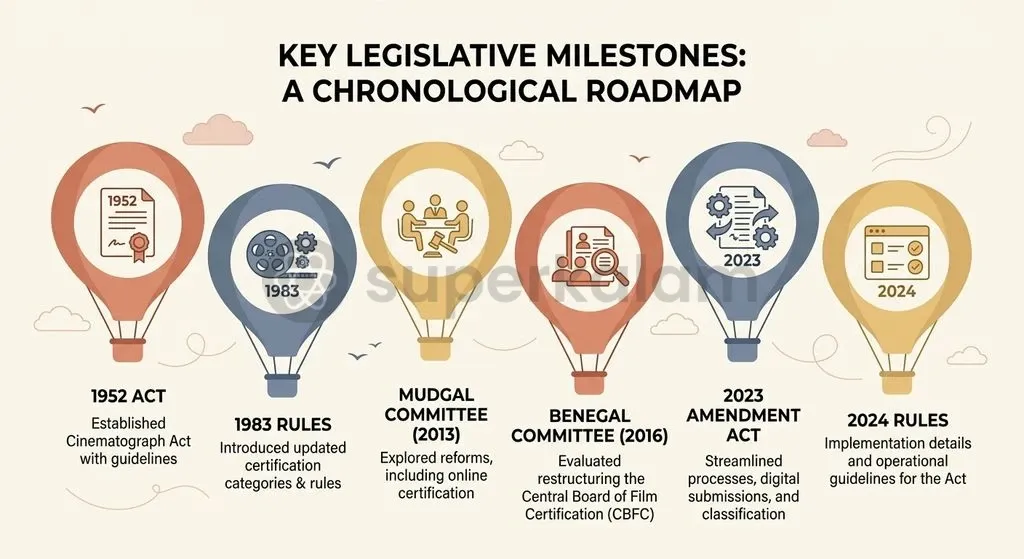
Legal Framework:
The certification framework is primarily based on:
-
-
- Cinematograph Act, 1952
- Cinematograph (Certification) Rules, 2024
- Guidelines issued by the Central Government under Section 5B of the Cinematograph Act.
- Relevant laws dealing with issues such as national symbols, protection of children, obscenity, tobacco and animal cruelty.
- Cinematograph Act, 1952
-
Two Major Changes in the 2026 Guidelines:
-
-
- Mandatory Warning on Narcotics:
- Scenes depicting or involving the use, consumption or trafficking of narcotic drugs or psychotropic substances are required to carry a disclaimer/statutory warning:
- The guideline does not amount to a blanket prohibition on depicting narcotics; rather, it introduces a specific warning requirement for relevant scenes.
- Scenes depicting or involving the use, consumption or trafficking of narcotic drugs or psychotropic substances are required to carry a disclaimer/statutory warning:
- New-Age UA Markers:
- The revised guidelines incorporate the age-based UA categories introduced under the Cinematograph (Certification) Rules, 2024:
- UA 7+
- UA 13+
- UA 16+
- These markers indicate that the film may be publicly exhibited but parents or guardians should exercise discretion regarding children below the indicated age.
- The revised guidelines incorporate the age-based UA categories introduced under the Cinematograph (Certification) Rules, 2024:
- Mandatory Warning on Narcotics:
-
Key Principles of Film Certification:
The revised guidelines retain several principles of the 1991 framework.
-
-
- No glorification of violence/crime: Anti-social activities, violence, criminal methods and drinking should not be glorified or encouraged.
- Child protection: Avoid unnecessary depiction of children facing or witnessing violence and child abuse.
- Human dignity: Prevent obscenity, degrading portrayal of women, ridicule of persons with disabilities, animal cruelty and contemptuous portrayal of communities.
- Sexual violence: Avoid such scenes; where essential, keep them minimal and non-graphic.
- No glorification of violence/crime: Anti-social activities, violence, criminal methods and drinking should not be glorified or encouraged.
-
About Section 5B of the Cinematograph Act, 1952:
Section 5B provides that a film shall not be certified where, among other things, it is considered contrary to:
-
-
- Sovereignty and integrity of India
- Security of the State
- Friendly relations with foreign States
- Public order
- Decency or morality
- Sovereignty and integrity of India
-
It also covers defamation, contempt of court and likelihood of inciting an offence.
Thus, Section 5B provides the principal statutory foundation for the certification guidelines.
Certification Categories:
Under the current age-based framework introduced through the 2024 Rules, the major categories include:
|
Category |
Meaning |
|
U |
Unrestricted public exhibition |
|
UA 7+ |
Unrestricted exhibition with caution for children below 7 |
|
UA 13+ |
Unrestricted exhibition with caution for children below 13 |
|
UA 16+ |
Unrestricted exhibition with caution for children below 16 |
|
A |
Restricted to adults |
The earlier broad UA category was subdivided into UA 7+, UA 13+ and UA 16+. The age markers are intended to guide parents/guardians rather than create an absolute prohibition on younger children viewing UA-certified films.
Significance:
The revised framework:
-
-
- Retains the core 1991 certification principles.
- Provides clearer age-based guidance for parents.
- Adds a specific anti-narcotics warning.
- Seeks to balance artistic freedom with public order, decency and child protection.
- Continues the shift towards digital certification through e-Cinepramaan.
- Retains the core 1991 certification principles.
-
Conclusion:
The 2026 guidelines largely preserve the existing certification framework while updating it through narcotics warnings and age-based UA classifications. The central regulatory challenge remains balancing freedom of expression with child protection, public order and other constitutionally recognised interests.



