
Why in News?
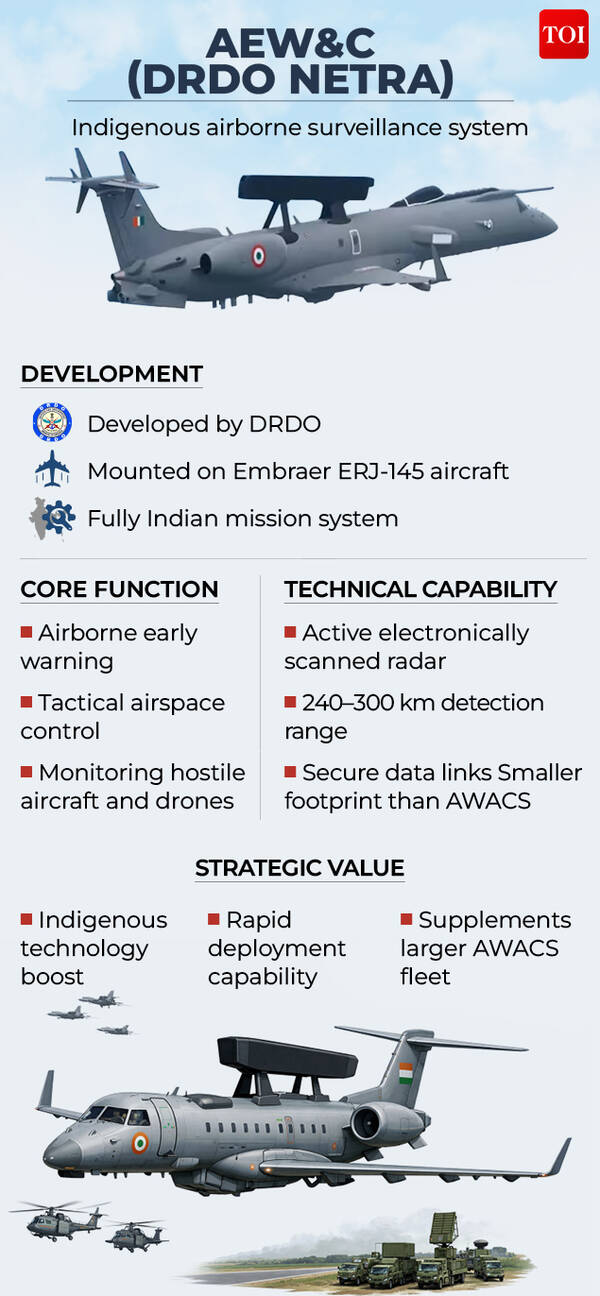
In a major boost to India's defence manufacturing capability and strategic autonomy, the indigenous Netra Airborne Early Warning and Control (AEW&C) system has received Final Operational Clearance (FOC).
Technical Specifications:
The Netra AEW&C system is integrated onto the Brazilian Embraer EMB-145I aircraft platform and is equipped with an advanced suite of mission systems, including:
-
- AESA Radar (Active Electronically Scanned Array): Provides 240-degree surveillance coverage.
- Identification Friend or Foe (IFF): Advanced system to distinguish friendly from hostile aircraft.
- Mission Computer: Enables real-time data processing and rapid decision-making.
- Secure Communication Network: Supports encrypted data sharing through Data Link and Satellite Communication (SATCOM).
- Electronic Support Measures (ESM) and Communication Support Measures (CSM): Capable of intercepting enemy electronic and communication signals.
- AESA Radar (Active Electronically Scanned Array): Provides 240-degree surveillance coverage.
The system can detect, track, and identify aerial as well as maritime targets, significantly enhancing the Indian Air Force’s (IAF) network-centric warfare capabilities.
Background:
The Netra AEW&C has proven to be a significant force multiplier for the Indian Air Force. Its operational effectiveness has been demonstrated in two major military operations:
1. Balakot Airstrike (2019):
2. Operation Sindoor (2025):
Comparison with China's AWACS Capability:
A significant capability gap exists between India and China in terms of airborne early warning systems.
Numerical Imbalance
-
- The Indian Air Force currently operates six airborne surveillance aircraft, comprising:
- 3 indigenous Netra AEW&C aircraft
- 3 Israeli Phalcon AWACS
- 3 indigenous Netra AEW&C aircraft
- In contrast, the People's Liberation Army Air Force (PLAAF) operates more than 30 advanced AWACS platforms, including:
- KJ-2000
- KJ-200
- KJ-500
- Next-generation KJ-3000
- KJ-2000
- The Indian Air Force currently operates six airborne surveillance aircraft, comprising:
Technological Gap and Radar Range
China's primary surveillance aircraft, the KJ-500 and the newer KJ-3000, employ fixed triangular AESA radar arrays that provide continuous 360-degree coverage without blind spots.
By comparison:
-
- Netra Mk-1 has an operational surveillance range of approximately 200–250 km.
- It offers only 240-degree radar coverage, leaving a blind spot behind the aircraft.
- Netra Mk-1 has an operational surveillance range of approximately 200–250 km.
Theatre Dominance
China's large AWACS fleet enables it to maintain 24×7 airborne surveillance across multiple strategic theatres simultaneously, including:
-
- Tibet (along the LAC)
- Taiwan Strait
- South China Sea
- Tibet (along the LAC)
India, however, is estimated to require at least 18 AEW&C/AWACS aircraft to maintain continuous surveillance across both the China and Pakistan fronts.
Geopolitical and Strategic Significance:
Strengthening India's Role in the Indo-Pacific
As China's military presence expands across the Indian Ocean Region (IOR) and the wider Indo-Pacific, the indigenous Netra system significantly enhances India's Maritime Domain Awareness (MDA). It reinforces India's role as a Net Security Provider in the region.
Technological Edge over Pakistan
Pakistan currently operates 11 airborne early warning platforms, including:
-
- Swedish Saab-2000 Erieye
- Chinese ZDK-03 Karakoram Eagle
- Swedish Saab-2000 Erieye
With Netra attaining Final Operational Clearance (FOC) and full combat readiness, India's air deterrence capability has strengthened considerably since the Balakot Airstrike, enabling a faster and more coordinated response to any potential aerial aggression.
Strategic Autonomy
The indigenous development of Netra reduces India's dependence on foreign suppliers such as Israel and Russia for critical surveillance capabilities. This enhances India's ability to make independent strategic decisions during crises without external constraints.
Conclusion
To bridge the existing capability gap, the Union Cabinet has approved the Netra Mk-2 project, with an estimated investment of ₹19,000 crore. Under the project:
-
- Six Airbus A321 aircraft, acquired from Air India, will be converted into advanced AEW&C platforms.
- They will be equipped with larger indigenous AESA radars capable of:
- More than 500 km surveillance range
- Improved radar coverage and tracking capability
- More than 500 km surveillance range
- Six Airbus A321 aircraft, acquired from Air India, will be converted into advanced AEW&C platforms.
Despite these advancements, India continues to rely partially on foreign components, such as the Brazilian Embraer aircraft platform, for its AEW&C programme. Achieving complete defence self-reliance will require the indigenous development of aircraft engines, aircraft platforms, and other critical aerospace technologies, thereby reducing dependence on imported systems.



