
Context:
The United Nations has declared 2026 as the International Year for Rangelands and Pastoralists, highlighting the global importance of grasslands and the livelihoods they sustain. Despite this recognition, COP30 in Brazil focused overwhelmingly on forests, exemplified by initiatives such as the Tropical Forest Forever Facility (TFFF). Grasslands and other open ecosystems received minimal attention, underscoring the urgent need to integrate them into national and global climate agendas.
About Grasslands:
-
-
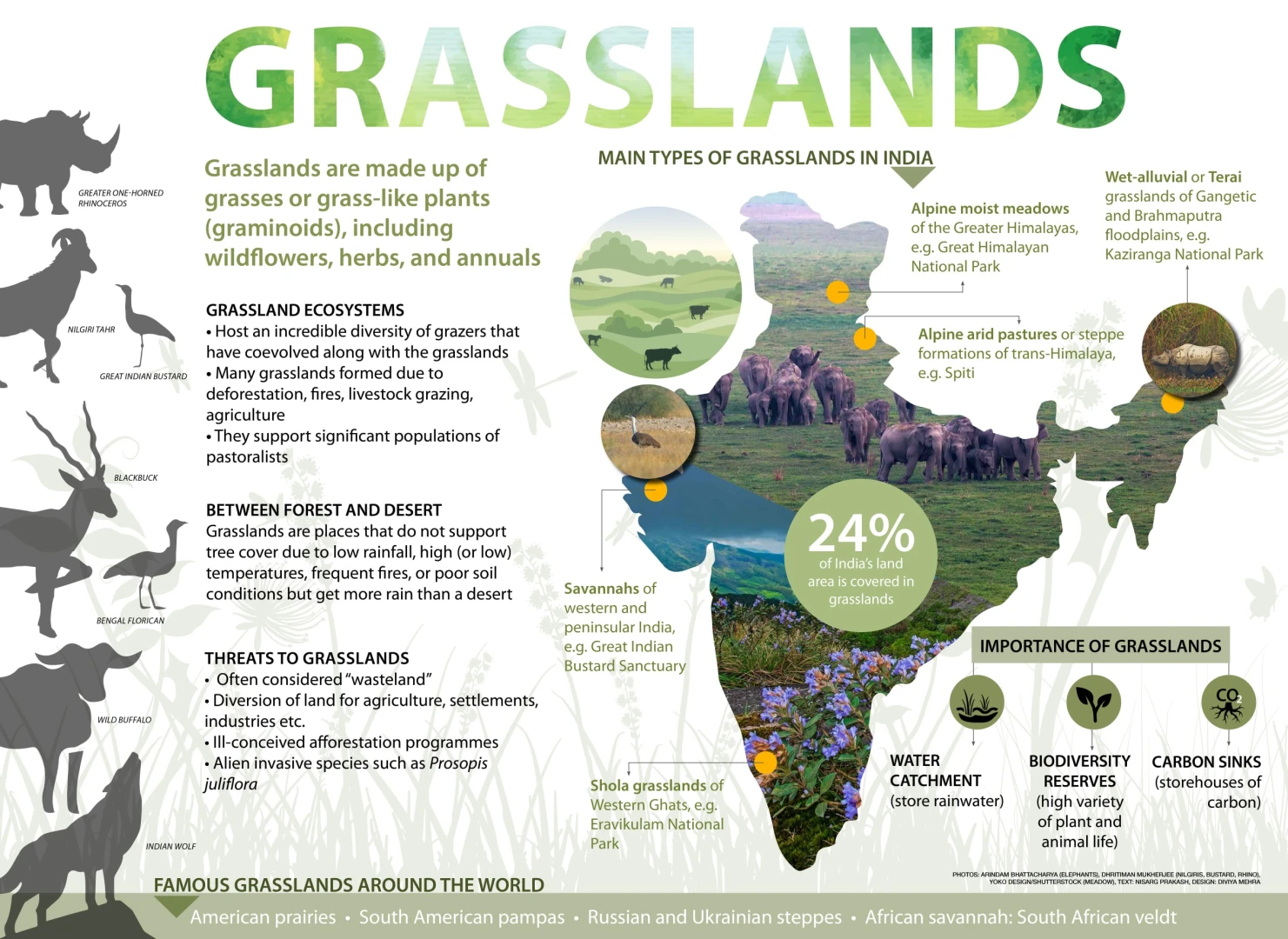
- Grasslands are vast open landscapes where grasses constitute the dominant vegetation, covering between 20% and 40% of the Earth’s land surface. They typically occur in “transitional” zones that receive sufficient rainfall to prevent desertification, but not enough to sustain dense forests.
- Despite their critical role in carbon sequestration, biodiversity conservation, and livelihood support, grasslands are among the most threatened ecosystems globally. Climate negotiations often overlook them in favour of forests, even as grasslands face rapid degradation due to agricultural expansion, invasive species, plantation conversion, and the suppression of indigenous land management practices. Without explicit recognition, climate mitigation and adaptation strategies remain incomplete.
- Grasslands are vast open landscapes where grasses constitute the dominant vegetation, covering between 20% and 40% of the Earth’s land surface. They typically occur in “transitional” zones that receive sufficient rainfall to prevent desertification, but not enough to sustain dense forests.
-
Global Grasslands Under Stress:
-
- Australia: Desert grasslands are increasingly exposed to extreme heat, prolonged droughts, flash floods, and invasive buffel grass. Indigenous groups such as the Indigenous Desert Alliance (IDA) employ culturally appropriate fire management, invasive species control, and round-the-clock monitoring to sustain these fragile ecosystems.
- Brazil: The Cerrado savannah, vital to eight of Brazil’s twelve major river systems, is losing habitat at nearly twice the rate of the Amazon due to agriculture, mining, and fire suppression. Securing land rights for indigenous and Afro-descendant communities is essential, making grassland conservation a matter of social justice as well as ecology.
- Australia: Desert grasslands are increasingly exposed to extreme heat, prolonged droughts, flash floods, and invasive buffel grass. Indigenous groups such as the Indigenous Desert Alliance (IDA) employ culturally appropriate fire management, invasive species control, and round-the-clock monitoring to sustain these fragile ecosystems.
Grasslands deliver ecosystem services comparable to forests including carbon storage, water regulation, and biodiversity support, yet remain undervalued in Nationally Determined Contributions (NDCs).
Grassland Conservation: A Governance Challenge:
Effective grassland conservation requires integration across key UN frameworks:
-
- UNFCCC: Focused on climate change mitigation and carbon management.
- CBD (Convention on Biological Diversity): Focused on biodiversity conservation.
- UNCCD (Convention to Combat Desertification): Focused on land degradation neutrality.
- UNFCCC: Focused on climate change mitigation and carbon management.
Reports by organisations such as WWF and IUCN advocate an ecosystem-based approach that includes grasslands within NDCs and bridges institutional silos between these conventions. UNCCD COP16, for example, recognised rangelands as complex socio-ecological systems and called for secure land tenure and increased investment in their sustainable management.
Grasslands in India:
In India, grasslands fall under the jurisdiction of nearly 18 ministries, resulting in fragmented and often conflicting policies. The Ministry of Environment tends to view grasslands as potential sites for afforestation, while the Ministry of Rural Development has, at times, classified them as “wastelands” suitable for conversion. Recognising grasslands as carbon sinks and biodiversity-rich ecosystems can significantly strengthen India’s climate action beyond a forest-centric approach.
Way Forward:
-
- Recognise grasslands as distinct ecosystems with significant carbon and biodiversity value.
- Integrate grasslands into national climate plans and NDCs.
- Ensure land rights and management authority for indigenous and local communities.
- Promote coordination among UNFCCC, CBD, and UNCCD frameworks.
- Prioritise science-based policy and civil society engagement over narrow fossil fuel and agribusiness interests.
- Recognise grasslands as distinct ecosystems with significant carbon and biodiversity value.
Conclusion:
Protecting grasslands is both a climate imperative and a social justice necessity. Through multilateral cooperation, integrated policymaking, and empowered local stewardship, these vital yet neglected ecosystems can receive the recognition and protection they urgently deserve.



