
Why in News?
Recently, the Union Home Minister and Minister of Cooperation Amit Shah released the NCB Annual Report 2025 and the Vision Document on Drug Control (2026–2029) under the NCORD framework.
Key Highlights of NCB Annual Report 2025:
Record Enforcement Actions
India witnessed its highest narcotics-related arrests in five years (2021–2025).
-
-
- 1,83,675 persons arrested in 2025, compared to 1,22,224 in 2024.
- 810 preventive detention orders issued (2024: 531).
This reflects stronger intelligence-based enforcement and coordination among agencies.
- 1,83,675 persons arrested in 2025, compared to 1,22,224 in 2024.
-
Rise of Digital Drug Trafficking
Encrypted messaging platforms such as Telegram, WhatsApp, and Signal are increasingly used for drug trafficking.
-
-
- Telegram has emerged as a key platform for drug advertising and coordination.
This indicates a shift from physical networks to cyber-enabled narcotics trade.
- Telegram has emerged as a key platform for drug advertising and coordination.
-
Myanmar as a Major Opium Source
Myanmar has overtaken Afghanistan as the leading source of illicit opium.
-
-
- A major trafficking corridor connects Myanmar with Northeast India.
- The drug trade is linked with arms smuggling and insurgent financing.
This raises serious internal security concerns for India.
- A major trafficking corridor connects Myanmar with Northeast India.
-
Large-Scale Destruction of Illicit Cultivation
-
-
- Poppy cultivation destroyed: 42,282 acres (2025) vs 22,512 acres (2024).
- Cannabis cultivation destroyed: 38,193 acres vs 34,018 acres.
This shows intensified supply-side disruption efforts.
- Poppy cultivation destroyed: 42,282 acres (2025) vs 22,512 acres (2024).
-
Emerging Synthetic Drug Threat
-
-
- Methamphetamine and amphetamine dominate global seizures.
- New threat: nitazenes, synthetic opioids up to 500 times stronger than heroin.
- Production hubs include Myanmar, Mexico, Afghanistan, and Europe.
- Methamphetamine and amphetamine dominate global seizures.
-
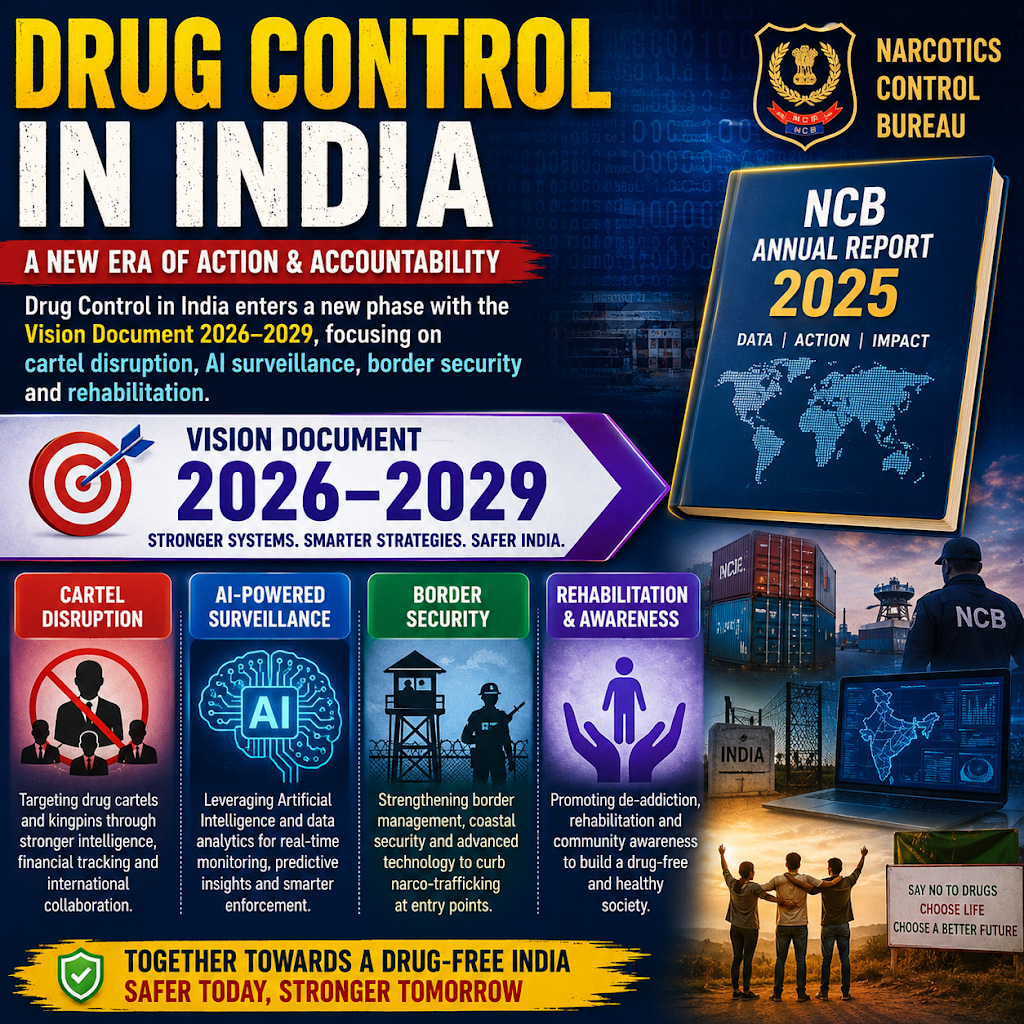
About Vision Document on Drug Control (2026–2029):
-
-
- The document aims for a “Nasha Mukt Bharat” aligned with Viksit Bharat 2047 and is built on four pillars:
- Enforcement, Intelligence & Operations: Targeted action to dismantle drug trafficking networks.
- Precursor & Synthetic Drug Control: Stopping drugs at the production and chemical stage.
- Demand Reduction & Harm Control: Awareness, rehabilitation, and community-based prevention.
- Capacity Building & Coordination: Strengthening institutions, data systems, and inter-agency cooperation.
- Enforcement, Intelligence & Operations: Targeted action to dismantle drug trafficking networks.
- The document aims for a “Nasha Mukt Bharat” aligned with Viksit Bharat 2047 and is built on four pillars:
-
Golden Triangle and Golden Crescent:
-
- Golden Crescent: Iran–Afghanistan–Pakistan region, major opium source.
- Golden Triangle: Myanmar–Thailand–Laos region, major drug production hub.
- Golden Crescent: Iran–Afghanistan–Pakistan region, major opium source.
India lies between these two regions, making it vulnerable to drug inflows and transit trafficking. These zones are sometimes referred to as the “Death Crescent” and “Death Triangle” due to their global narcotics impact.
Legal Framework for Drug Control in India:
Constitutional Basis: India’s drug policy is rooted in Article 47, which directs the State to prohibit intoxicating substances except for medical use and improve public health.
NDPS Act, 1985:
The Narcotic Drugs and Psychotropic Substances (NDPS) Act, 1985 is the primary law. It:
-
-
- Prohibits cultivation, production, sale, possession, and transport of narcotics
- Allows regulated medical and scientific use
- Implements UN drug conventions
- Prohibits cultivation, production, sale, possession, and transport of narcotics
-
Classification:
-
-
- Narcotic drugs: opium, coca, cannabis derivatives
- Psychotropic substances: LSD, MDMA, sedatives
- Controlled substances: precursor chemicals
- Narcotic drugs: opium, coca, cannabis derivatives
-
Cannabis exception: bhang is regulated by state laws, not NDPS Act.
Penalties and Bail:
Punishment depends on quantity:
-
-
- Small: up to 1 year
- Intermediate: up to 10 years
- Commercial: 10–20 years + heavy fine; repeat offence may attract death penalty Bail is highly restricted for commercial quantities.
- Small: up to 1 year
-
Conclusion:
The NCB Annual Report 2025 highlights the evolving nature of India’s drug challenge from traditional smuggling routes to digital trafficking networks and synthetic drugs. The Vision Document 2026–29 provides a comprehensive roadmap combining enforcement, prevention, and rehabilitation to achieve a drug-free India.



