
Context:
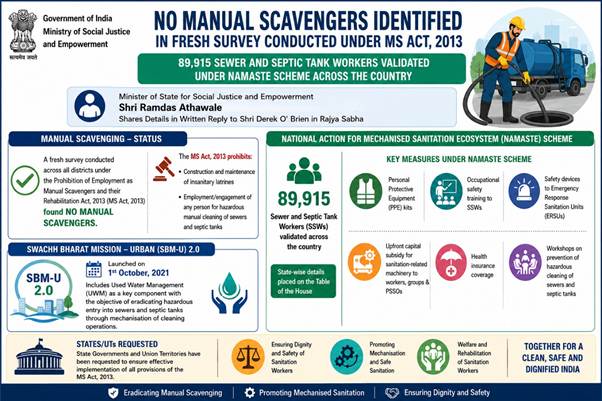
Recently, The Union Government informed the Rajya Sabha that a fresh nationwide survey conducted under the Prohibition of Employment as Manual Scavengers and their Rehabilitation Act, 2013 did not identify any manual scavengers across the country.
What is Manual Scavenging?
Manual scavenging refers to the practice of manually cleaning, carrying, disposing, or handling human excreta from dry latrines, open drains, railway tracks, sewers, or septic tanks using basic tools such as buckets, baskets, and brooms.
Key Findings:
-
-
- The survey reported no manual scavengers under the provisions of the MS Act, 2013. However, 89,915 Sewer and Septic Tank Workers (SSWs) have been validated under the NAMASTE Scheme.
- The Government has expanded mechanisation by providing Personal Protective Equipment (PPE) kits, occupational safety training, safety devices for Emergency Response Sanitation Units (ERSUs), and mechanised sewer and septic tank cleaning equipment.
- The survey reported no manual scavengers under the provisions of the MS Act, 2013. However, 89,915 Sewer and Septic Tank Workers (SSWs) have been validated under the NAMASTE Scheme.
-
Legal and Constitutional Framework:
-
-
- Manual scavenging violates Article 17 (Abolition of Untouchability) and Article 21 (Right to Life with Dignity) of the Constitution. The Employment of Manual Scavengers and Construction of Dry Latrines (Prohibition) Act, 1993 first prohibited manual scavenging and dry latrines.
- It was strengthened by the Prohibition of Employment as Manual Scavengers and their Rehabilitation (PEMSR) Act, 2013, which expanded the prohibition to hazardous cleaning of sewers and septic tanks, mandated rehabilitation of identified workers, and made offences cognizable and non-bailable. The SC/ST (Prevention of Atrocities) Act, 1989 also penalises the employment of manual scavengers belonging to Scheduled Castes.
- Manual scavenging violates Article 17 (Abolition of Untouchability) and Article 21 (Right to Life with Dignity) of the Constitution. The Employment of Manual Scavengers and Construction of Dry Latrines (Prohibition) Act, 1993 first prohibited manual scavenging and dry latrines.
-
Government Initiatives:
-
-
- The NAMASTE Scheme, jointly implemented by the Ministries of Social Justice & Empowerment and Housing & Urban Affairs, promotes complete mechanisation of sanitation work, occupational safety, skill development, livelihood support, and social security.
- The Self Employment Scheme for Rehabilitation of Manual Scavengers (SRMS) provides skill training, concessional loans, and rehabilitation support to former manual scavengers. Additionally, Swachh Bharat Mission–Urban 2.0 encourages mechanised sewer and septic tank cleaning under its Used Water Management component to eliminate hazardous manual entry.
- The NAMASTE Scheme, jointly implemented by the Ministries of Social Justice & Empowerment and Housing & Urban Affairs, promotes complete mechanisation of sanitation work, occupational safety, skill development, livelihood support, and social security.
-
Significance:
The survey reflects the Government's emphasis on replacing hazardous manual scavenging with safe and mechanised sanitation practices. It seeks to enhance workers' dignity, occupational safety, and social security while strengthening urban sanitation systems and reducing health hazards.
Conclusion:
Although the nationwide survey did not identify any manual scavengers, the persistence of sewer deaths and implementation gaps indicates that the challenge is not yet fully resolved. Achieving the complete eradication of manual scavenging requires strict enforcement of the law, universal mechanisation of sanitation work, rehabilitation through schemes such as NAMASTE and SRMS, technological innovation, and sustained efforts to eliminate caste-based discrimination, thereby ensuring dignity, safety, and social justice for sanitation workers.



