
Context:
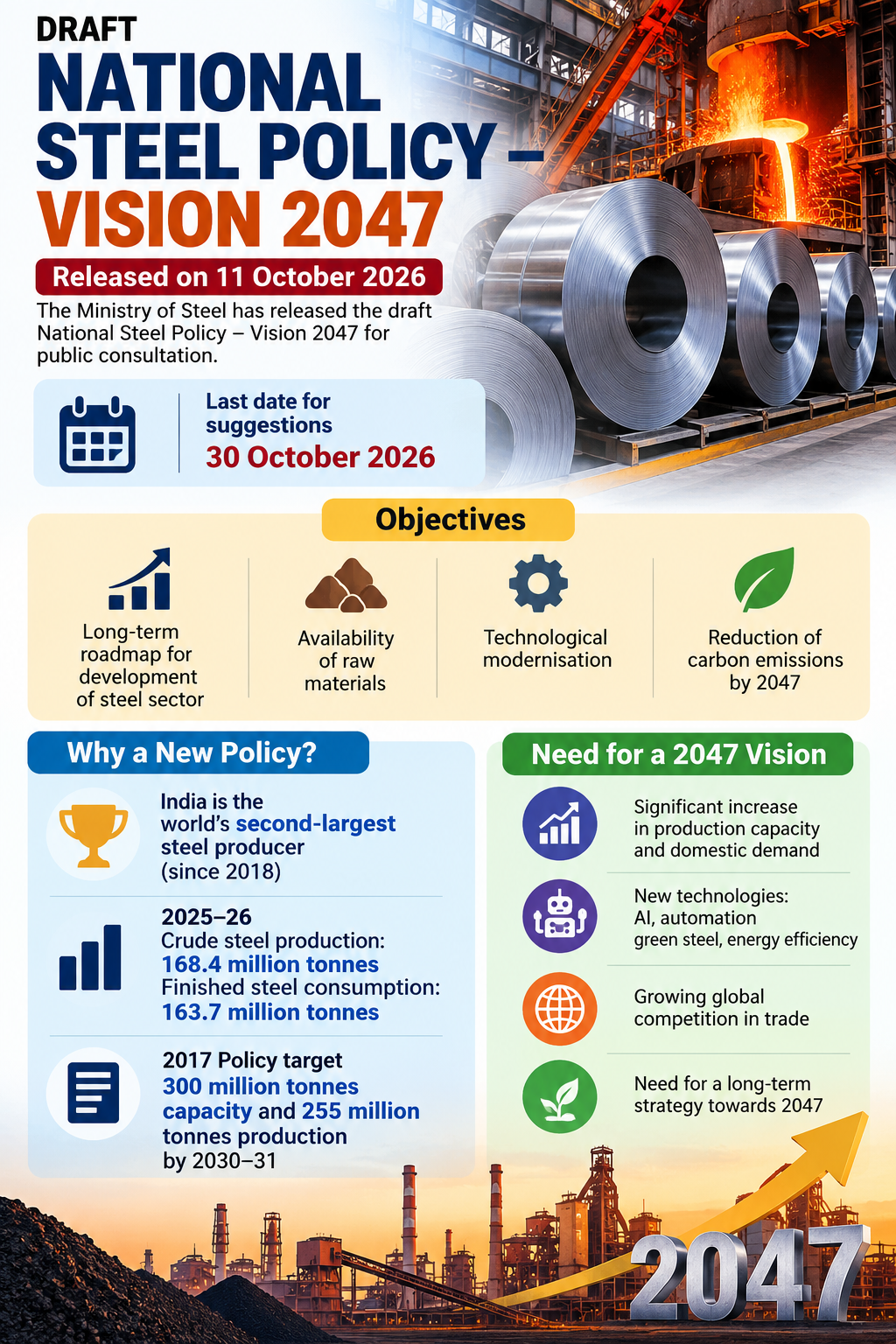
On 11 October 2026, the Ministry of Steel released the draft of the National Steel Policy–Vision 2047 (Draft National Steel Policy – Vision 2047) for public consultation. The last date for submitting suggestions on this draft has been set as 30 October 2026. Its objective is to prepare a long-term roadmap for the development of India’s steel sector, availability of raw materials, technological modernisation, and reduction of carbon emissions by 2047.
Background: Need for a National Steel Policy in India
-
-
- India secured the position of the world’s second-largest steel-producing country in 2018 and has maintained it since then. In 2025–26, the country’s crude steel production was approximately 168.4 million tonnes, while finished steel consumption stood at 163.7 million tonnes.
- The National Steel Policy, 2017, set a target of increasing crude steel production capacity to 300 million tonnes and production to 255 million tonnes by 2030–31. It also emphasised domestic production of high-quality automotive, electrical, and specialty steel, along with reducing import dependence on coking coal.
- However, over the past decade, India’s steel production capacity and domestic demand have increased significantly. New challenges, such as artificial intelligence, automation, green steel, energy efficiency, and growing competition in global trade, have created the need for a new policy extending up to 2047.
- India secured the position of the world’s second-largest steel-producing country in 2018 and has maintained it since then. In 2025–26, the country’s crude steel production was approximately 168.4 million tonnes, while finished steel consumption stood at 163.7 million tonnes.
-
Major Targets of the Proposed Policy:
-
-
-
- Steel Production Capacity: To increase it from the current approximately 220 million tonnes to 604 million tonnes per year by 2047.
- Demand for Finished Steel: To increase from 164 million tonnes in FY 2025–26 to 505 million tonnes.
- Per Capita Consumption: To increase from 116 kilograms to 302 kilograms.
- Exports: To increase finished steel exports to 45 million tonnes by 2047.
- Emission Intensity: To reduce carbon dioxide emissions per tonne of crude steel from 2.54 tonnes to approximately 1.54 tonnes.
- Steel Production Capacity: To increase it from the current approximately 220 million tonnes to 604 million tonnes per year by 2047.
- This proposal will replace the National Steel Policy of 2017, which set a target of 300 million tonnes of production capacity by 2030–31.
-
-
Major Challenge:
Raw materials account for approximately 65–70% of the total cost of steel production. India is largely self-reliant in iron ore, but it meets approximately 92% of its coking coal requirements through imports. Coking coal is essential for producing coke in the conventional blast furnace process, where it acts as a fuel and also helps remove oxygen from iron ore.
The policy proposes the following measures:
-
-
- Increasing the capacity of domestic coal mines and coal washeries.
- Developing additional sources of imports from countries such as Australia, the United States, and Russia.
- Investing in mineral assets abroad and entering into long-term supply agreements.
- Developing slurry pipelines for the transportation of iron ore and coking coal.
- Improving the monitoring of coal blending and imports through artificial intelligence (AI).
- In addition, the demand for iron ore is estimated to increase to 772 million tonnes by 2047. Therefore, the availability of high-quality iron ore will also be important.
- Increasing the capacity of domestic coal mines and coal washeries.
-
Environmental Challenges and Green Steel:
The steel industry is a major source of carbon emissions due to its energy-intensive nature. The proposed policy aims to reduce emission intensity by approximately 39% by 2047. Four major measures are important for achieving this target:
-
-
- Increasing energy efficiency and the use of renewable energy.
- Promoting scrap-based steel production.
- Adopting green hydrogen-based Direct Reduced Iron (DRI) technology.
- Developing technologies such as Carbon Capture, Utilisation and Storage (CCUS).
- Increasing energy efficiency and the use of renewable energy.
-
Importance for the Indian Economy:
Steel is a major foundation of the road, railway, housing, defence, machinery, renewable energy, and manufacturing sectors. Increasing production capacity can promote employment, industrial investment, exports, and domestic value addition. At the same time, indigenous production of specialty steel will help reduce dependence on high-technology imports.
Conclusion:
The National Steel Policy–Vision 2047 is an important proposal towards making India a global steel manufacturing hub. Its success will depend not only on increasing production capacity but also on raw material supply, technological modernisation, worker safety, and environmental sustainability. Therefore, India should move towards developing a competitive, resource-efficient, and low-carbon steel industry.



