
Context:
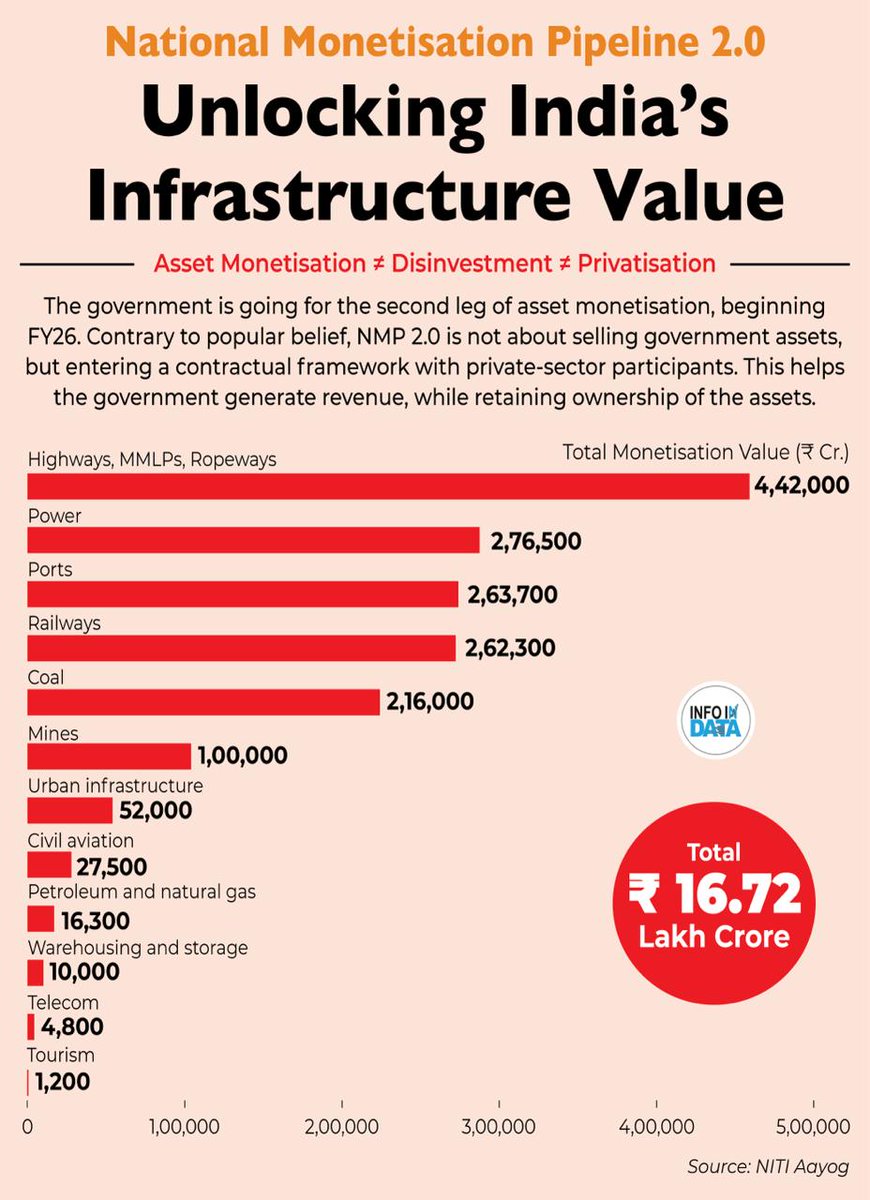
Recently, The Government of India launched the National Monetisation Pipeline 2.0 (NMP 2.0), the second phase of its asset‑monetisation programme to unlock the value of public assets and mobilise investment without increasing the fiscal burden. Prepared by NITI Aayog in consultation with infrastructure line ministries, NMP 2.0 reflects the Asset Monetisation Plan 2025‑30 announced in the Union Budget 2025‑26.
About NMP 2.0:
-
-
- The National Monetisation Pipeline is a systematic framework to mobilise public assets (brownfield infrastructure) through private participation, recycling them to generate funds for new infrastructure investment. While asset ownership remains with the government, monetisation creates revenue streams for reinvestment in productive capital.
- Under NMP 2.0, the government aims to generate ₹16.72 lakh crore between FY 2026 and FY 2030 by unlocking value from over 2,000 assets across 12 sectors including highways, railways, power, ports, coal and mines. This figure also includes an estimated ₹5.8 lakh crore of private sector investment.
- The National Monetisation Pipeline is a systematic framework to mobilise public assets (brownfield infrastructure) through private participation, recycling them to generate funds for new infrastructure investment. While asset ownership remains with the government, monetisation creates revenue streams for reinvestment in productive capital.
-
Significance:
-
-
- Boosting Infrastructure Financing Without Fiscal Strain: NMP 2.0 helps reduce dependence on direct budgetary expenditure for capital projects. By recycling existing assets, it creates new resources for infrastructure investment without worsening fiscal deficits.
- Enhancing Private Sector Participation: By inviting private capital into infrastructure through diverse monetisation models, the initiative strengthens the PPP ecosystem, augments long‑term investment flows and enhances operational efficiency of public assets.
- Potential Multiplier Impact: According to estimates, monetisation under NMP 2.0 could contribute to a significant boost in GDP over the next 5‑10 years by enabling new capital expenditure and economic activity, possibly adding around ₹40 lakh crore to India’s economy through investment multipliers and reinvestment of proceeds.
- Alignment With National Infrastructure Goals: The roadmap aligns with India’s broader infrastructure expansion ambitions and long‑term growth strategy, supporting connectivity, energy transition, logistics efficiency and urban development.
- Boosting Infrastructure Financing Without Fiscal Strain: NMP 2.0 helps reduce dependence on direct budgetary expenditure for capital projects. By recycling existing assets, it creates new resources for infrastructure investment without worsening fiscal deficits.
-
Challenges and Criticisms:
-
-
- Execution Risk: The ambitious target of monetising a diverse set of assets depends heavily on effective implementation, regulatory frameworks, market demand conditions and investor confidence.
- Valuation and Pricing: Accurate valuation of public assets and transparent pricing mechanisms are critical to ensure that monetisation yields fair value for the nation and protects public interest.
- Social and Strategic Concerns: There are debates about the extent of private participation in public infrastructure, especially in critical sectors, and the need for safeguards to ensure continuity of services and equity considerations for users.
- Execution Risk: The ambitious target of monetising a diverse set of assets depends heavily on effective implementation, regulatory frameworks, market demand conditions and investor confidence.
-
Conclusion:
The National Monetisation Pipeline 2.0 represents a significant policy initiative to harness India’s existing infrastructure assets for financing future development. Its ₹16.72 lakh crore target by FY 2030 underscores a strategic shift toward asset recycling, market participation, and capital mobilisation to accelerate infrastructure growth while managing fiscal constraints.



