
Context:
Recently, the Ministry of Health and Family Welfare (MoHFW) released the National Family Health Survey-6 (NFHS-6) for the year 2023–24. The survey covered 715 districts and approximately 679,000 households across India.
About NFHS-6:
-
-
- NFHS-6 is a comprehensive, multi-stage survey aimed at assessing key health and social development indicators in India. It examines trends related to maternal and child health, fertility rates, nutrition, immunization, health insurance coverage, and digital inclusion.
- The survey is conducted by the International Institute for Population Sciences (IIPS) and is regarded as India's most extensive health and demographic survey. It provides district-level data on population, health, nutrition, and family welfare, playing a crucial role in evidence-based policymaking and monitoring progress toward the Sustainable Development Goals (SDGs).
- The survey also serves as a benchmark for evaluating the performance of major government health programs and identifying regional disparities in healthcare access and outcomes.
- NFHS-6 is a comprehensive, multi-stage survey aimed at assessing key health and social development indicators in India. It examines trends related to maternal and child health, fertility rates, nutrition, immunization, health insurance coverage, and digital inclusion.
-
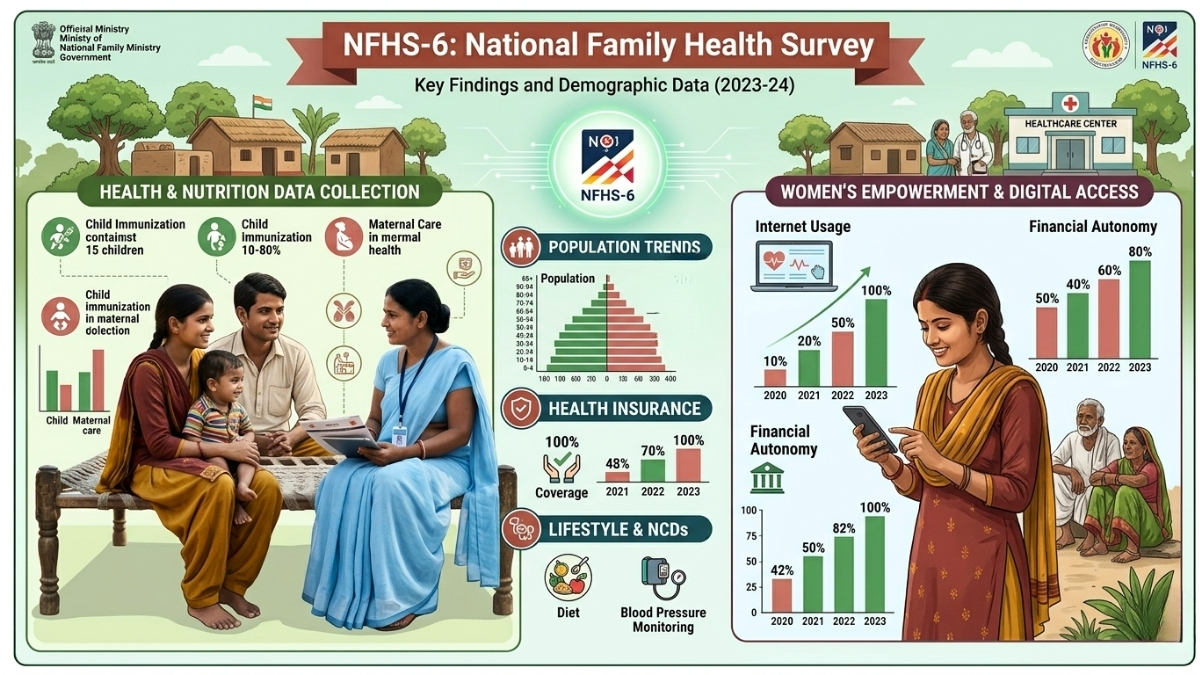
Key Findings of the Survey:
Significant Improvement in Maternal Health
According to the survey, maternal health indicators have shown remarkable progress:
-
-
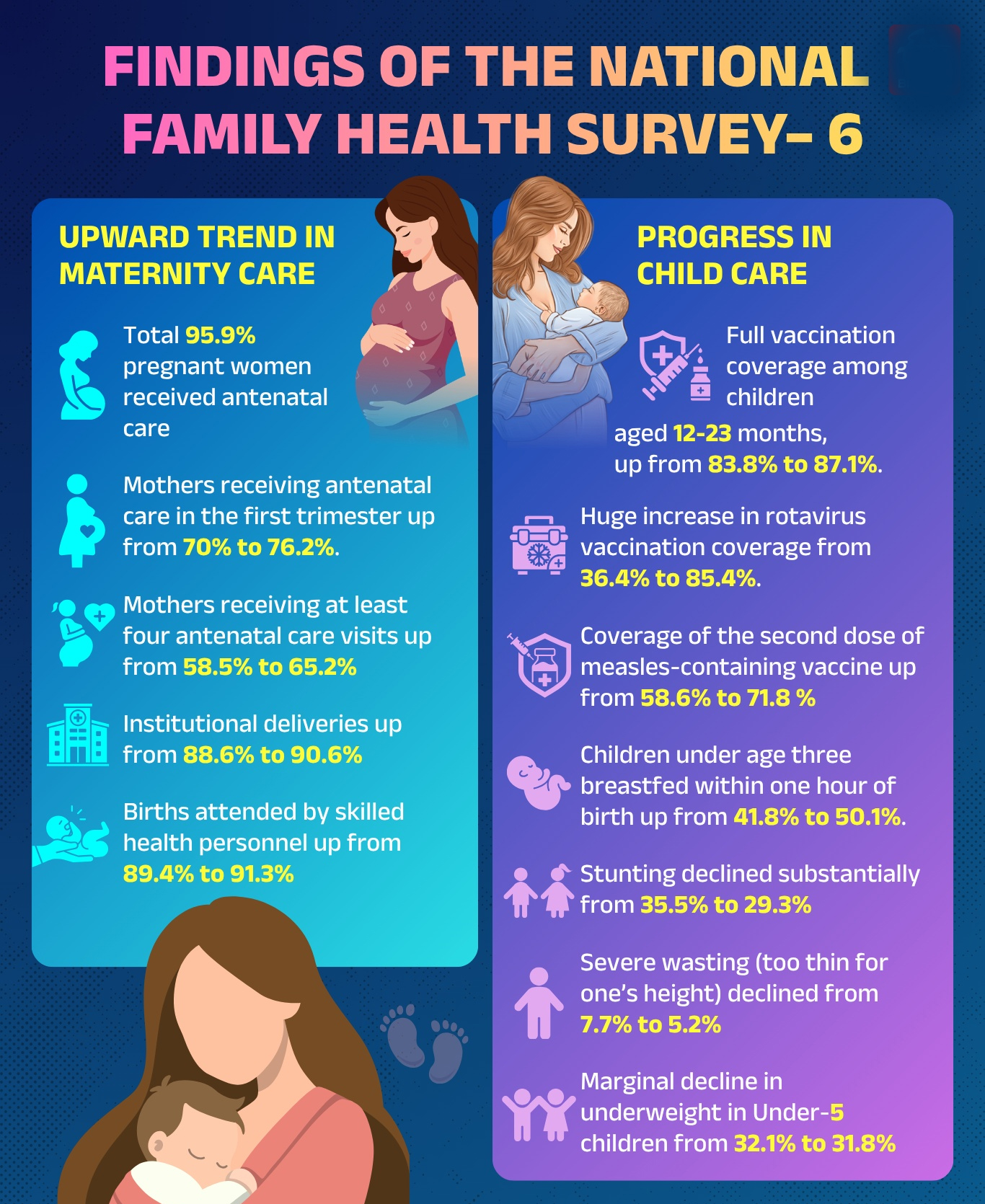
- Institutional deliveries increased to 90.6%.
- Antenatal Care (ANC) coverage reached 95.9%.
- Early registration of pregnancies and regular health check-ups also recorded substantial improvement.
- Institutional deliveries increased to 90.6%.
-
These achievements reflect better access to healthcare services and the effective implementation of maternal health programs.
Improvement in Child Health and Nutrition
NFHS-6 reports positive progress in child health and nutrition indicators:
-
-
- Stunting among children declined from 35.5% to 29.3%.
- Severe wasting decreased from 7.7% to 5.2%.
- Full immunization coverage increased to 87.1%.
- Rotavirus vaccine coverage rose significantly to 85.4%.
- Stunting among children declined from 35.5% to 29.3%.
-
These improvements indicate better implementation of child health and nutrition initiatives.
Enhanced Healthcare Access and Social Security
Access to healthcare services and financial protection has improved considerably:
-
-
- Health insurance coverage increased from 41% to 60.2%.
- Government schemes such as Ayushman Bharat – Pradhan Mantri Jan Arogya Yojana (PM-JAY) played a significant role in this expansion.
- 95.6% of children's vaccinations were administered through government health facilities.
- Internet usage among women increased substantially from 33.3% to 64.3%.
- Health insurance coverage increased from 41% to 60.2%.
-
This reflects reduced digital inequality and improved access to services.
Key Challenges:
Despite the progress, several challenges remain:
-
- Around 40.5% of infants aged 6–8 months do not receive adequate complementary feeding.
- Approximately 12.9% of children remain partially immunized or completely unvaccinated.
- The prevalence of Non-Communicable Diseases (NCDs) is increasing.
- A double burden of malnutrition is emerging, with undernutrition coexisting alongside rising obesity.
- Only 37.8% of pregnant women receive the recommended dosage of iron and folic acid supplements.
- Around 40.5% of infants aged 6–8 months do not receive adequate complementary feeding.
Way Forward:
To address these challenges, targeted interventions are necessary:
-
- Adoption of AI-based micro-planning through U-WIN can improve immunization monitoring and coverage.
- Strengthening POSHAN 2.0 and Saksham Anganwadi can further enhance child nutrition outcomes.
- Expanding Health and Wellness Centres will support early detection and management of non-communicable diseases.
- Behavioral change campaigns can encourage better nutritional compliance among pregnant women.
- Adoption of AI-based micro-planning through U-WIN can improve immunization monitoring and coverage.
Conclusion:
NFHS-6 highlights India's significant progress in the health sector. Improvements in maternal and child health, nutrition, immunization, and health insurance coverage are encouraging. However, challenges such as malnutrition, incomplete immunization, and the rising burden of lifestyle-related diseases indicate that healthcare policy must increasingly shift from a treatment-centered approach toward preventive healthcare, improved nutritional quality, and the promotion of healthy lifestyles.



