
Context:
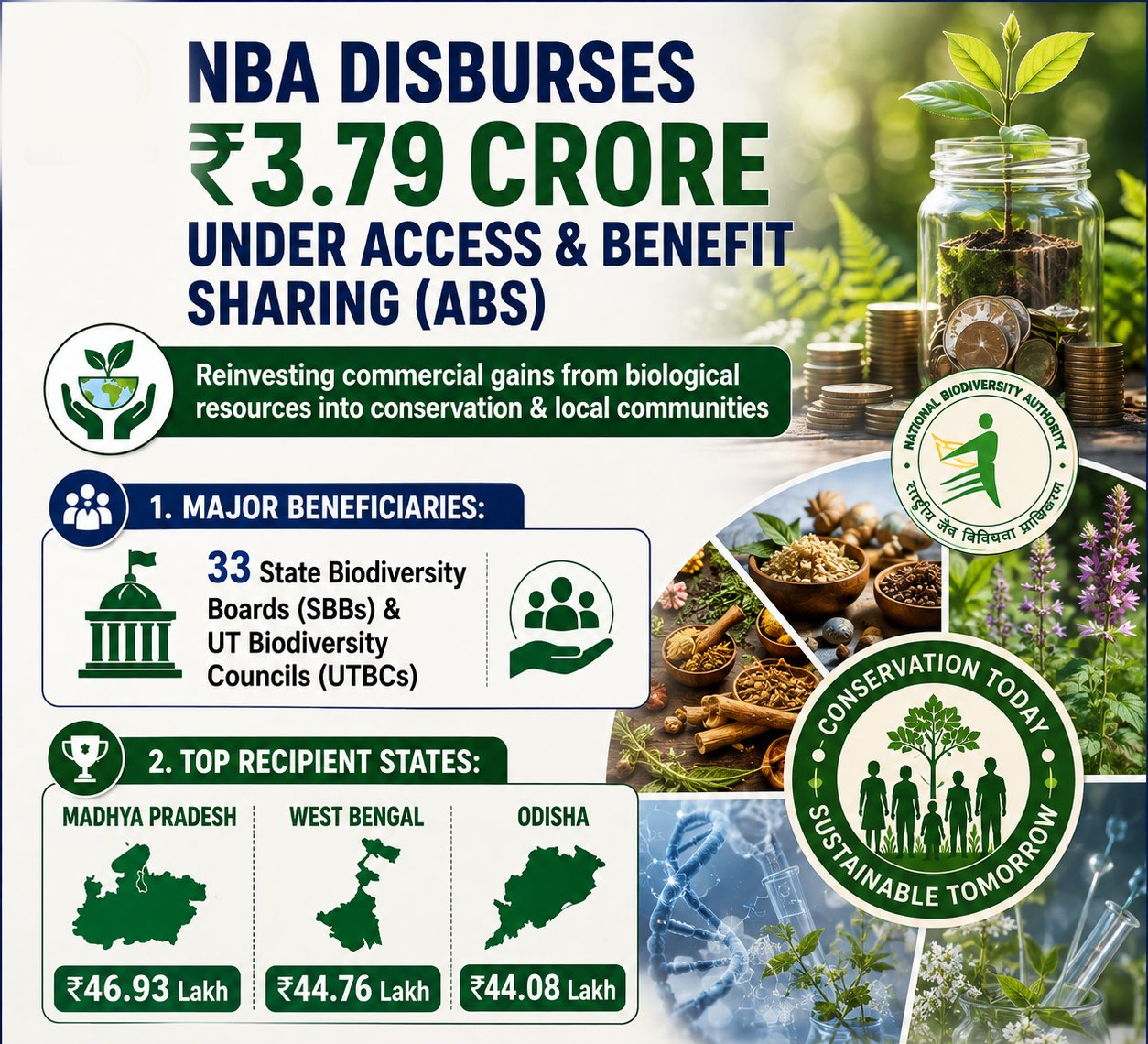
Recently, The National Biodiversity Authority (NBA) has disbursed nearly ₹3.79 crore under the Access and Benefit Sharing (ABS) mechanism to 33 State Biodiversity Boards (SBBs), Union Territory Biodiversity Councils (UTBCs) and national institutions involved in biodiversity conservation. The cumulative ABS disbursement by the NBA has now crossed ₹166 crore.
What is Access and Benefit Sharing?
Access and Benefit Sharing (ABS) is a mechanism through which benefits arising from the utilisation of biological and genetic resources are shared fairly and equitably with stakeholders involved in their conservation. It seeks to balance commercial utilisation, scientific research, biodiversity conservation and community welfare.
Legal and Institutional Framework:
India's ABS framework is based on the Biological Diversity Act, 2002, and is aligned with the Nagoya Protocol under the Convention on Biological Diversity.
India follows a three-tier biodiversity governance structure:
1. National level: National Biodiversity Authority.
2. State level: State Biodiversity Boards.
3. Local level: Biodiversity Management Committees(BMCs).
BMCs are also involved in preparing People's Biodiversity Registers (PBRs), which document local biological resources and associated knowledge.
International Conventions and Protocols:
Convention on Biological Diversity (CBD), 1992: The CBD is a landmark international environmental treaty with three major objectives:
-
-
- Conservation of biological diversity.
- Sustainable use of biodiversity.
- Fair and equitable sharing of benefits arising from genetic resources.
- Conservation of biological diversity.
-
India is a Party to the CBD.
Nagoya Protocol, 2010:
The Nagoya Protocol on Access to Genetic Resources and the Fair and Equitable Sharing of Benefits is a supplementary agreement to the CBD. It provides an international framework for ABS and supports countries in ensuring that benefits arising from genetic resources are shared fairly.
Cartagena Protocol, 2000
The Cartagena Protocol on Biosafety deals with the safe handling, transport and use of living modified organisms (LMOs) result from modern biotechnology. It is relevant to biodiversity protection but is distinct from the ABS framework.
Kunming-Montreal Global Biodiversity Framework, 2022
The GBF provides global biodiversity targets for 2030. Target 4 focuses on genetic diversity, while Target 13 concerns fair and equitable benefit sharing from the utilisation of genetic resources.
Significance:
-
-
- The ABS mechanism helps prevent biopiracy, promotes sustainable utilisation and generates resources for biodiversity conservation. The funds can support in-situ and ex-situ conservation, Biodiversity Heritage Sites, PBRs, capacity building of BMCs and socio-economic development of local communities.
- It is particularly important for agrobiodiversity, which supports food security, crop improvement and climate resilience.
- The ABS mechanism helps prevent biopiracy, promotes sustainable utilisation and generates resources for biodiversity conservation. The funds can support in-situ and ex-situ conservation, Biodiversity Heritage Sites, PBRs, capacity building of BMCs and socio-economic development of local communities.
-
Challenges:
Major challenges include identifying the original source of biological resources, inadequate documentation of traditional knowledge, limited institutional capacity and ensuring effective utilisation of ABS funds. India must also balance biodiversity regulation with scientific research and commercial innovation.
Conclusion:
The ₹3.79-crore disbursement demonstrates India's effort to link economic utilisation of biological resources with conservation and community welfare. A strong ABS mechanism can promote sustainable development, biodiversity conservation and environmental justice, while fulfilling India's commitments under the CBD, Nagoya Protocol and Kunming-Montreal Global Biodiversity Framework.



