
Context:
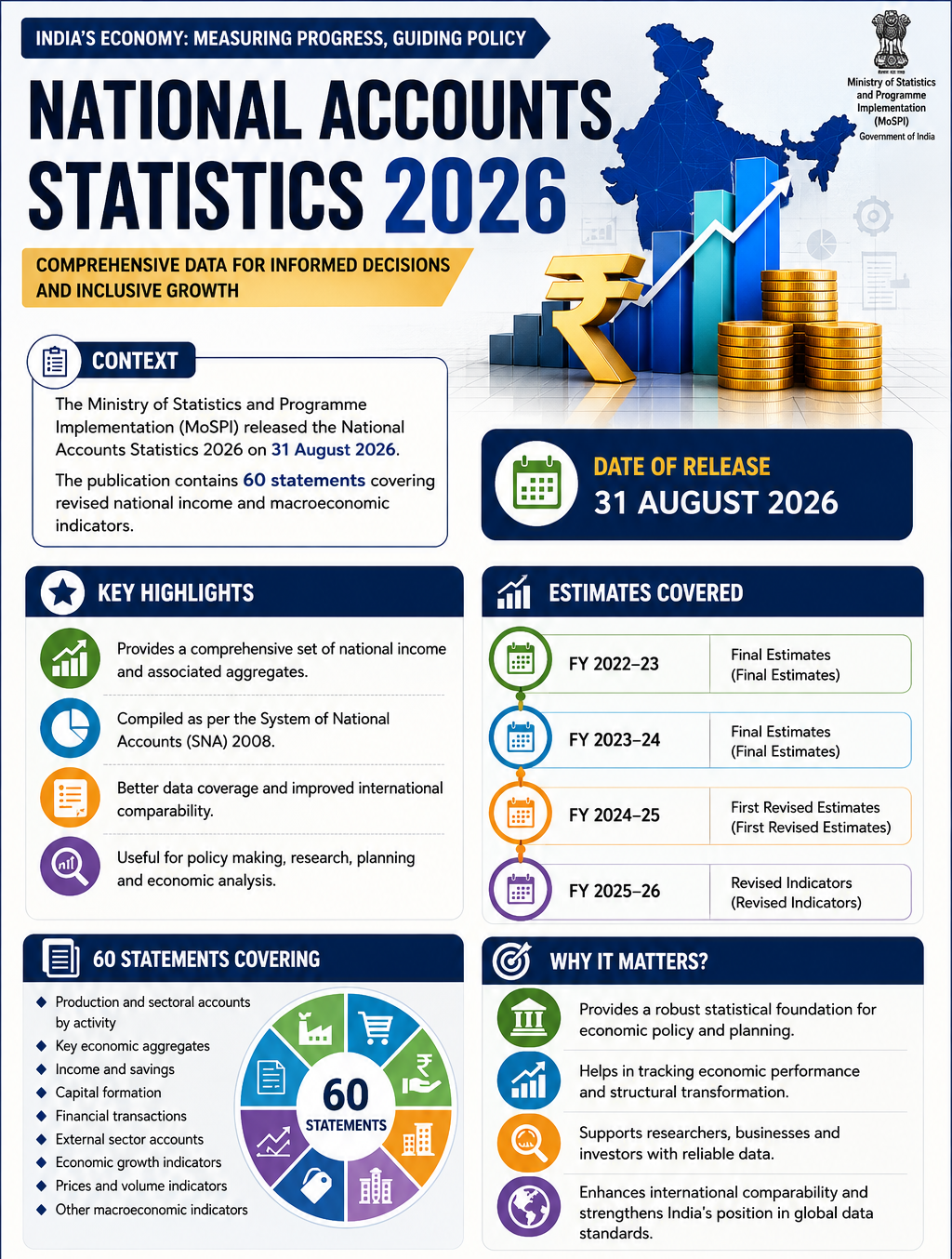
The Ministry of Statistics and Programme Implementation (MoSPI) released the National Accounts Statistics 2026 on 31 August 2026. The publication contains 60 statements covering revised national income and macroeconomic indicators. It includes Final Estimates for FY 2022–23 and FY 2023–24, First Revised Estimates for FY 2024–25, and revised indicators for FY 2025–26.
What are National Accounts Statistics?
National Accounts Statistics is India’s official compilation of major macroeconomic aggregates such as Gross Domestic Product (GDP), Gross Value Added (GVA), consumption, savings and investment. These statistics are essential for measuring economic performance and framing economic policies.
GDP Growth Revisions:
The latest publication revised several GDP growth figures. Real GDP growth for FY 2023–24 was revised from 7.2% to 7.3%, while nominal GDP growth increased from 11.0% to 11.1%. For FY 2024–25, real GDP growth was revised from 7.1% to 7.2%, whereas nominal growth was revised downward from 9.7% to 9.4%. For FY 2025–26, real GDP growth increased from 7.7% to 7.8%, while nominal growth declined from 8.9% to 8.6%.
New Base Year of GDP:
A major feature is the adoption of 2022–23 as the new base year, replacing 2011–12. The new series was introduced on 27 February 2026. Updating the base year helps national accounts better reflect changes in consumption patterns, production structures, emerging industries and the modern services economy.
About Real GDP and Nominal GDP:
-
-
- Real GDP measures economic output at constant prices and therefore provides a better measure of actual volume growth.
- Nominal GDP is measured at current prices and reflects both changes in output and prices.
- GDP = GVA + Net Taxes on Products, while GVA = Output − Intermediate Consumption.
- Real GDP measures economic output at constant prices and therefore provides a better measure of actual volume growth.
-
Quarterly GDP Growth:
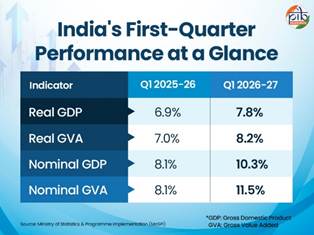
India's real GDP grew by 7.8% in Q1 of FY 2026–27, while nominal GDP grew by 10.3%. Quarterly estimates help assess short-term economic momentum and emerging trends.
Why is GDP Estimates Revised?
-
-
- GDP estimates are revised as additional information becomes available. Revisions may incorporate new administrative data, improved surveys, updated production information, revised price indices and methodological improvements.
- Thus, revisions are a normal feature of national income accounting and do not necessarily imply that earlier estimates were incorrect.
- GDP estimates are revised as additional information becomes available. Revisions may incorporate new administrative data, improved surveys, updated production information, revised price indices and methodological improvements.
-
Conclusion:
The National Accounts Statistics 2026 highlights the importance of regularly updating the statistical base, incorporating better datasets and revising estimates as new information becomes available. A robust national accounts system is essential for accurate economic assessment and evidence-based policymaking.



