
Context:
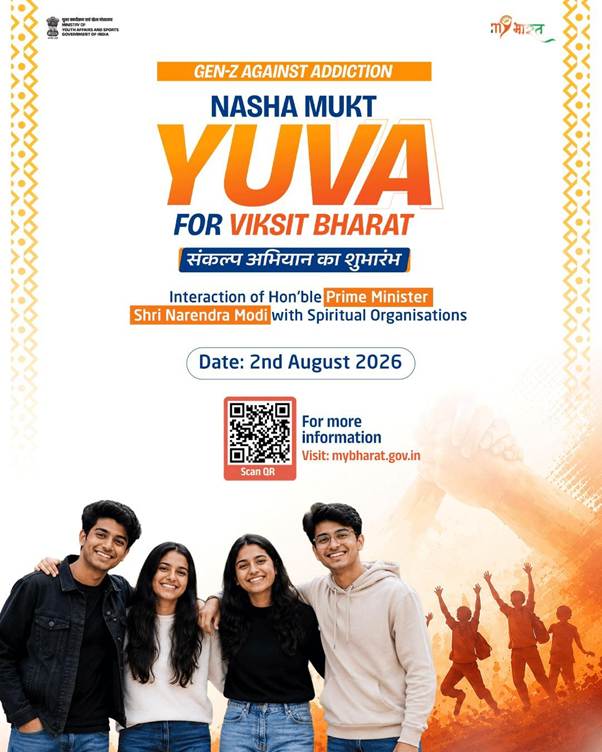
Prime Minister Narendra Modi launched the 'Nasha Mukt Yuva for Viksit Bharat Sankalp Abhiyan' on 2 August 2026, marking the beginning of a 100-week nationwide campaign to build a drug-free India.
Key Features:
The campaign seeks to create a healthy, mentally resilient, and addiction-free youth population, recognising that the vision of Viksit Bharat @2047 depends on empowered and productive young citizens.
Originating as a pilot initiative in Kashi, it has evolved into a national movement with the support of over 125 spiritual organisations and NGOs under the Kashi Declaration. Every Sunday for the next 100 weeks will feature awareness drives, sports, cultural programmes, meditation, and community outreach to strengthen public participation.
About India's Anti-Narcotics Strategy:
India is implementing a time-bound strategy with a zero-tolerance policy to achieve a drug-free India by 2029. The strategy is anchored on the MANAS Portal, the NCORD Vision Document (2026–2029), and Anti-Narcotics Task Forces (ANTFs) across all States and Union Territories. According to government estimates, nearly 16 crore people consume alcohol, over 3.1 crore use cannabis, 1.18 crore use sedatives, and 2.26 crore use opioids, with around 28 lakh requiring urgent treatment. The MANAS Helpline provides confidential reporting through 1933 and de-addiction counselling through 14446. The Government has also intensified enforcement through nationwide drug disposal campaigns and coordinated action against trafficking networks.
Significance:
The initiative aims to transform the fight against drug abuse into a Jan Bhagidari (people's movement), similar to the Swachh Bharat and Fit India campaigns. It emphasises prevention, rehabilitation, community support, and social acceptance of recovering addicts, while encouraging educational institutions, families, and civil society to actively combat substance abuse. The campaign is being implemented through MY Bharat, which has already connected over 2.3 crore youth through volunteering and leadership programmes.
Conclusion:
The Nasha Mukt Yuva for Viksit Bharat Sankalp Abhiyan complements India's broader anti-drug strategy by integrating awareness, rehabilitation, community participation, and strict law enforcement. Through initiatives such as the NCORD Vision Document, MANAS Portal, and ANTFs, the Government seeks to reduce both the demand and supply of narcotic substances. A sustained whole-of-government and whole-of-society approach is expected to strengthen India's human capital and contribute to the vision of a drug-free and developed India by 2047.



