
Nasha Mukt Vidyalaya: Ministry of Education’s 3-Year Action Plan (2026–2029)
Context:
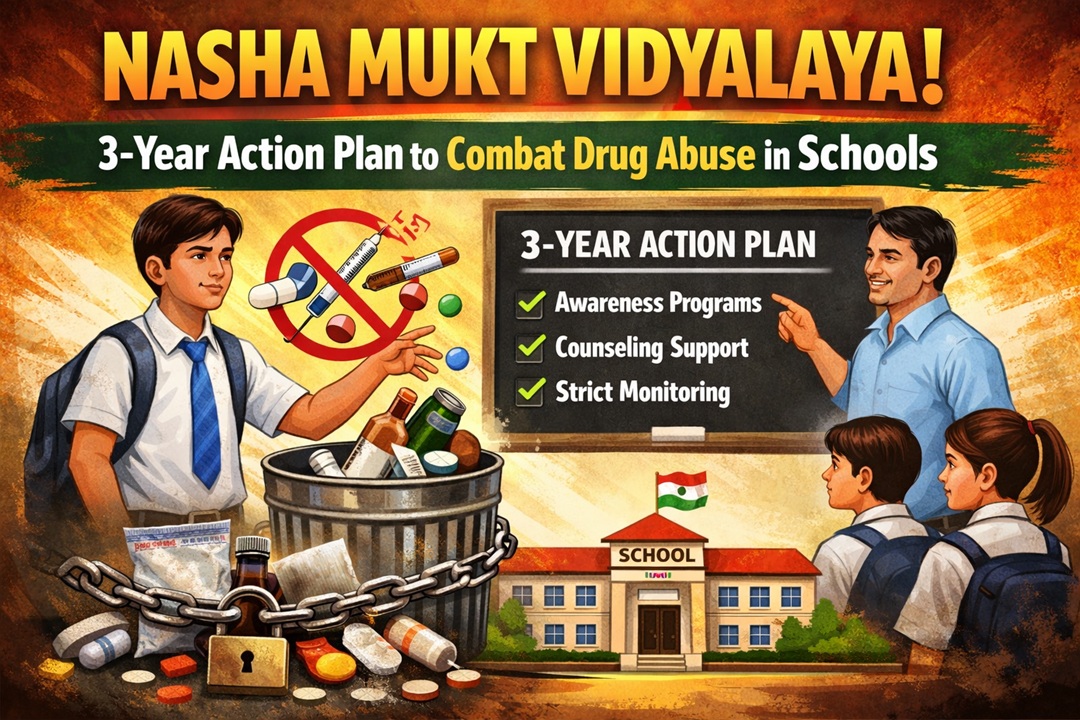
Recently, the Department of School Education and Literacy under the Ministry of Education has released a comprehensive three-year action plan (2026–2029) for the “Nasha Mukt Vidyalaya” initiative under the Nasha Mukt Bharat Abhiyan (NMBA). To address the growing challenge of substance abuse, the Ministry of Home Affairs and the Ministry of Education have jointly issued a detailed advisory to the Chief Secretaries of all states. This decision has been taken in compliance with the directions of the 9th apex meeting of the Narco-Coordination Centre (NCORD) chaired by the Union Home Minister.
Key Highlights of the Action Plan:
-
-
- Drug-Free Zone (500-meter radius): A mandatory “drug-free zone” will be declared within a 500-meter radius around every school to ensure a safe educational environment for students.
- Mandatory Reporting Mechanism: School heads and designated nodal teachers will be required to report any suspicious activities or violations within this zone to local administration and police authorities.
- Behavioural Change and Awareness: Schools will be developed as effective platforms for behavioural change and early identification, enabling control of substance abuse at an initial stage.
- Capacity Building: Teachers will be provided with specialized training to identify early signs of substance abuse among students and offer appropriate counselling.
- Student Participation (Peer-led Initiatives): Peer-led programmes will be encouraged among students to foster mutual support and build a culture against substance abuse.
- Robust Monitoring Framework: A clear and multi-tier monitoring and reporting system has been developed at school, district, and state levels to ensure effective implementation of the plan.
- Drug-Free Zone (500-meter radius): A mandatory “drug-free zone” will be declared within a 500-meter radius around every school to ensure a safe educational environment for students.
-
Nasha Mukt Bharat Abhiyan (NMBA):
-
-
- Launch: 15 August 2020
- Nodal Ministry: Ministry of Social Justice and Empowerment
- Coverage: Initially launched in 272 vulnerable districts, now expanded to all districts across the country
- Strategic Approach: The campaign follows a three-pronged strategy-
- Supply control of narcotic substances (by NCB)
- Awareness generation and demand reduction (by MoSJE)
- Treatment and rehabilitation (by the Health Department)
- Supply control of narcotic substances (by NCB)
- Launch: 15 August 2020
-
Significance and Implications:
-
-
- Institutional Empowerment: This initiative positions schools not merely as centers of education but as the “first line of defense” against social evils.
- Whole-of-Government Approach: Coordination among the Ministries of Home Affairs, Education, Health, and Social Justice makes this initiative a comprehensive and effective policy intervention.
- Youth-Centric Approach: The plan focuses on safeguarding youth from the trap of substance abuse and contributes to building healthy social capital.
- Institutional Empowerment: This initiative positions schools not merely as centers of education but as the “first line of defense” against social evils.
-
Conclusion:
The “Nasha Mukt Vidyalaya” initiative is an integral part of the long-term national goal set for 2029, aiming to protect youth from substance abuse and lay the foundation of a healthy, empowered, and productive society.
This initiative not only strengthens the vision of a Drug-Free India but also ensures holistic development of human resources for building a Developed India.



