
Context:
Recently, under the chairmanship of Prime Minister Narendra Modi, the Union Cabinet has approved significant bills to quickly implement 33% reservation for women in the Lok Sabha and State Legislative Assemblies. This step is not only a big leap towards women’s empowerment but also indicates a broad change in the country’s legislative structure.
Background and Recent Developments:
-
-
- The ‘Nari Shakti Vandan Act’ passed by Parliament in September 2023 (128th Constitutional Amendment Bill) had a provision that the reservation would come into effect only after the census and subsequent delimitation.
- However, considering the delay in the census, the government has now made a strategic change. The Cabinet has decided that the process of implementing the women’s quota will be ‘delinked’ from the next census.
- Instead, it is proposed to proceed with the delimitation process using the data of the 2011 census so that women’s reservation can be fully implemented by the 2029 general elections.
- The ‘Nari Shakti Vandan Act’ passed by Parliament in September 2023 (128th Constitutional Amendment Bill) had a provision that the reservation would come into effect only after the census and subsequent delimitation.
-
Major Change in Parliamentary Structure:
-
-
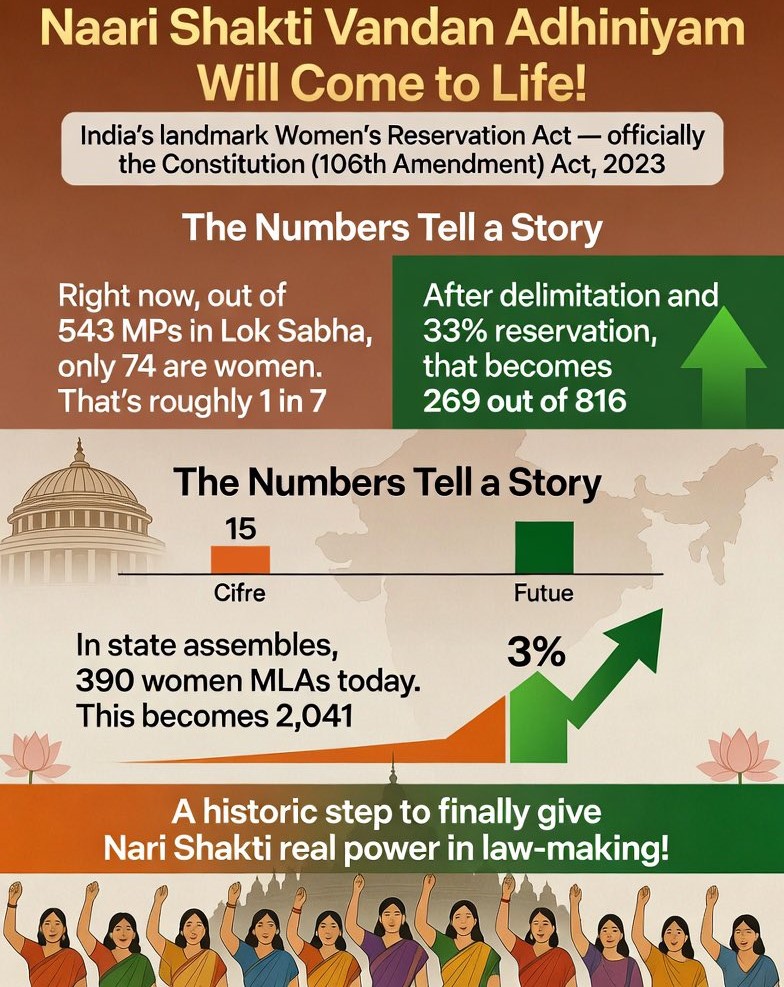
- The biggest impact of this historic decision will be on the number of seats in the Lok Sabha.
- To ensure a 33% quota without reducing existing seats, the government has proposed a 50% increase in Lok Sabha seats. Under this, the number of seats will rise from 543 to 816, of which 273 seats will be reserved for women.
- Even within seats reserved for Scheduled Castes (SC) and Scheduled Tribes (ST), 33% of seats will be reserved for women (quota within quota).
- The biggest impact of this historic decision will be on the number of seats in the Lok Sabha.
-
Significance:
This decision has the potential to change women’s ‘symbolic presence’ in Indian politics into ‘active participation.’ Currently, the number of women MPs in the Lok Sabha is about 15%, which is much lower than the global average. A 33% reservation will increase gender sensitivity in policymaking and give greater priority to grassroots issues.
Challenges:
However, expanding seats based on the 2011 census could be a complex process, especially concerning the balance of representation between states in North and South India. Opposition parties and civil society will now watch how the government manages these geographic and demographic imbalances.
Conclusion:
In conclusion, the Cabinet’s approval to implement the women’s reservation bill reiterates India’s commitment to inclusive development. If successfully implemented by 2029, it will mark the beginning of a new era for the world’s largest democracy, where ‘women power’ will be an equal partner in shaping the nation’s future.



