
Minimum Support Price (MSP) & Procurement Issues in India
Context:
Recently, A Parliamentary Standing Committee headed by Kanimozhi Karunanidhi has expressed concern over the persistent gap between estimated and actual procurement of rice and wheat.
Key findings of the committee:
-
-
- Since 2022–23, procurement of wheat and rice has been less than 30% of total production.
- Wheat procurement stood at 76.71%, 71.35% and 87.29% of estimates for 2023–24, 2024–25 and 2025–26 respectively.
- Several States like Bihar, Gujarat, Punjab, Uttar Pradesh recorded lower-than-target procurement.
- The committee has recommended better procurement planning, real-time monitoring, and improved Centre–State coordination.
- Since 2022–23, procurement of wheat and rice has been less than 30% of total production.
-
Key Issues Highlighted:
-
-
- The gap between estimates and actual procurement of crops indicates inefficient planning and forecasting, weakening food security buffer stocking. Procurement is concentrated in states like Punjab and Haryana, while eastern states like Bihar lag behind.
- Market dynamics play a role, with farmers preferring private buyers when market prices exceed MSP. Infrastructure constraints, such as storage shortages and logistics gaps, further hinder procurement. The focus on wheat and rice leads to cropping imbalance, neglecting other essential crops
- The gap between estimates and actual procurement of crops indicates inefficient planning and forecasting, weakening food security buffer stocking. Procurement is concentrated in states like Punjab and Haryana, while eastern states like Bihar lag behind.
-
About Minimum Support Price:
-
-
- Minimum Support Price (MSP) is a pre-announced price at which the government purchases crops from farmers, acting as a safety net against market fluctuations. Announced annually for 23 crops, MSP is based on recommendations from the Commission for Agricultural Costs and Prices, ensuring at least a 50% margin over the cost of production.
- The procurement mechanism involves agencies like the Food Corporation of India (FCI) and state agencies, focusing on crops like wheat and paddy/rice. Procurement is open-ended for these crops, with the government buying all produce meeting quality standards.Factors affecting procurement include production levels, market surplus, MSP vs market price, demand-supply conditions, and private trader participation.
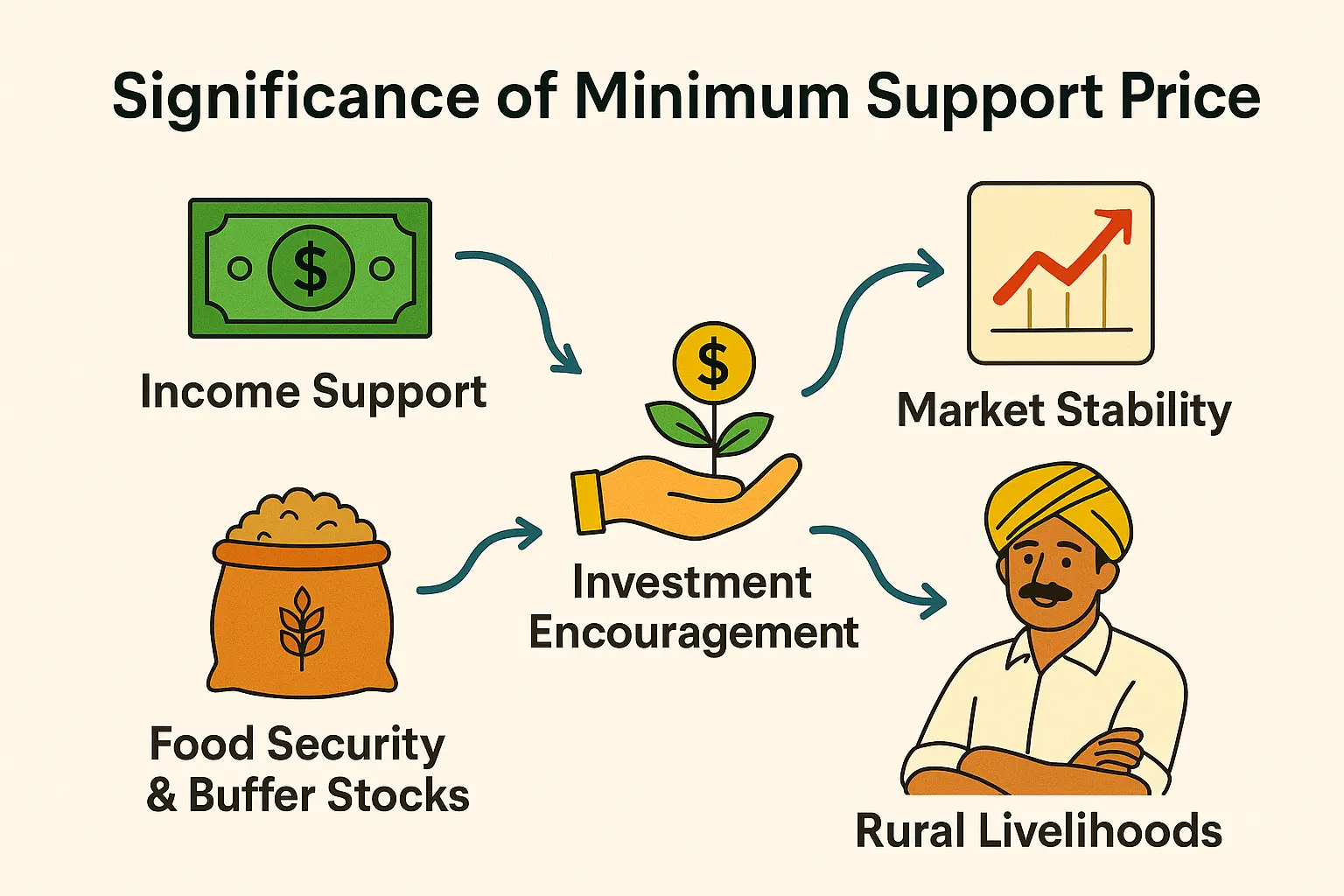
- MSP ensures income security for farmers, prevents distress sales, supports the Public Distribution System (PDS), and maintains food security buffer stocks. For instance, the wheat MSP for 2026-27 is ₹2,585/quintal, providing stable returns to farmers.
- Minimum Support Price (MSP) is a pre-announced price at which the government purchases crops from farmers, acting as a safety net against market fluctuations. Announced annually for 23 crops, MSP is based on recommendations from the Commission for Agricultural Costs and Prices, ensuring at least a 50% margin over the cost of production.
-
Committee Recommendations:
-
-
- Strengthen procurement planning methodology
- Improve real-time monitoring of production and arrivals
- Enhance coordination with States
- Make procurement system more realistic and responsive
- Strengthen procurement planning methodology
-
Way Forward:
-
-
- Expand procurement in eastern India (Bihar, Odisha, etc.)
- Promote crop diversification (pulses, oilseeds)
- Improve digital tracking & transparency
- Strengthen storage and logistics infrastructure
- Reform MSP system towards income support + market reforms
- Expand procurement in eastern India (Bihar, Odisha, etc.)
-
Conclusion:
The declining share of procurement despite high production highlights structural inefficiencies in India’s MSP system. Strengthening procurement mechanisms and broadening its regional base is essential for farmer welfare, food security, and sustainable agriculture.



