
Context:
Recently, The Micro, Small and Medium Enterprises Development (Amendment) Bill, 2026 was passed by Parliament in August 2026. It seeks to amend the MSMED Act, 2006 to modernise the regulatory framework, reduce delayed payments, ensure faster dispute resolution and promote Ease of Doing Business for MSMEs.
Importance of MSMEs:
MSMEs are a key pillar of India's economy. According to the Economic Survey 2025-26, they contribute 31.1% of GDP, 35.4% of manufacturing output and 48.58% of exports. As of August 2026, about 9.16 crore MSMEs are registered on the Udyam platform, employing more than 40 crore people. They are important for employment generation, entrepreneurship, exports and inclusive regional development.
Key Provisions of the Bill:
-
-
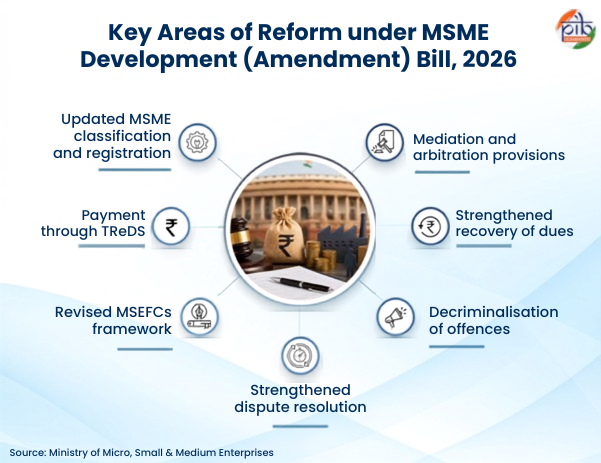
- MSME Classification: The amendment provides for classification of enterprises on the basis of investment in plant and machinery/equipment as well as turnover, providing a broader measure of enterprise size.
- Free and Voluntary Registration: Registration will be free and voluntary for all MSMEs. A national digital platform may be notified by the Central Government, while States may establish their own platforms.
- Strengthening TReDS: All Central Public Sector Enterprises (CPSEs) will be required to settle invoices for goods and services procured from MSMEs through the Trade Receivables Discounting System (TReDS). This can reduce working-capital stress caused by delayed payments.
- Faster Dispute Resolution: States can establish multiple MSE Facilitation Councils (MSEFCs) with adequate infrastructure and digital systems. The Bill introduces timelines of 90 days for mediation, 30 days for referral to arbitration after failed mediation, and 90 days for making an arbitral award after completion of pleadings.
- Protection of MSME Suppliers: Courts may direct payment of a reasonable portion of the deposited award amount to MSME suppliers during proceedings. If a case remains pending for more than six months, at least 50% of the awarded amount must be paid to the MSE supplier.
- Recovery of Dues: Mediated settlements and arbitral awards can be recovered as arrears of land revenue through the District Collector, Deputy Commissioner or another notified authority.
- Decriminalisation: Certain compliance-related offences are decriminalised. The framework moves towards warnings, penalties and fines, reducing unnecessary criminalisation while retaining deterrence.
- MSME Classification: The amendment provides for classification of enterprises on the basis of investment in plant and machinery/equipment as well as turnover, providing a broader measure of enterprise size.
-
Supporting Digital Ecosystem:
The reforms complement Udyam Registration, Udyam Assist, TReDS and the Online Dispute Resolution (ODR) Portal. The ODR Portal was launched in June 2025, while 161 MSEFCs have been established across States and Union Territories.
Significance:
The Bill can improve liquidity, regulatory compliance, dispute resolution and Ease of Doing Business. Faster payments and stronger recovery mechanisms can enhance MSME competitiveness and resilience.
Conclusion:
The MSME Development (Amendment) Bill, 2026 marks an important step towards a simpler, digital and time-bound MSME ecosystem. By addressing delayed payments, regulatory burden and dispute resolution, it can strengthen MSMEs as engines of employment, exports, innovation and inclusive economic growth.



