
Context:
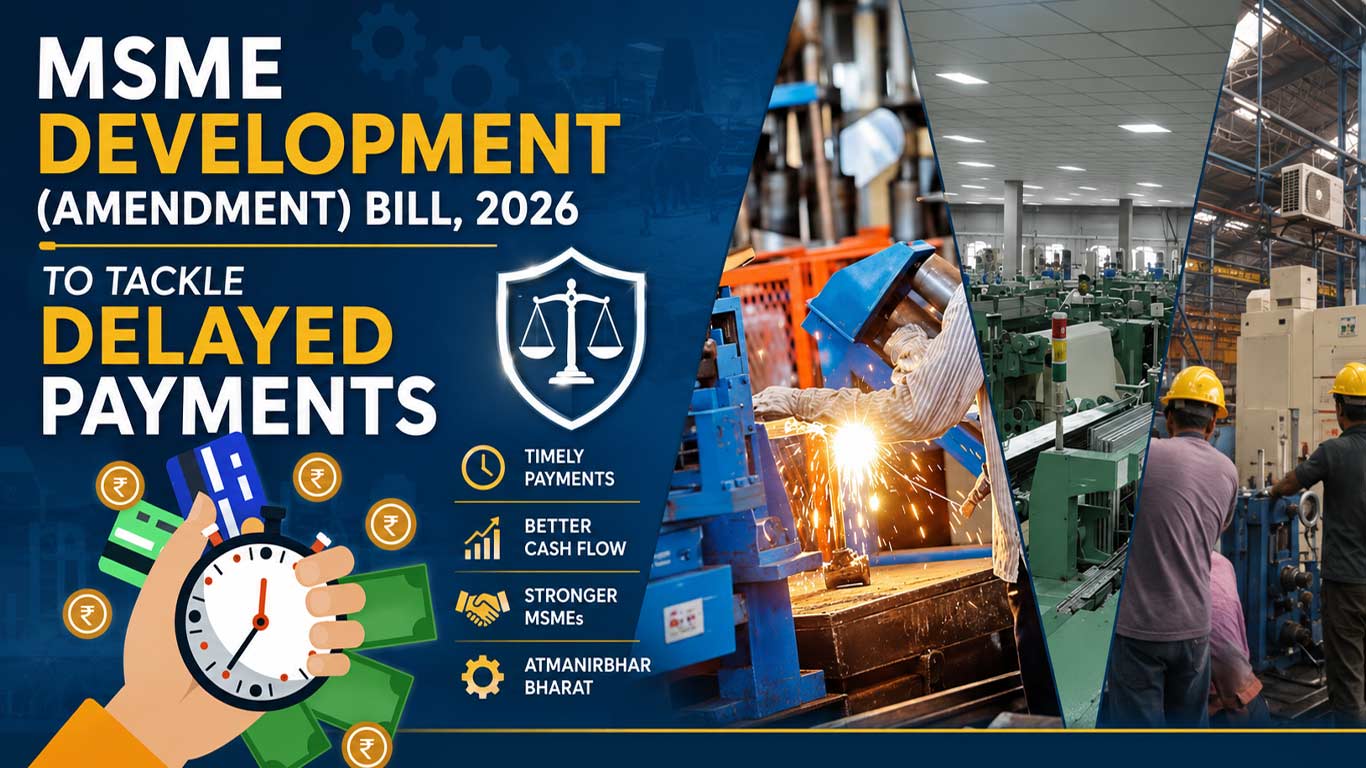
Recently, during the Monsoon Session of Parliament, the Rajya Sabha passed the Micro, Small and Medium Enterprises Development (Amendment) Bill, 2026. The Bill replaces the MSMED Act, 2006 and seeks to strengthen the MSME sector by promoting digital registration, ensuring timely payments, and improving access to institutional finance.
About the MSME Development (Amendment) Bill, 2026:
-
-
- The Amendment Bill provides for the establishment of a National Digital Platform for the free and voluntary registration of Micro, Small and Medium Enterprises (MSMEs).
- It also makes it mandatory for all Central Public Sector Enterprises (CPSEs) to settle payments for procurement from MSMEs through the Trade Receivables Discounting System (TReDS).
- These provisions aim to promote the formalisation of MSMEs, enhance transparency, and strengthen their financial position by ensuring timely payments.
- The Amendment Bill provides for the establishment of a National Digital Platform for the free and voluntary registration of Micro, Small and Medium Enterprises (MSMEs).
-
Need for the Amendment:
-
-
- MSMEs are the backbone of the Indian economy, yet they continue to face several challenges, including delayed payments, limited access to affordable institutional credit, technological backwardness, and complex regulatory procedures.
- Delayed payments, in particular, adversely affect their working capital, disrupting production, investment, and business continuity. Therefore, there was a need for a stronger legal and institutional framework to improve liquidity, encourage formalisation, and enhance the competitiveness of MSMEs.
- MSMEs are the backbone of the Indian economy, yet they continue to face several challenges, including delayed payments, limited access to affordable institutional credit, technological backwardness, and complex regulatory procedures.
-
Significance of MSMEs:
-
-
- Micro, Small and Medium Enterprises (MSMEs) form the backbone of the Indian economy. They contribute around 30–31% of India's Gross Domestic Product (GDP), nearly 36% of manufacturing output and approximately 41–45% of the country's total exports.
- The sector provides employment to over 11 crore people, making it the second-largest source of employment after agriculture.
- MSMEs promote entrepreneurship, innovation, and the efficient utilisation of local resources, thereby fostering inclusive economic growth. Their widespread presence in rural and semi-urban areas supports balanced regional development, reduces regional disparities, and strengthens national initiatives such as Atmanirbhar Bharat and Make in India.
- Micro, Small and Medium Enterprises (MSMEs) form the backbone of the Indian economy. They contribute around 30–31% of India's Gross Domestic Product (GDP), nearly 36% of manufacturing output and approximately 41–45% of the country's total exports.
-
Key Challenges:
-
-
- Despite their significant contribution, the MSME sector continues to face several structural challenges.
- Delayed payments by large industries and government agencies severely affect their working capital. Many enterprises also struggle to access affordable institutional credit, forcing them to depend on informal sources of finance.
- In addition, low technology adoption, outdated production processes, and inadequate digital capabilities reduce productivity and competitiveness. Regulatory and compliance burdens, along with limited access to domestic and international markets, further restrict the growth of MSMEs and their integration into Global Value Chains (GVCs).
- Despite their significant contribution, the MSME sector continues to face several structural challenges.
-
Government Initiatives:
-
-
- The Government has launched several important initiatives to strengthen the MSME sector.
- Udyam Registration provides a simple digital platform for enterprise registration.
- The Trade Receivables Discounting System (TReDS) enables timely payments and improves liquidity for MSMEs.
- The Emergency Credit Line Guarantee Scheme (ECLGS) provides collateral-free loans to eligible enterprises.
- The Raising and Accelerating MSME Performance (RAMP) programme aims to improve institutional capacity and competitiveness.
- MSME SAMADHAAN addresses disputes related to delayed payments, while MSME SAMBANDH monitors procurement from MSMEs by Central Public Sector Enterprises (CPSEs).
- In addition, schemes such as ASPIRE and SFURTI promote innovation, rural entrepreneurship, cluster development, and the revival of traditional industries.
- The Government has launched several important initiatives to strengthen the MSME sector.
-
Way Forward:
-
-
- The MSME Development (Amendment) Bill, 2026 is an important step towards building a stronger, more competitive, and self-reliant MSME sector. However, its success will depend on effective implementation, strict enforcement of timely payment provisions, wider adoption of digital technologies, technological upgradation, and improved access to affordable institutional credit.
- If these reforms are implemented effectively, MSMEs will not only accelerate the goals of Atmanirbhar Bharat, Make in India, and employment generation but will also play a vital role in enhancing India's export competitiveness and achieving the vision of Viksit Bharat 2047.
- The MSME Development (Amendment) Bill, 2026 is an important step towards building a stronger, more competitive, and self-reliant MSME sector. However, its success will depend on effective implementation, strict enforcement of timely payment provisions, wider adoption of digital technologies, technological upgradation, and improved access to affordable institutional credit.
-



