
MLFF Tolling System in India
Context:
Recently, The National Highways Authority of India (NHAI) has directed FASTag-issuing banks to verify and validate vehicle registration numbers (VRNs) linked with FASTags. This step comes amid concerns over mismatches between registered vehicle details and actual license plates. Banks have also been instructed to blacklist invalid FASTags. The move is crucial for the upcoming rollout of the Multi-Lane Free Flow (MLFF) tolling system, which aims to enable seamless, barrier-less toll collection across India’s highways.
About MLFF Tolling:
-
-
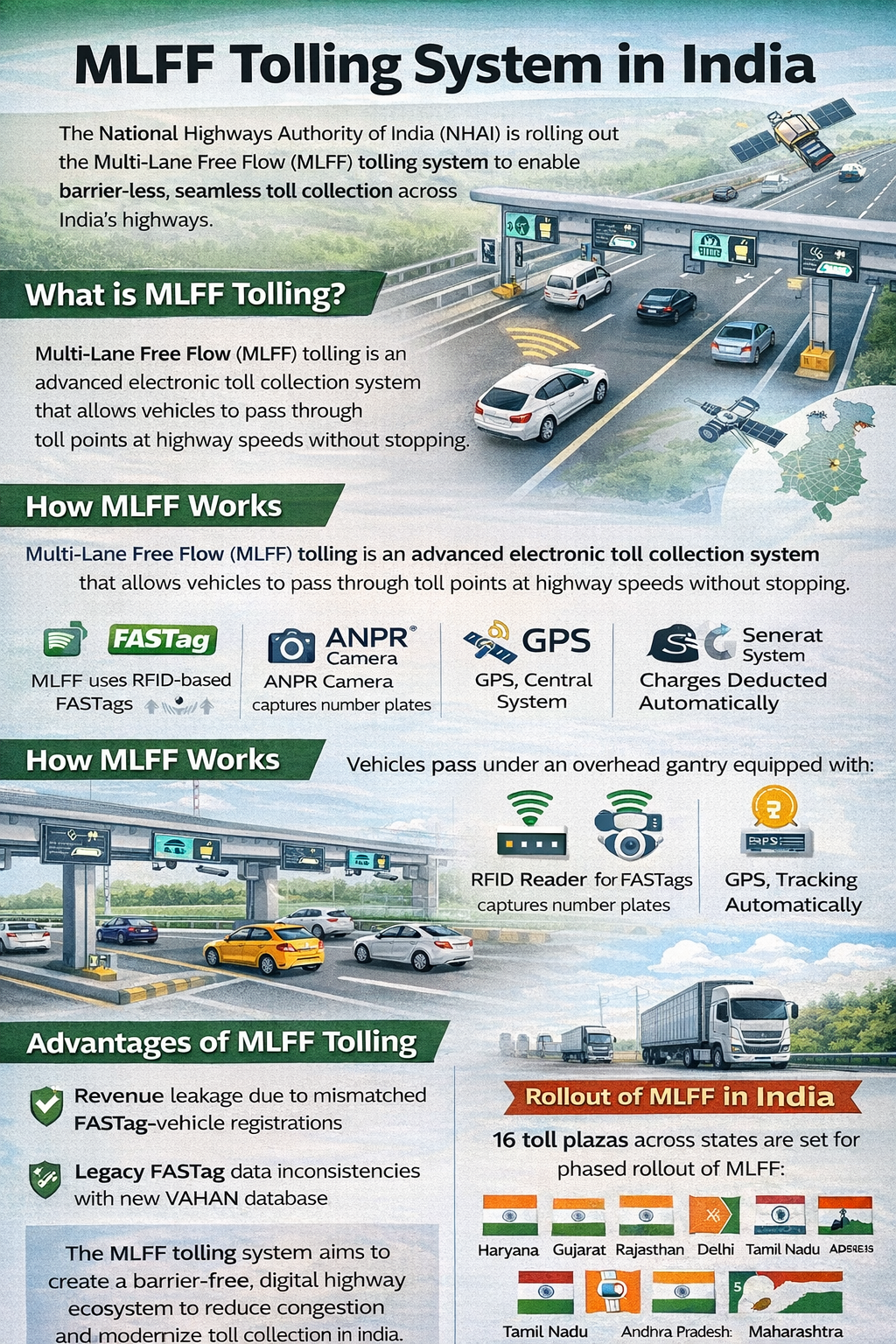
- Multi-Lane Free Flow (MLFF) tolling is an advanced electronic toll collection system that allows vehicles to pass through toll points at highway speeds without stopping or slowing down.
- It eliminates physical barriers by using a combination of RFID-enabled FASTag systems, Automatic Number Plate Recognition (ANPR) cameras, and GNSS-based tracking, which together identify vehicles and deduct toll charges automatically.
- Multi-Lane Free Flow (MLFF) tolling is an advanced electronic toll collection system that allows vehicles to pass through toll points at highway speeds without stopping or slowing down.
-
How MLFF Works:
-
-
- The system operates through a network of overhead gantries installed on highways. These gantries are equipped with RFID readers linked to FASTags and high-resolution ANPR cameras that capture vehicle number plates.
- The system matches the FASTag data with vehicle registration details and automatically deducts the applicable toll fee. Unlike traditional toll plazas, MLFF does not require boom barriers or manual intervention, ensuring continuous traffic flow.
- The system operates through a network of overhead gantries installed on highways. These gantries are equipped with RFID readers linked to FASTags and high-resolution ANPR cameras that capture vehicle number plates.
-
Advantages of MLFF Tolling:
-
-
- MLFF significantly improves highway efficiency by enabling uninterrupted travel at speeds exceeding 100 kmph.
- It reduces congestion at toll plazas, eliminates waiting time, and enhances fuel efficiency by avoiding frequent stops.
- For commuters and freight operators, the system ensures faster transit, lower travel time and improved logistics efficiency, contributing to reduced operational costs.
- MLFF significantly improves highway efficiency by enabling uninterrupted travel at speeds exceeding 100 kmph.
-
Challenges:
-
-
- The success of MLFF heavily depends on accurate FASTag–vehicle registration mapping. Mismatches between FASTag details and actual vehicle data can lead to revenue leakage and enforcement challenges.
- Additionally, legacy FASTags issued before integration with the VAHAN database have created inconsistencies due to earlier manual verification processes. Ensuring updated and verified data is therefore essential for effective implementation and electronic enforcement mechanisms.
- The success of MLFF heavily depends on accurate FASTag–vehicle registration mapping. Mismatches between FASTag details and actual vehicle data can lead to revenue leakage and enforcement challenges.
-
Rollout of MLFF in India:
The Ministry of Road Transport and Highways (MoRTH) has initiated the phased implementation of MLFF by awarding tenders for 16 toll plazas across states such as Haryana, Gujarat, Rajasthan, Delhi, Tamil Nadu, Andhra Pradesh, and Maharashtra.
Conclusion:
The introduction of MLFF tolling marks a major step towards a fully digital, barrier-free highway ecosystem in India. By integrating advanced technologies with FASTag infrastructure, the system aims to reduce congestion, improve efficiency, and modernise toll collection. However, its success will depend on robust data accuracy, strong enforcement mechanisms, and smooth technological integration across states.



