
MITRA Mission: ISRO’s Space Analog Study for Gaganyaan
Context:
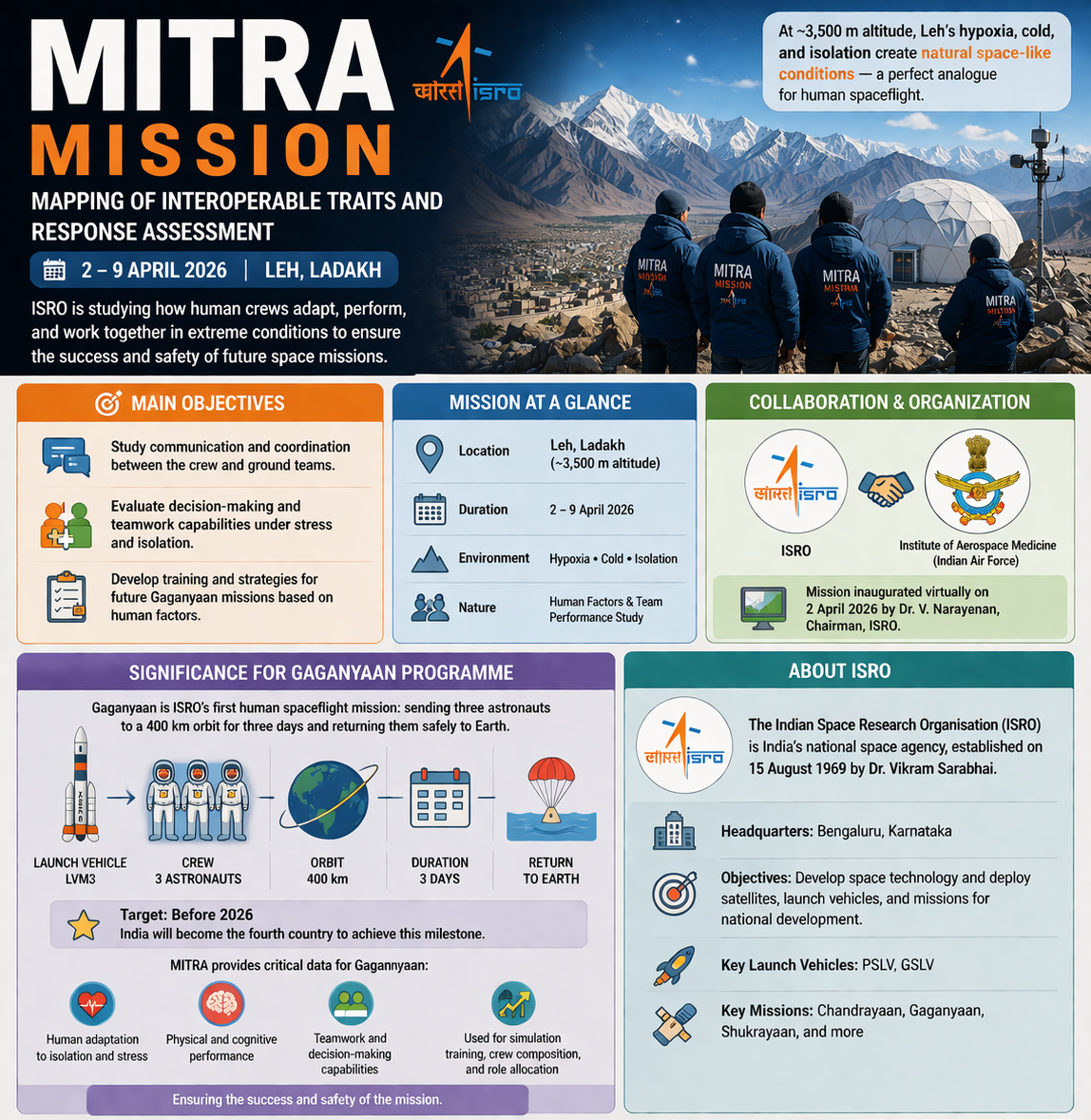
The Indian Space Research Organisation (ISRO) is conducting the MITRA Mission (Mapping of Interoperable Traits and Response Assessment) from 2–9 April 2026 in Leh, Ladakh. The mission aims to understand crew safety, performance, and teamwork in human space missions. The high-altitude environment of Leh, at approximately 3,500 meters, with hypoxia (low oxygen), cold, and isolation, simulates space-like conditions. For this reason, it is considered a natural analogue for human spaceflight.
Main Objectives of the Mission:
-
-
-
- Study communication and coordination between the crew and ground teams.
- Evaluate decision-making and teamwork capabilities under stress and isolation.
- Develop training and strategies for future Gaganyaan missions based on human factors.
- Study communication and coordination between the crew and ground teams.
-
-
Collaboration and Organization:
The mission was designed jointly by ISRO and the Institute of Aerospace Medicine (Indian Air Force). The mission was inaugurated virtually on 2 April 2026 by Dr. V. Narayanan, Chairman of ISRO.
Significance for Gaganyaan Programme:
The Gaganyaan mission is ISRO’s first human spaceflight programme, aimed at sending three astronauts into a 400 km orbit for three days and returning them safely to Earth. The mission is expected to be launched before 2026, using the LVM3 rocket, and India will become the fourth country to achieve this milestone.
MITRA Mission provides critical data for this effort, including:
-
-
-
- Human adaptation to isolation and stress
- Physical and cognitive performance
- Teamwork and decision-making capabilities
- Human adaptation to isolation and stress
-
-
This data will be used for simulation training, crew composition, and role allocation, ensuring the success and safety of the mission.
About ISRO:
The Indian Space Research Organisation (ISRO) is India’s national space agency, established on 15 August 1969 by Dr. Vikram Sarabhai. Headquartered in Bengaluru, Karnataka, ISRO’s objectives include developing space technology and deploying satellites, launch vehicles (PSLV, GSLV), and missions (Chandrayaan, Gaganyaan, Shukrayaan) for national development.
Conclusion:
The MITRA Mission is a strategic initiative in India’s human spaceflight preparation. By studying human and team responses in extreme and isolated environments, ISRO aims to ensure that astronauts are fully prepared for the challenges of space. The mission also exemplifies multi-disciplinary collaboration, combining expertise in space science, defence, and medical research, supporting India’s Gaganyaan programme and future human space exploration endeavours.



