
Mission for Cotton Productivity
Context:
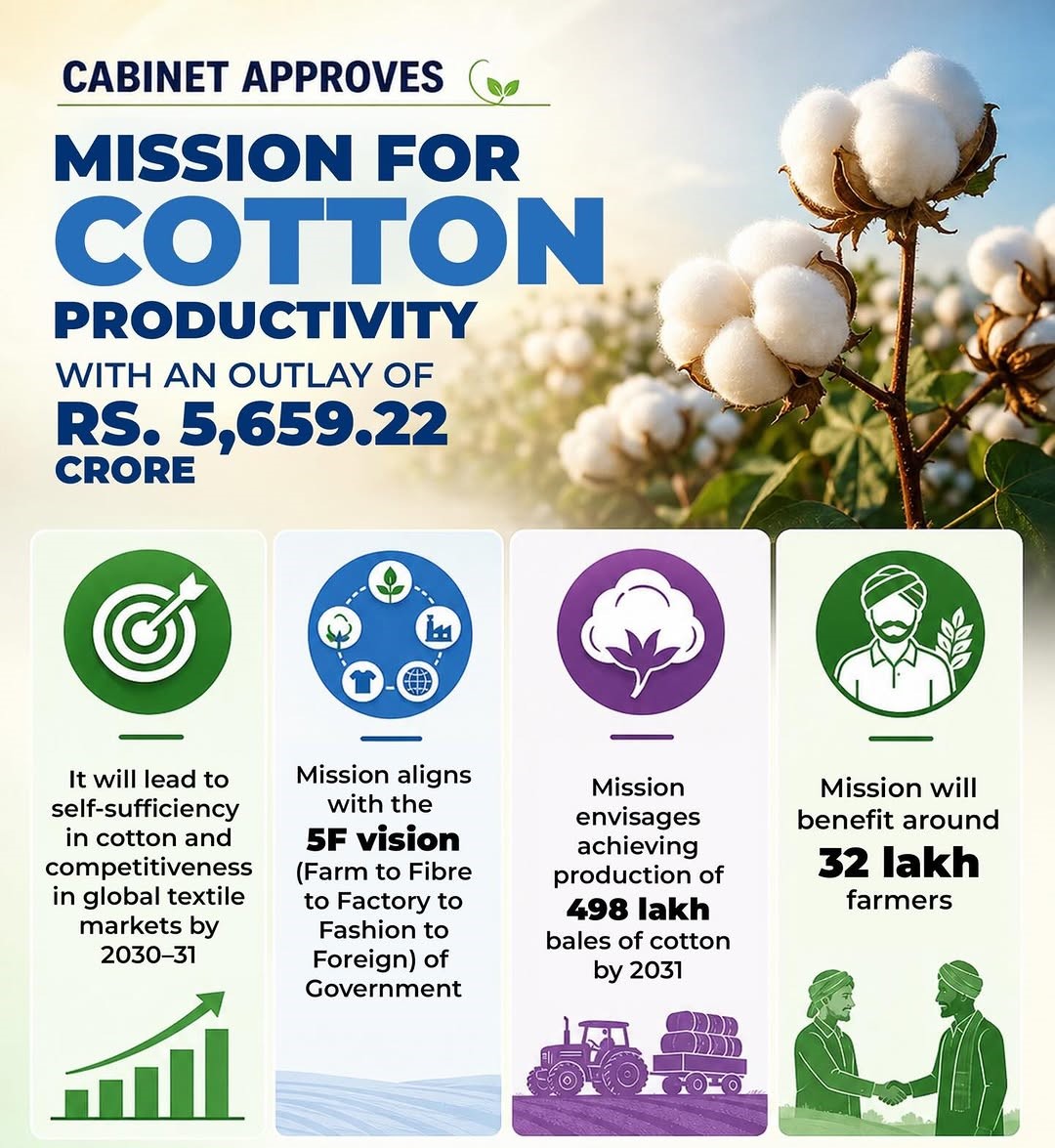
Recently, the Union Government approved ₹5,659.22 crore for the Mission for Cotton Productivity for a five-year period (2026–27 to 2030–31). Announced in the Union Budget 2025–26, the mission aims to enhance cotton productivity through science and technology while ensuring a stable supply of quality cotton for India’s textile industry.
About the Mission:
The Mission for Cotton Productivity is a transformative initiative designed to improve cotton productivity, quality, and sustainability in India. It aligns with the government’s 5F vision—Farm to Fibre to Factory to Fashion to Foreign, integrating the entire textile value chain. The mission also focuses on raising farmer incomes and strengthening India’s global competitiveness in textiles.
Key Objectives and Components:
The mission focuses on multiple science-driven and market-oriented interventions:
-
-
- High-yielding & climate-resilient seeds: Development of pest-resistant and climate-adaptive cotton varieties through advanced breeding techniques.
- Technology-driven farming: Promotion of High Density Planting System (HDPS), closer spacing, and Integrated Cotton Management to increase yields.
- Processing modernisation: Upgradation of ginning and processing units to improve efficiency and global competitiveness.
- Quality testing infrastructure: Establishment of accredited laboratories for standardized cotton grading and certification.
- Branding and traceability: Strengthening “Kasturi Cotton Bharat” to promote Indian cotton globally.
- Digital integration: Linking mandis with e-platforms for transparent pricing and better market access.
- Circular economy: Recycling cotton waste into value-added products to reduce environmental impact.
- Fibre diversification: Encouraging natural fibres like bamboo, flax, ramie, and banana fibre.
- High-yielding & climate-resilient seeds: Development of pest-resistant and climate-adaptive cotton varieties through advanced breeding techniques.
-
Targets of the Mission:
-
-
- Cotton production target: 498 lakh bales by 2031
- Productivity improvement: from 440 kg/ha to 755 kg/ha
- Cotton production target: 498 lakh bales by 2031
-
About India’s Cotton Sector:
-
-
- India is the world's largest cotton-producing country in terms of acreage, accounting for approximately 40% of the global cotton area. However, in terms of total production, India is typically the second-largest producer after China, contributing about 20–23% of global output.
- Major producing states include Maharashtra, Gujarat, Telangana, Karnataka, and Rajasthan. However, productivity remains lower than global leaders.
- India is the world's largest cotton-producing country in terms of acreage, accounting for approximately 40% of the global cotton area. However, in terms of total production, India is typically the second-largest producer after China, contributing about 20–23% of global output.
-
Challenges in Cotton Production:
Key issues include low yields, pest attacks like pink bollworm, climate vulnerability due to rainfed cultivation, and price volatility affecting farmer incomes.
Government Support Measures:
-
-
- Minimum Support Price (MSP) mechanism through Cotton Corporation of India (CCI)
- Promotion of Bt cotton
- Kapas Kisan App for procurement facilitation
- Advisory support by Commission for Agricultural Costs and Prices (CACP)
- Minimum Support Price (MSP) mechanism through Cotton Corporation of India (CCI)
-
Significance of the Mission:
The Mission for Cotton Productivity is expected to:
-
-
- Boost farm incomes
- Ensure raw material security for the textile industry
- Strengthen India’s global textile competitiveness
- Promote sustainable and technology-driven agriculture
- Boost farm incomes
-
Conclusion:
The Mission for Cotton Productivity is a strategic reform aimed at modernising India’s cotton sector through innovation, digitalisation, and sustainability, strengthening the textile value chain under the 5F vision.



