
Context:
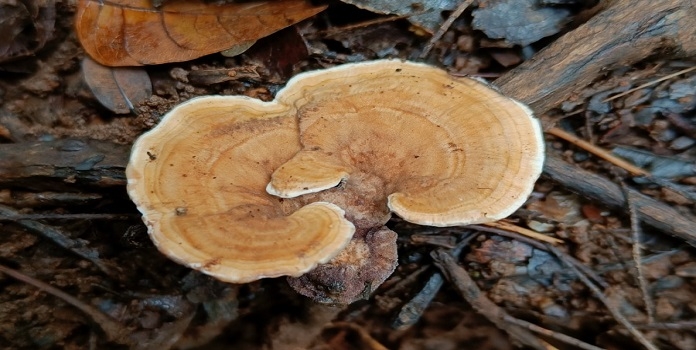
Recently, scientists discovered a new species of polypore (bracket) fungus, Microporellus kolhapurensis, in Bhudargad Taluka of Kolhapur district, Maharashtra.
About Microporellus kolhapurensis:
-
-
- It is a new species of polypore (bracket) fungus.
- It was discovered in Bhudargad Taluka, Kolhapur district, Maharashtra.
- The fungus grows on rotting wood.
- It primarily fruits between July and September.
- It generally grows singly.
- It is a new species of polypore (bracket) fungus.
-
Key Characteristics:
-
-
- This species differs from its closely related fungi due to the following distinctive features:
- Yellowish-orange to grayish-brown coloration.
- Umbrella-shaped structure.
- Lateral stalk.
- Ground-growing habit.
- Large pores.
- Teardrop-shaped spores.
- Yellowish-orange to grayish-brown coloration.
- Distinctive thick-walled cystidia, which are large cells found on the spore-bearing surface of certain fungi that do not produce spores themselves.
- This species differs from its closely related fungi due to the following distinctive features:
-
What are Polypores?
-
-
- Polypores, also known as bracket fungi or shelf fungi, are a group of fungi.
- They are characterized by the presence of numerous tiny pores on the underside of their fruiting body, which is why they are called polypores.
- These pores contain and protect spores, which enable fungal reproduction.
- The pores increase the surface area, allowing the production and release of a larger number of spores.
- In most polypores, the pores are circular and regularly arranged.
- Their shelf-like or bracket-like appearance gives them the common name bracket fungi.
- They commonly grow on living trees, fallen logs, and decaying wood.
- Some species possess a short stalk that helps them attach to their substrate.
- While they can damage healthy trees, they also play a vital role in the decomposition of dead trees.
- Their mycelium remains embedded inside the trunk of the host tree, while only the fruiting body is visible externally.
- Polypores, also known as bracket fungi or shelf fungi, are a group of fungi.
-
Ecological Significance:
-
-
- They facilitate the decomposition of dead wood, thereby promoting nutrient recycling.
- They play an important role in maintaining the balance of forest ecosystems.
- They are considered important indicators of biodiversity conservation and forest health.
- They facilitate the decomposition of dead wood, thereby promoting nutrient recycling.
-



