
Context:
The Centre has resumed the implementation of MGNREGA in West Bengal after a gap of three years. This follows the Calcutta High Court directive asking the Union government to restart the scheme prospectively from August 1, 2025, while allowing it to impose “special conditions”.
Background of Suspension:
-
- Implementation of MGNREGA in West Bengal was suspended on March 9, 2022.
- The suspension was invoked under Section 27 of the MGNREGA Act, 2005, citing “non-compliance of directives of the Central Government”.
- Implementation of MGNREGA in West Bengal was suspended on March 9, 2022.
Key Points of Resumption:
1. Immediate Effect
-
-
- The Ministry of Rural Development issued an order on December 6, 2025, resuming prospective implementation of MGNREGA in the state.
- The Ministry of Rural Development issued an order on December 6, 2025, resuming prospective implementation of MGNREGA in the state.
-
2. Special Conditions and Regulatory Measures
-
-
- The resumption is conditional, with measures aimed at ensuring transparency, integrity, and accountability.
- These conditions relate to job cards, biometric attendance, financial management, labour budgeting, monitoring of works, accountability mechanisms, recovery processes, and penal action.
- The resumption is conditional, with measures aimed at ensuring transparency, integrity, and accountability.
-
3. Mandatory e-KYC for Workers
-
-
- 100% e-KYC completion is required before any muster rolls are issued.
- 100% e-KYC completion is required before any muster rolls are issued.
-
4. Quarterly Labour Budget
-
-
- Instead of annual approval, labour budgets for West Bengal will now be approved quarterly, based on performance and compliance with the special conditions.
- Instead of annual approval, labour budgets for West Bengal will now be approved quarterly, based on performance and compliance with the special conditions.
-
5. Cost Ceiling for Works
-
-
- No work costing more than ₹20 lakh is permitted under MGNREGA.
- A Detailed Project Report (DPR) is mandatory for all community works and must be approved by the District Magistrate (DM) and District Programme Coordinator (DPC) for projects up to ₹20 lakh.
- All estimates must be generated using the SECURE software platform.
- No work costing more than ₹20 lakh is permitted under MGNREGA.
-
Significance of the Resumption:
Relief for Beneficiaries
-
-
- Millions of rural households dependent on MGNREGA wages stand to benefit from the revival of the scheme after three years.
- Millions of rural households dependent on MGNREGA wages stand to benefit from the revival of the scheme after three years.
-
Political Implications
-
-
- With West Bengal Assembly elections due next year, the resumption may ease economic distress for rural voters and carry political implications for both the state and the Centre.
- With West Bengal Assembly elections due next year, the resumption may ease economic distress for rural voters and carry political implications for both the state and the Centre.
-
Administrative Reform
-
-
- Mandatory e-KYC, quarterly labour budgets, and DPR-based approvals are expected to enhance accountability, reduce leakages, and improve transparency in implementation.
- Mandatory e-KYC, quarterly labour budgets, and DPR-based approvals are expected to enhance accountability, reduce leakages, and improve transparency in implementation.
-
About Mahatma Gandhi National Rural Employment Guarantee Scheme (MGNREGS):
-
- MGNREGS is implemented under the Mahatma Gandhi National Rural Employment Guarantee Act, 2005 (MGNREGA).
- It is one of the world’s largest rights-based social security programmes.
- It provides a legal guarantee of at least 100 days of wage employment in a financial year to every rural household whose adult members volunteer to perform unskilled manual work.
- MGNREGS is implemented under the Mahatma Gandhi National Rural Employment Guarantee Act, 2005 (MGNREGA).
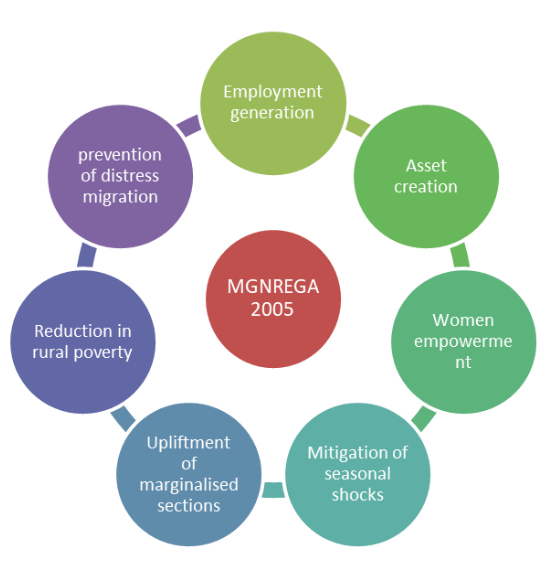
Objectives of MGNREGS:
-
- Enhance livelihood security of rural households.
- Create durable assets such as water conservation structures, land development works, and rural infrastructure.
- Strengthen natural resource management.
- Promote inclusive development and reduce distress-driven rural-to-urban migration.
- Empower marginalized groups including SCs, STs, women, and small or marginal farmers.
- Enhance livelihood security of rural households.
Key Features of MGNREGS:
1. Rights-Based Framework: Provides a legal guarantee of wage employment—unique globally.
2. Demand-Driven Approach: Employment is provided upon request; workers are entitled to unemployment allowance if work is not provided within 15 days.
3. Universal Rural Coverage: Open to all rural households without income criteria.
4. Minimum 100 Days of Work: States may offer additional days using their own funds.
5. Social Audits: Conducted by Gram Sabhas to ensure transparency and accountability.
6. Time-Bound Wage Payments: Wages must be paid within 15 days; delays require compensation.
7. Women’s Participation: At least one-third of workers must be women; many states exceed 50%.
8. Decentralized Planning: Gram Sabhas and Panchayats play a central role in planning, prioritizing, and monitoring works.



