
Context:
Mexico has recently announced the imposition of import tariffs of up to 50% on goods imported from India, China and other Asian countries. These tariffs will be effective on countries, including India, with which Mexico does not have a free trade agreement (FTA). The decision will come into effect from 1 January 2026 and is expected to impact more than 1,400 products. This move reflects the growing trend of protectionism in the global trading system.
Key Reasons behind Mexico’s Decision:
-
-
- Protection of Domestic Industry: In recent years, the increasing inflow of low-cost industrial goods from Asian countries, particularly India and China has put significant pressure on Mexico’s domestic manufacturing base. As a result, sectors such as MSMEs, auto parts, textiles, steel, and plastics have been adversely affected. Higher tariffs are intended to shield domestic producers from intense price competition and safeguard local industries.
- Employment Protection and Social Stability: Manufacturing is a major source of employment in Mexico. When cheap imports undermine the competitiveness of local industries, the consequences are often seen in the form of job losses and wage pressures. By raising tariffs, the Mexican government aims to encourage domestic production and protect local employment. This measure is not purely economic in nature; it is also linked to social stability and political considerations, as rising unemployment can fuel internal discontent.
- Geo-economic Strategy: Mexico’s decision is also viewed as part of a broader geo-economic strategy. Under the United States–Mexico–Canada Agreement (USMCA), Mexico is a crucial component of the North American supply chain. By imposing higher tariffs on Asian imports, Mexico seeks to strengthen regional production networks and concentrate manufacturing activities within North America. This approach aligns with global trends such as supply chain fragmentation, re-shoring, and near-shoring.
- Impact of Global Protectionist Trends: Mexico’s move is influenced by the broader global shift toward protectionism. The United States and Europe have already increased tariffs and non-tariff barriers in the name of national security, employment protection, and safeguarding strategic industries. This trend is now extending to Latin America as well. The declining effectiveness of the WTO-based multilateral trading system has encouraged countries to adopt more unilateral and interest-driven trade policies, and Mexico’s decision is part of this global pattern.
- Protection of Domestic Industry: In recent years, the increasing inflow of low-cost industrial goods from Asian countries, particularly India and China has put significant pressure on Mexico’s domestic manufacturing base. As a result, sectors such as MSMEs, auto parts, textiles, steel, and plastics have been adversely affected. Higher tariffs are intended to shield domestic producers from intense price competition and safeguard local industries.
-
Possible Impact on India:
-
-
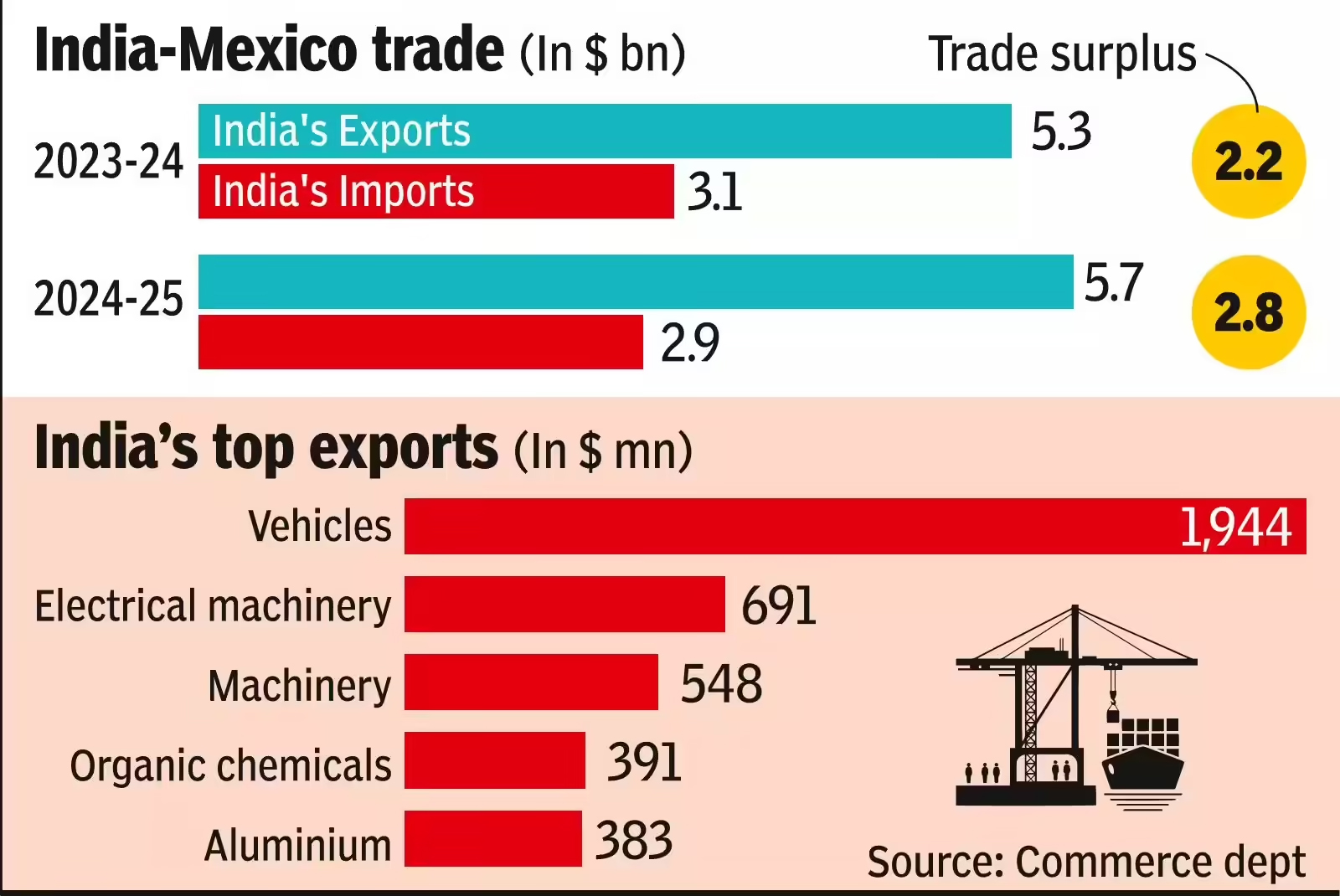
- Decline in Export Competitiveness: Indian goods will become more expensive in the Mexican market, potentially reducing their demand. Sectors likely to be affected include auto components, steel and metal products, chemicals and plastics and textiles.
- Impact on India’s Latin America Strategy: Mexico is regarded as a gateway for India into Latin American markets. Higher tariffs could weaken India’s export diversification strategy in the region.
- Setback to the “China + 1” Strategy: Global companies have been seeking alternatives to China by viewing countries like India as potential manufacturing hubs. However, the imposition of high, uniform tariffs on Asian countries may reduce India’s relative cost advantage and market access, thereby limiting the competitive edge India aims to build as an alternative to China.
- Decline in Export Competitiveness: Indian goods will become more expensive in the Mexican market, potentially reducing their demand. Sectors likely to be affected include auto components, steel and metal products, chemicals and plastics and textiles.
-
Broader Global and Policy Implications:
Mexico’s decision highlights the declining relevance of the WTO-based multilateral trading order. Unilateral tariff hikes undermine principles such as Most Favoured Nation (MFN) in practice. Moreover, the rise of trade barriers among developing countries themselves sends a negative signal for South–South cooperation. Overall, this trend underscores the growing regionalisation of global value chains.
Conclusion:
The imposition of high tariffs by Mexico on India and other Asian countries is a clear indicator of shifting global economic politics. It demonstrates that the ideal of free trade is increasingly being shaped by national interests and strategic priorities. For India, this development underscores the need for active trade diplomacy, improved export competitiveness and greater market diversification in order to safeguard its trade interests in an increasingly protectionist global environment.



