
Context:
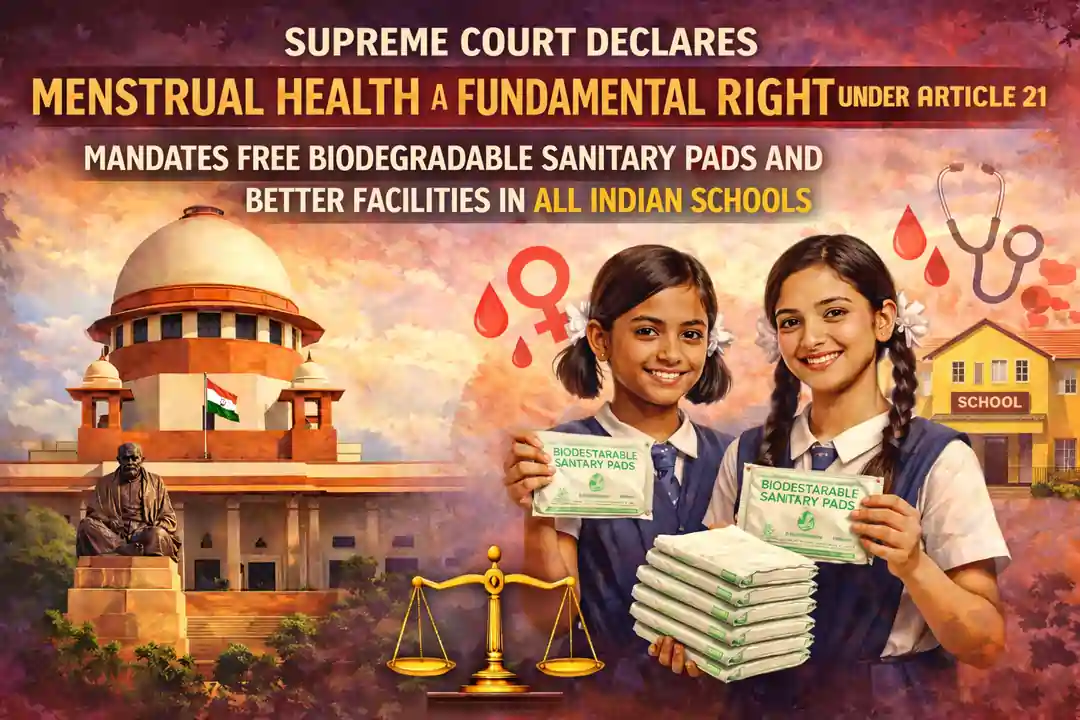
The Supreme Court of India recently delivered a landmark judgment in Dr. Jaya Thakur v. Union of India & Others, declaring menstrual health and hygiene an integral part of the right to life, dignity, and bodily autonomy under Article 21 of the Constitution. This decision is not merely the recognition of a public health concern; rather, it significantly advances the constitutional jurisprudence of gender equality and social justice in India.
-
-
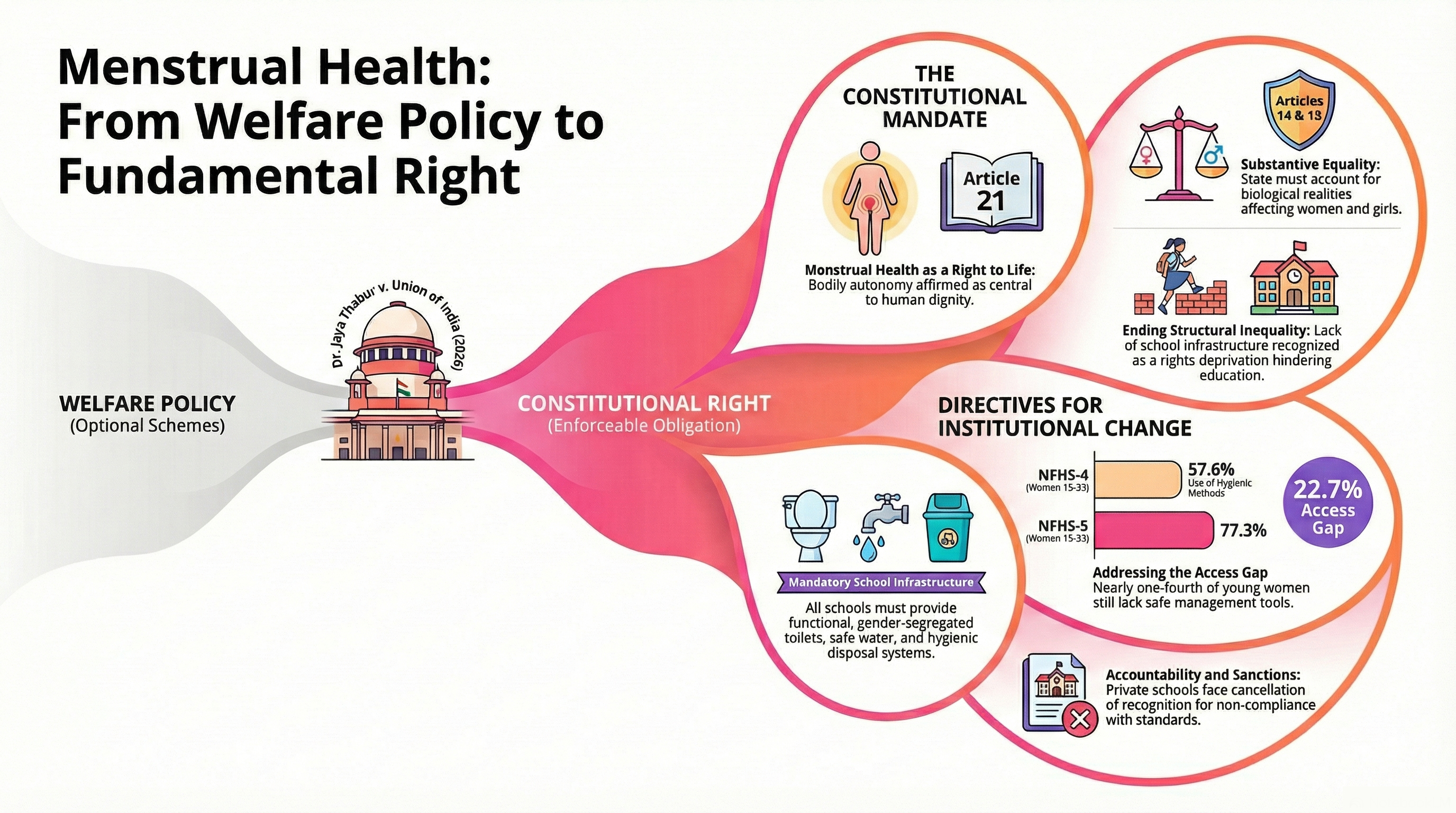
- By doing so, the Court has elevated menstrual health from the domain of welfare schemes and policy initiatives to an enforceable fundamental right. This shift is not symbolic but structural, as the responsibility of the State now extends beyond policy formulation to constitutional accountability.
- By doing so, the Court has elevated menstrual health from the domain of welfare schemes and policy initiatives to an enforceable fundamental right. This shift is not symbolic but structural, as the responsibility of the State now extends beyond policy formulation to constitutional accountability.
-
Constitutional Basis:
-
-
- The interpretation of “life” under Article 21 has evolved over time. The Court has consistently expanded it beyond mere physical existence to include the right to live with dignity. In this continuum, linking menstrual health with dignity and bodily autonomy affirms that ignoring biological realities renders the concept of equality hollow.
- The Court clarified that the absence of safe toilets, clean water, menstrual hygiene products, and proper disposal systems during menstruation amounts to a violation of a girl’s dignity, privacy, and equal opportunity. Therefore, the judgment must be read in conjunction with Article 14 (Right to Equality) and Article 15 (Prohibition of Discrimination on Grounds of Sex).
- This reasoning builds upon earlier constitutional precedents such as Suchita Srivastava v. Chandigarh Administration and K.S. Puttaswamy v. Union of India, where bodily autonomy and privacy were recognized as central to fundamental freedoms. Menstrual health must be understood as a continuation of these constitutional principles.
- The interpretation of “life” under Article 21 has evolved over time. The Court has consistently expanded it beyond mere physical existence to include the right to live with dignity. In this continuum, linking menstrual health with dignity and bodily autonomy affirms that ignoring biological realities renders the concept of equality hollow.
-
Structural Inequality:
-
-
- A significant aspect of the judgment is the Court’s recognition that menstrual challenges are not merely personal inconveniences or social taboos but manifestations of structural rights deprivation.
- Many girls studying in rural and government schools are compelled to miss classes during menstruation due to the absence of separate toilets, safe water, access to sanitary products, and proper waste disposal systems.
- Thus, the lack of menstrual infrastructure is not merely a health issue; it directly affects education, economic opportunity, and the constitutional promise of equal citizenship. By acknowledging this reality, the Court linked menstrual health to the right to education and dignity.
- A significant aspect of the judgment is the Court’s recognition that menstrual challenges are not merely personal inconveniences or social taboos but manifestations of structural rights deprivation.
-
Education, Equality and Substantive Equality:
-
-
- The classical notion of equality rests on the principle of “treating equals equally.” However, the Court observed that ignoring biological and social differences can deepen real inequality.
- By connecting menstrual health to the right to education, the Court strengthened the doctrine of substantive equality. This implies that the State must account for conditions that uniquely affect women and girls.
- At the international level, the Convention on the Elimination of All Forms of Discrimination Against Women (CEDAW) and UN Special Rapporteurs on water and sanitation have emphasized that menstrual hygiene is essential for gender equality and the right to education. In this respect, the Indian Supreme Court’s ruling aligns with global human rights discourse.
- The classical notion of equality rests on the principle of “treating equals equally.” However, the Court observed that ignoring biological and social differences can deepen real inequality.
-
Court Directions:
-
-
- The Court went beyond mere declaration and issued clear directives to States and Union Territories:
- Ensure functional and gender-segregated toilets in all schools.
- Provide safe water, hygienic disposal systems, and access to menstrual hygiene products.
- Hold government schools accountable through State responsibility and permit cancellation of recognition of non-compliant private schools.
- Ensure functional and gender-segregated toilets in all schools.
- These directions clearly demonstrate that the Court has attempted to mandate implementation. This decision goes beyond policy advice and calls for a responsibility-based administrative structure.
- The Court went beyond mere declaration and issued clear directives to States and Union Territories:
-
Challenges:
-
-
- India’s constitutional experience demonstrates that judicial recognition of rights alone is insufficient; effective implementation is crucial.
- According to the National Family Health Survey (NFHS-5), the percentage of women aged 15–24 using hygienic methods during menstruation increased from 57.6% in NFHS-4 to 77.3% in NFHS-5. While this progress is commendable, nearly one-fourth of young women still lack access to safe menstrual management.
- Similarly, under the Swachh Bharat Mission, the Ministry of Drinking Water and Sanitation issued guidelines on Menstrual Hygiene Management. However, implementation has often been inconsistent and project-based rather than sustained. After menstrual health is recognised as a fundamental right, the biggest challenge is its effective implementation. The main challenges are as follows:
- Lack of infrastructure: Many schools have toilets but they are not functional. Lack of water, soap, safe disposal facilities, and privacy leads to girls missing school during menstruation.
- Lack of financial commitment: Menstrual hygiene programs are often project-based and lack consistent budgeting, monitoring, and social audits. According to the National Family Health Survey (NFHS-5), the use of hygienic methods has increased to 77.3%, yet nearly one-quarter of young women remain deprived, reflecting structural inequalities.
- Social taboos: The stigma and silence surrounding menstruation impact girls' self-confidence, education, and social participation.
- Environmental challenges: Waste management is also a significant issue, as is the lack of safe and environmentally friendly disposal mechanisms.
- Lack of infrastructure: Many schools have toilets but they are not functional. Lack of water, soap, safe disposal facilities, and privacy leads to girls missing school during menstruation.
- India’s constitutional experience demonstrates that judicial recognition of rights alone is insufficient; effective implementation is crucial.
-
Conclusion:
Menstruation has long been treated as a private matter. This judgment transforms it into a matter of public rights and institutional responsibility. It forms part of the broader judicial trend expanding Article 21 to include mental health, reproductive autonomy, disability access, and environmental health within the framework of dignified life. By constitutionally protecting menstrual health, the Court addresses a historically neglected dimension of gender inequality rooted not in explicit legal discrimination but in institutional neglect.
The Central and State governments must treat menstrual health not as ancillary welfare expenditure but as essential public health investment. Without sustained financial commitment, community awareness, and school-level monitoring, the right will remain incomplete. Ultimately, this decision strengthens the democratic promise of equal citizenship. If effectively implemented, it will mark not merely progress in menstrual health policy but a decisive step toward dignity, equality, and constitutional morality.
|
UPSC/PCS Mains Practice Question: |



