
Context:
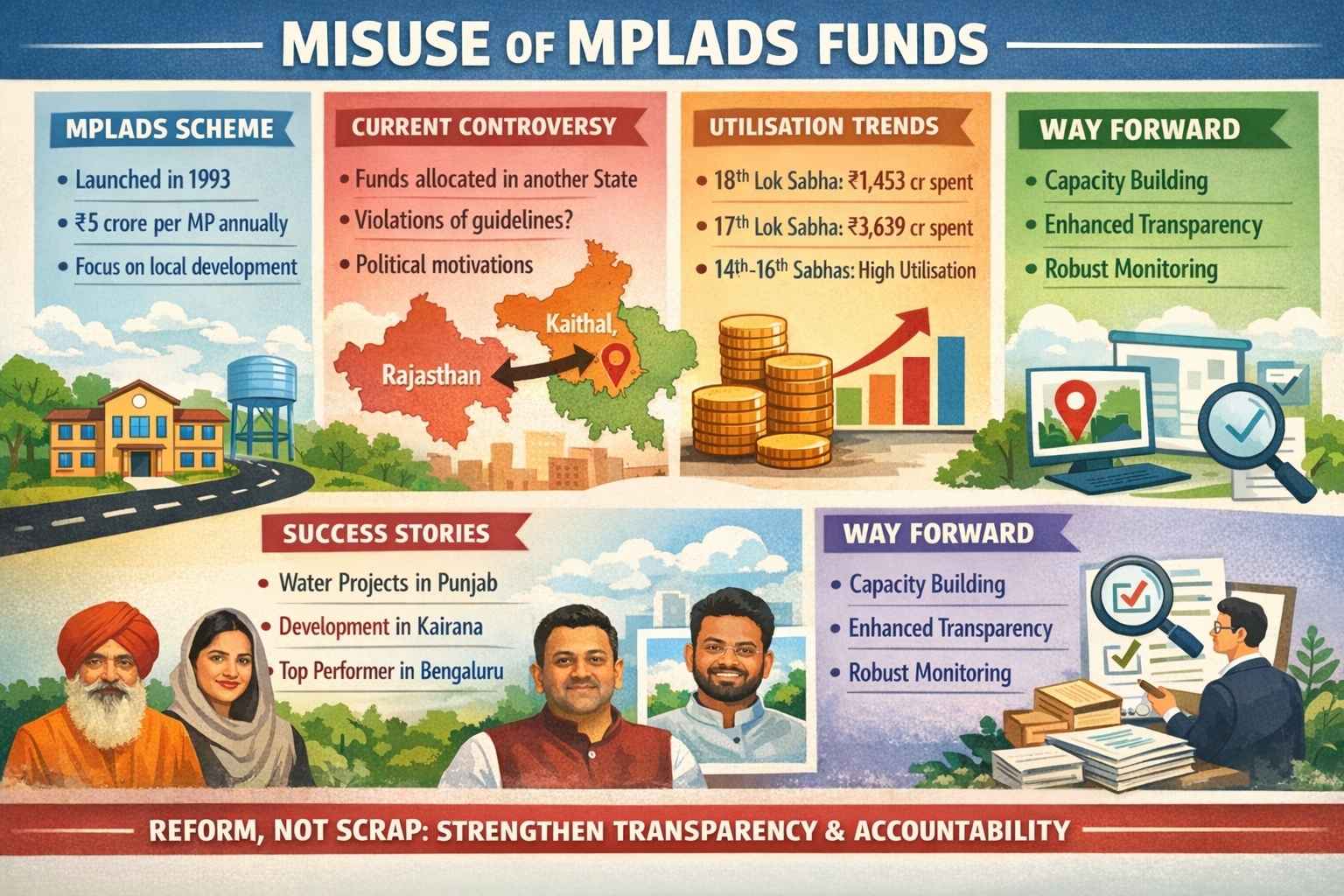
Recently, the use of MPLADS funds has come under political scrutiny. Allegations were made against some Members of Parliament (MPs) for allocating funds outside their constituencies, sparking debates over compliance with the scheme’s guidelines. While critics have called for the discontinuation of MPLADS, supporters have argued for its continuation with reforms to improve transparency and fund utilisation. This discussion has renewed attention on the scheme’s role in grassroots development.
About the MPLADS Scheme:
-
-
- Launch and Funding: MPLADS was launched in December 1993 as a Central Sector Scheme, fully funded by the Government of India.
- Allocation: Each MP can recommend works worth ₹5 crore annually for the development of their constituency.
- Permissible Projects: The scheme focuses on the creation of durable community assets such as roads, drinking water facilities, school buildings, and community centres.
- Works Outside the Constituency: MPs may recommend projects worth up to ₹50 lakh outside their constituency or state in a financial year. In cases of severe natural calamities, this limit is enhanced to ₹1 crore.
- Implementation and Monitoring: Projects are implemented by district authorities, with progress monitored through the MPLADS online dashboard.
- Launch and Funding: MPLADS was launched in December 1993 as a Central Sector Scheme, fully funded by the Government of India.
-
Benefits of MPLADS:
-
-
- Localised Development: Enables MPs to address the specific developmental needs of their constituencies in areas such as infrastructure, water supply, education, and health.
- Rapid Response: Allows quick allocation of funds for urgent community requirements and time-sensitive projects.
- Public Accountability: Digital dashboards with geotagged photographs enable citizens to verify the completion and quality of works.
- Political Incentive for Development: Encourages MPs to deliver tangible benefits to their electorate, thereby strengthening representative accountability.
- Flexibility in Emergencies: Permits allocations outside constituencies during natural disasters, facilitating timely relief and rehabilitation efforts.
- Historical Utilisation: Past data indicate high utilisation rates across several Lok Sabhas, with many MPs effectively deploying funds for social welfare and infrastructure development.
- Localised Development: Enables MPs to address the specific developmental needs of their constituencies in areas such as infrastructure, water supply, education, and health.
-
Conclusion:
MPLADS remains a vital instrument for constituency-level development. Allegations of misuse or delays in fund utilisation point to implementation challenges rather than inherent flaws in the scheme itself. Scrapping MPLADS would deprive MPs of a crucial mechanism for addressing local development gaps. Instead, targeted reforms, such as enhanced transparency, capacity-building workshops for MPs, and streamlined project approval processes can strengthen the scheme’s effectiveness and ensure that public funds continue to benefit communities across India.



