
Context:
Recently, the Government of Meghalaya launched Mission Clouded Leopard, a dedicated conservation programme for the mainland clouded leopard (Neofelis nebulosa), the State animal of Meghalaya. The mission will be implemented under the Meghalaya Clouded Leopard Action Plan, which is being prepared by the State Forest and Environment Department.
Why was the Mission Launched?
-
-
- The Mission aims to address the growing threats faced by the clouded leopard and its habitat. The key reasons include:
- Habitat loss and fragmentation due to shifting cultivation (Jhum), deforestation, mining, and infrastructure development.
- Illegal poaching for its distinctive cloud-patterned skin and body parts.
- Declining forest connectivity, affecting movement and genetic diversity.
- Need for scientific monitoring through camera traps and environmental DNA (eDNA).
- Habitat loss and fragmentation due to shifting cultivation (Jhum), deforestation, mining, and infrastructure development.
- Promotion of community-led conservation in the biodiversity-rich forests of Northeast India.
- The Mission focuses on habitat protection and restoration, scientific research, long-term monitoring, stronger anti-poaching measures, landscape connectivity, capacity building of frontline forest staff, public awareness, and local community participation.
- The Mission aims to address the growing threats faced by the clouded leopard and its habitat. The key reasons include:
-
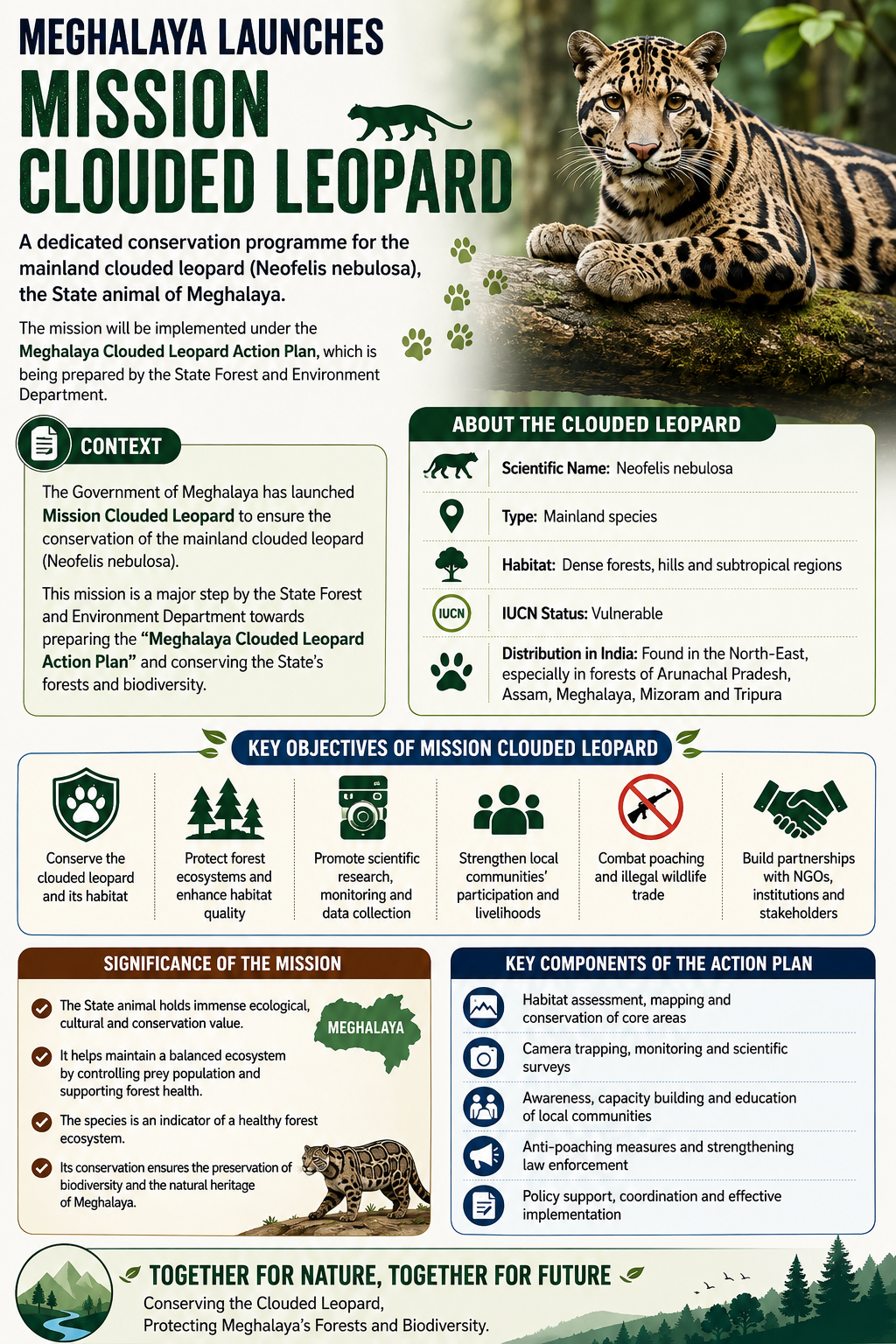
About the Clouded Leopard (Neofelis nebulosa):
The Clouded Leopard is an evolutionarily ancient, medium-sized wild cat that forms an important evolutionary link between big cats (Panthera) and small cats (Felinae). It is considered an indicator species, reflecting the ecological health of tropical forest ecosystems.
Distribution and Habitat:
-
-
- Global Distribution: Himalayan foothills, mainland Southeast Asia, and Southern China.
- Indian Distribution: Northeastern states including Arunachal Pradesh, Assam, Meghalaya, Mizoram, Nagaland, Manipur, Tripura, and northern West Bengal.
- Habitat: Dense tropical evergreen forests, subtropical forests, and dry woodlands up to 7,000 feet.
- Important Habitats: Namdapha National Park (Arunachal Pradesh) and Dampa Tiger Reserve (Mizoram) are among the most important habitats for the species.
- Global Distribution: Himalayan foothills, mainland Southeast Asia, and Southern China.
-
Key Characteristics:
-
-
- Highly arboreal and nocturnal.
- Possesses rotating rear ankles, enabling it to descend trees head-first.
- Has the longest upper canine teeth relative to skull size among living cats, earning it the nickname "modern sabre-tooth."
- Its long tail provides excellent balance while moving through tree canopies.
- It is the State Animal of Meghalaya.
- Highly arboreal and nocturnal.
-
Conservation Status:
-
-
- IUCN Red List: Vulnerable
- CITES: Appendix I
- Wildlife (Protection) Act, 1972: Schedule I (Highest legal protection)
- IUCN Red List: Vulnerable
-
Conclusion:
Mission Clouded Leopard represents a landmark initiative in India's wildlife conservation efforts by combining scientific research, habitat restoration, and community participation. As an indicator of healthy forest ecosystems, conserving the clouded leopard will also help protect the biodiversity of the Northeast.



