
Maternity Leave for Adoptive Mothers
Context:
Recently, The Supreme Court of India granted 12 weeks of maternity leave to all adoptive mothers, irrespective of the child’s age. The ruling struck down the provisions of Maternity Benefit Act, 1961 and social security code, 2020, which currently limits maternity benefits for adoptive mothers only 3 month old Childs.
Background of the Issue:
-
-
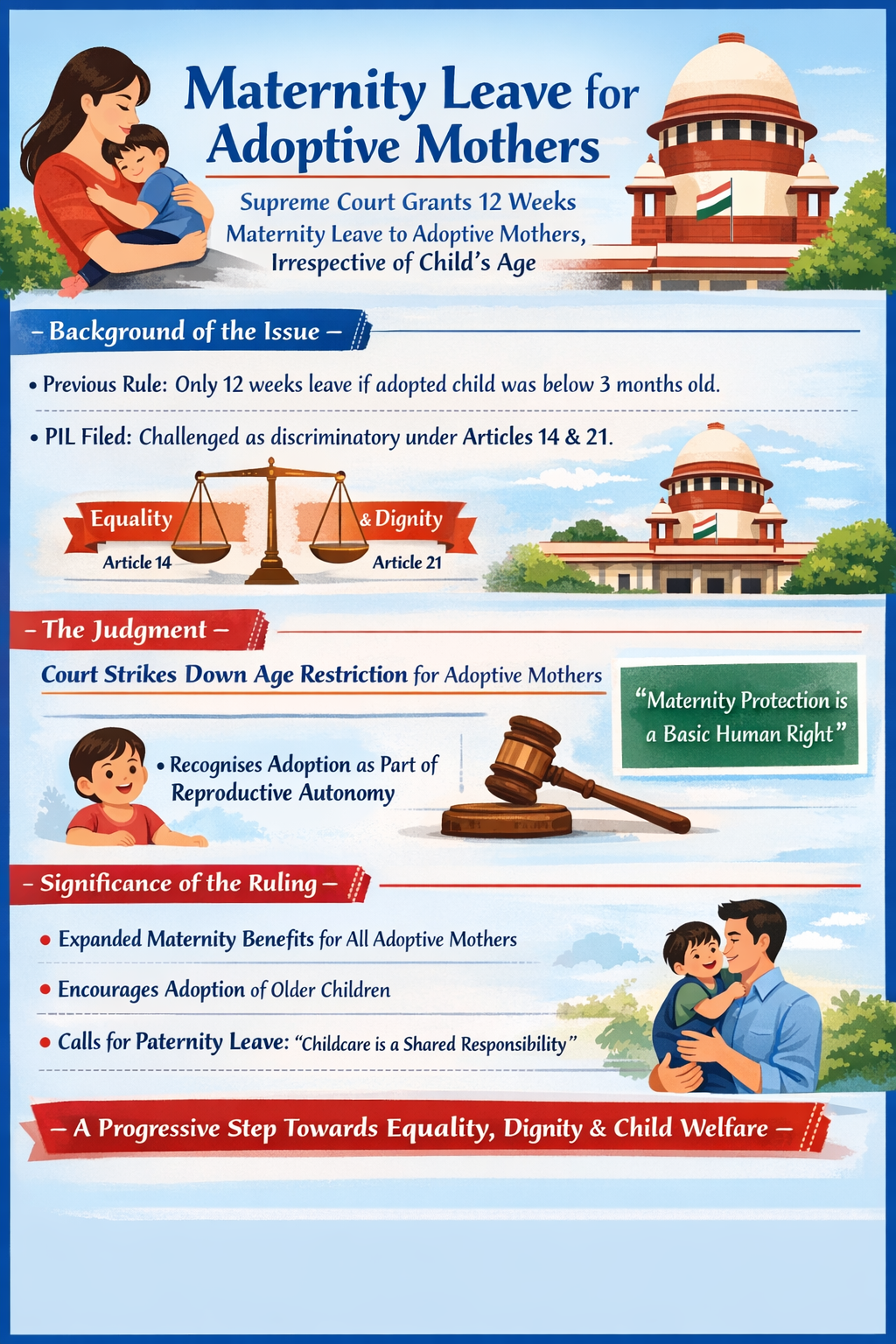
- The case before the Supreme Court of India arose from concerns over discriminatory provisions governing maternity benefits for adoptive mothers. Under Section 5(4) of the Maternity Benefit Act, 1961 and similar provisions in the Code on Social Security, 2020, adoptive mothers were entitled to only 12 weeks of maternity leave if the adopted child was below three months of age. This created an arbitrary classification, excluding adoptive mothers of older children from availing maternity benefits.
- A Public Interest Litigation (PIL) challenged this provision as violative of Articles 14 and 21 of the Constitution, arguing that it discriminated against adoptive mothers and failed to recognise their caregiving responsibilities. It also highlighted that adoption procedures under the Juvenile Justice Act, 2015 are often time-consuming, making it difficult to adopt infants below three months, thereby rendering the benefit ineffective for most adoptive parents.
- The case before the Supreme Court of India arose from concerns over discriminatory provisions governing maternity benefits for adoptive mothers. Under Section 5(4) of the Maternity Benefit Act, 1961 and similar provisions in the Code on Social Security, 2020, adoptive mothers were entitled to only 12 weeks of maternity leave if the adopted child was below three months of age. This created an arbitrary classification, excluding adoptive mothers of older children from availing maternity benefits.
-
About the Judgment:
-
-
- The Court removed the age-based restriction for adoptive mothers by reading down Section 60(4) of the Code, holding it violative of Articles 14 and 21 of the Constitution. It emphasized that maternity benefits are linked to caregiving responsibilities rather than childbirth alone, thereby recognising adoption as part of reproductive autonomy.
- Importantly, the judgment termed maternity protection a “basic human right,” essential for economic security and workplace inclusion. The Court also highlighted the need for paternity leave, noting that childcare is a shared responsibility and that its absence reinforces gender stereotypes. This interpretation strengthens constitutional values of equality, dignity, and substantive justice.
- The Court removed the age-based restriction for adoptive mothers by reading down Section 60(4) of the Code, holding it violative of Articles 14 and 21 of the Constitution. It emphasized that maternity benefits are linked to caregiving responsibilities rather than childbirth alone, thereby recognising adoption as part of reproductive autonomy.
-
Significance of judgement:
The judgment of the Supreme Court of India is significant as it expands maternity benefits to adoptive mothers without age restrictions, promoting substantive equality under Article 14 and dignity under Article 21. By recognising motherhood beyond biological childbirth, it adopts a care-centric approach to parental rights. It also strengthens child welfare by encouraging adoption of older children. Further, the Court’s push for paternity leave highlights the need for gender-neutral caregiving policies. Overall, the ruling advances gender justice, workplace inclusion, and aligns labour laws with constitutional values and evolving social realities.
Conclusion:
The judgment marks a progressive shift from a biological understanding of motherhood to a caregiving-based approach. By striking down the age cap, the Supreme Court has reaffirmed that maternity benefits are rooted in dignity, equality, and child welfare, not merely childbirth.



