
Context:
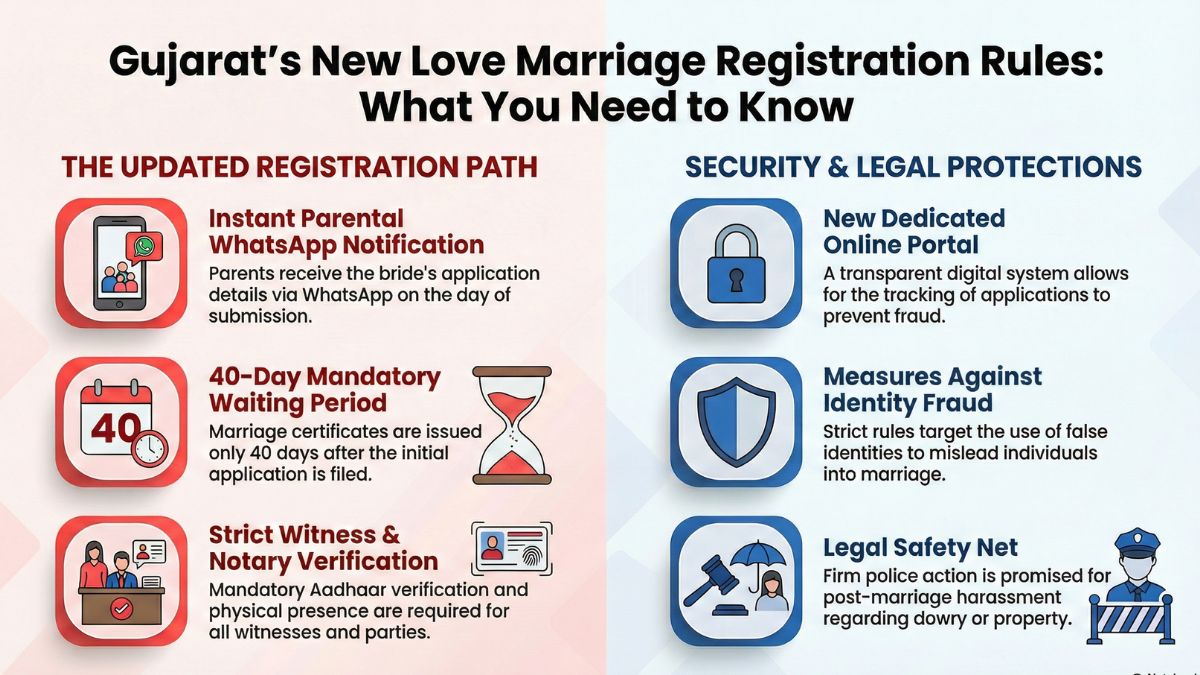
Recently, the Gujarat government has proposed amendments to the Gujarat Registration of Marriages Act, 2006 that would mandate parental notification and declaration of consent for all marriage registrations. Under the draft rules, couples must state whether they have informed their parents before applying, provide their parents’ contact and identity details, and registrars would be required to formally notify families during the process, with a 30-day waiting period before registration can be completed. This would make Gujarat the first state in India to move towards state-mandated parental involvement in adult marriages.
Government’s Rationale:
-
-
- The government has defended the move as a measure to prevent fraud, elopement, and misuse of marriage registration procedures, particularly in cases where false identities or coercion might be involved.
- The proposals come amid concerns raised in the Assembly and consultations with community groups, and aim to enhance transparency in the process. The state government insists that it is not opposed to genuine love marriages, but seeks to act against deception and exploitation.
- The government has defended the move as a measure to prevent fraud, elopement, and misuse of marriage registration procedures, particularly in cases where false identities or coercion might be involved.
-
Legal and Constitutional Challenges:
-
-
- Critics argue that the proposal conflicts with constitutional liberties, especially Article 21 (protection of life and personal liberty), which the Supreme Court has interpreted to include the right to choose a partner and marry by one’s own choice without external interference.
- In cases such as Shafin Jahan v. Ashokan (the Hadiya case, 2018) and Laxmibai Chandaragi B v. State of Karnataka (2021), the Supreme Court reiterated that the consent of family or community is not necessary for adult marriages, and that the freedom to marry is intrinsic to dignity.
- Legal experts point out that while the Special Marriage Act, 1954 requires a 30-day notice before solemnisation, it does not mandate parental consent for adults. Any state law seeking to require such consent could therefore be challenged as violative of fundamental rights.
- Critics argue that the proposal conflicts with constitutional liberties, especially Article 21 (protection of life and personal liberty), which the Supreme Court has interpreted to include the right to choose a partner and marry by one’s own choice without external interference.
-
Arguments on Both Sides:
-
-
- Supporters of the draft rules frame them as protective mechanisms, emphasising family involvement and the prevention of deception.
- Opponents, including editorial voices and civil liberties commentators, argue that the scheme is regressive, paternalistic, and undermines individual autonomy, particularly that of women by implying that adults lack the capacity to choose partners independently. They contend that it risks reintroducing family veto into a sphere of life where the judiciary has expressly rejected it.
- Supporters of the draft rules frame them as protective mechanisms, emphasising family involvement and the prevention of deception.
-
Conclusion:
The Gujarat proposal to mandate parental consent or notification for marriage registration highlights a clash between state policy and constitutional freedoms. While the government frames the rule as a protective measure, Supreme Court jurisprudence firmly upholds an adult couple’s right to choose a partner as part of personal liberty under Article 21. Any law that effectively places familial approval above individual autonomy risks contravening established constitutional principles.



