
Context:
During the India AI Impact Summit 2026 in New Delhi, Prime Minister Narendra Modi unveiled MANAV Vision for AI governance in India. India is positioning itself as a global leader in responsible AI development, especially from the perspective of the Global South.
Components of MANAV Vision:
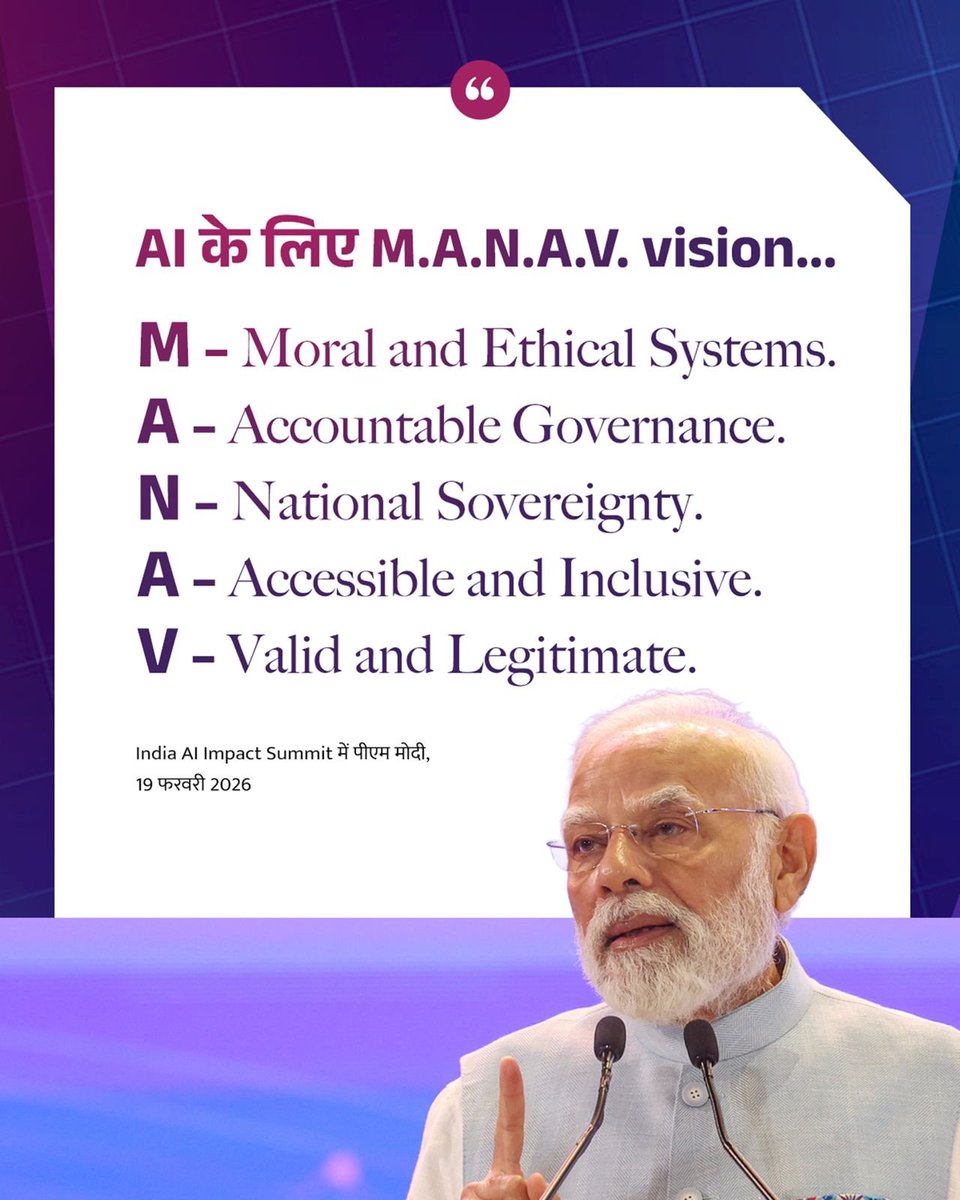
The acronym MANAV represents five guiding principles for AI in India:
-
-
- M — Moral and Ethical Systems: AI must be guided by ethical frameworks, ensuring decisions respect human rights, societal norms, and moral accountability.
- A — Accountable Governance: AI governance should be transparent and robust, with clear rules, oversight mechanisms, and mechanisms to hold developers and operators responsible.
- N — National Sovereignty: Data belonging to individuals or nations should be protected, reinforcing the principle of data ownership and sovereignty — “whose data, his right.”
- A — Accessible and Inclusive: AI should benefit all citizens, enabling wide participation rather than creating monopolies. Equity, accessibility, and democratization are key.
- V — Valid and Legitimate: AI applications must be lawful, verifiable, and scientifically sound, ensuring trust, accountability, and legitimacy in real-world deployment.
- M — Moral and Ethical Systems: AI must be guided by ethical frameworks, ensuring decisions respect human rights, societal norms, and moral accountability.
-
Significance of MANAV Vision:
-
-
- Positions India as a global leader in responsible AI, particularly in the Global South.
- Promotes human-centric AI that prioritizes welfare, fairness, and ethical governance.
- Balances innovation with regulation, ensuring AI development is safe, transparent, and socially beneficial.
- Provides a framework for international cooperation, emphasizing values-based AI in a rapidly evolving technological world.
- Positions India as a global leader in responsible AI, particularly in the Global South.
-
India’s Strategic Approach to AI:
-
-
- Inclusive and Socially Useful AI: Through the IndiaAI Mission, the government promotes fairness, inclusivity, and social utility, using AI to bridge urban–rural divides and enhance healthcare, education, and livelihoods.
- Practical Applications: In the dairy sector, AI initiatives through Amul benefit over 36 lakh women workers, improving productivity and strengthening incomes.
- Employment & Skilling: AI is framed as a transformative tool, not a threat, with large-scale skilling programs preparing the workforce for technological change.
- Inclusive and Socially Useful AI: Through the IndiaAI Mission, the government promotes fairness, inclusivity, and social utility, using AI to bridge urban–rural divides and enhance healthcare, education, and livelihoods.
-
Global AI Frameworks & Collaboration:
Governance is shifting to inclusive frameworks addressing bias, digital colonization, and the North–South divide.
Key initiatives:
-
-
- Bletchley Park Declaration (2023): 28 nations agreed on frontier AI risks and shared scientific understanding.
- Global Partnership on AI (GPAI, 2024): India led efforts to treat AI as a global public good, supporting the Global South.
- AI Action Summit (Paris, 2025): Focused on responsible deployment and equitable access.
- AI Impact Summit (New Delhi, 2026): Emphasizes People, Planet, and Progress, ensuring AI benefits are widely shared.
- Bletchley Park Declaration (2023): 28 nations agreed on frontier AI risks and shared scientific understanding.
-
Conclusion:
The MANAV Vision marks India’s effort to shape AI policy not merely as a technological roadmap, but as a framework rooted in human welfare, ethical governance, inclusivity, accountability and national interests — integral concerns in contemporary governance debates.



