
Lokpal seeks Supreme Court clarification on prosecution sanction
Context:
Recently, the anti-corruption ombudsman Lokpal of India has approached the Supreme Court of India seeking clarification on the procedure for granting sanction to prosecute public servants under the Lokpal and Lokayuktas Act, 2013.
Background of the Case:
-
-
- The issue emerged after the Delhi High Court ruled that the Act does not require separate sanctions for filing a chargesheet and initiating prosecution. This interpretation created ambiguity regarding the correct procedure under the law, prompting the Lokpal to seek an authoritative interpretation from the Supreme Court.
- The dispute arose in the context of a corruption investigation involving Mahua Moitra in the alleged “cash-for-query” case.
- The Supreme Court has agreed to examine the legal framework governing sanction for prosecution under the Lokpal Act and has temporarily stayed further prosecution in the case until the issue is clarified.
- The issue emerged after the Delhi High Court ruled that the Act does not require separate sanctions for filing a chargesheet and initiating prosecution. This interpretation created ambiguity regarding the correct procedure under the law, prompting the Lokpal to seek an authoritative interpretation from the Supreme Court.
-
Issue Before the Supreme Court:
The central legal issue involves the interpretation of Section 20 of the Lokpal and Lokayuktas Act, 2013.
-
-
- The Court will determine whether:
- Two separate sanctions are required
- One sanction for filing a chargesheet
- Another sanction for initiating prosecution
- One sanction for filing a chargesheet
- Two separate sanctions are required
- The Court will determine whether:
-
OR
-
-
-
- A single composite sanction is sufficient to cover both the filing of chargesheet and initiation of prosecution.
- A single composite sanction is sufficient to cover both the filing of chargesheet and initiation of prosecution.
- The Court is expected to clarify the relationship between Section 20(7)(a) and Section 20(8) of the Act.
-
-
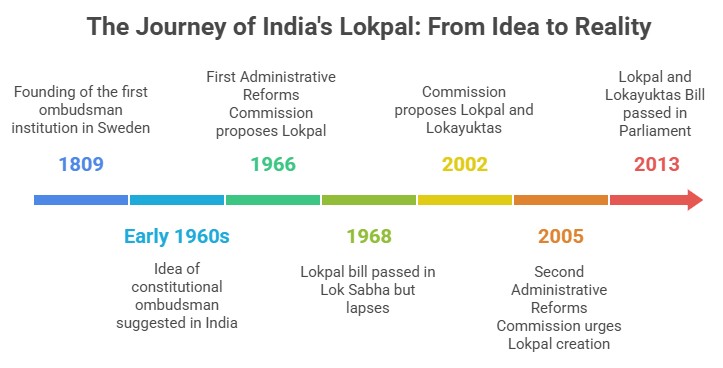
About Lokpal in India:
The idea of an anti-corruption ombudsman was first recommended by the Administrative Reforms Commission in the 1960s to address corruption in public offices. After several attempts, the institution was finally established through the Lokpal and Lokayuktas Act, 2013.
Composition
The Lokpal consists of:
-
-
- A Chairperson (former Chief Justice of India, Supreme Court judge, or eminent person)
- Up to eight members
- At least 50% of members must be judicial members, and 50% must belong to SC/ST/OBC/Minorities/Women categories.
- A Chairperson (former Chief Justice of India, Supreme Court judge, or eminent person)
-
Jurisdiction
The Lokpal can investigate corruption allegations against:
-
-
- The Prime Minister (with certain safeguards)
- Union Ministers
- Members of Parliament
- Group A, B, C and D officials of the central government
- Officials of government-funded NGOs.
- The Prime Minister (with certain safeguards)
-
Powers and Functions
-
-
- Order preliminary inquiries through agencies such as the Central Vigilance Commission or the CBI.
- Supervise investigations conducted by the CBI.
- Initiate prosecution through its prosecution wing in designated special courts.
- Order preliminary inquiries through agencies such as the Central Vigilance Commission or the CBI.
-
Conclusion:
The interpretation of sanction provisions by the Supreme Court will play a crucial role in improving transparency and accountability in governance. By clarifying the powers and procedures under the Lokpal Act, the judgment could help strengthen institutional mechanisms for combating corruption while safeguarding due process.



