
Context:
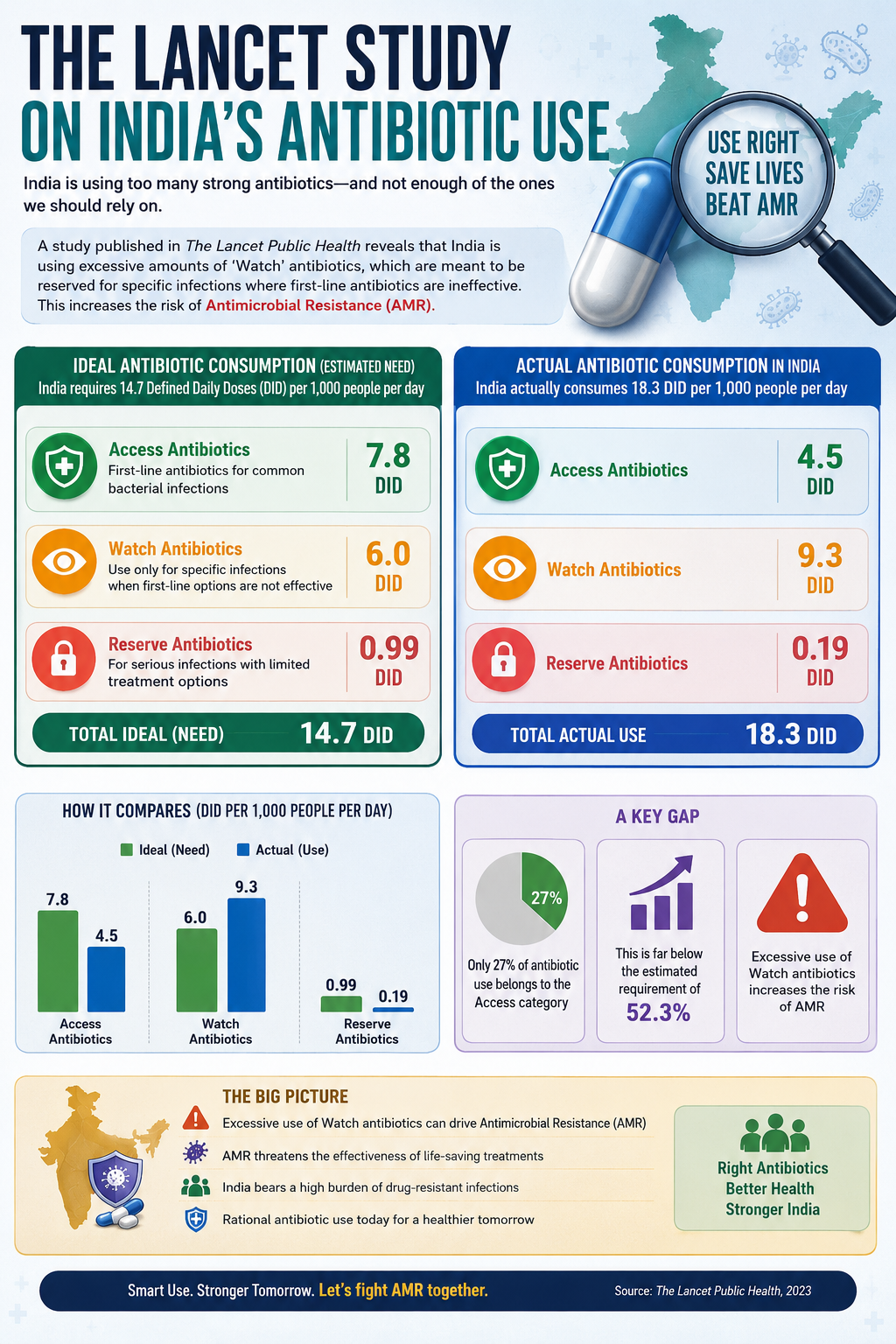
Recently, a study published in The Lancet Public Health revealed that India is using excessive amounts of 'Watch' antibiotics, which are meant to be reserved for specific infections where first-line antibiotics are ineffective. The study highlights concerns over inappropriate antibiotic use, increasing the risk of Antimicrobial Resistance (AMR).
WHO AWaRe Classification of Antibiotics:
The World Health Organization (WHO) classifies antibiotics into three categories under the AWaRe (Access, Watch, Reserve) Framework:
-
-
- Access: First-line antibiotics for common bacterial infections with a lower risk of antimicrobial resistance.
- Watch: Broad-spectrum antibiotics that should be used only for specific infections due to their higher potential to promote antimicrobial resistance.
- Reserve: Last-resort antibiotics used for treating multidrug-resistant (MDR) infections.
- Access: First-line antibiotics for common bacterial infections with a lower risk of antimicrobial resistance.
-
Key Findings for India:
-
-
- The study estimates that India ideally requires 14.7 Defined Daily Doses (DID) of antibiotics per 1,000 people per day, including:
- 7.8 DID of Access antibiotics.
- 6 DID of Watch antibiotics.
- 0.99 DID of Reserve antibiotics.
- 7.8 DID of Access antibiotics.
- However, India's actual antibiotic consumption is 18.3 DID, comprising:
- 4.5 DID of Access antibiotics.
- 9.3 DID of Watch antibiotics.
- 0.19 DID of Reserve antibiotics.
- 4.5 DID of Access antibiotics.
- Only 27% of antibiotic use belongs to the Access category, against the estimated requirement of 52.3%.
- The excessive use of Watch antibiotics indicates that stronger antibiotics are often prescribed unnecessarily, while Reserve antibiotics remain underutilized despite the country's high burden of drug-resistant infections.
- The study estimates that India ideally requires 14.7 Defined Daily Doses (DID) of antibiotics per 1,000 people per day, including:
-
Global Findings:
-
-
- The study analysed antibiotic use across 186 countries and territories.
- 72% of countries used more antibiotics than estimated to be necessary.
- 99% of countries overused antibiotics that contribute significantly to antimicrobial resistance.
- 60% continued to use antibiotics that the WHO no longer recommends for routine use.
- Globally, about 77% of antibiotic use should come from the Access category, supporting the UN target of 70% Access antibiotic use by 2030.
- The study analysed antibiotic use across 186 countries and territories.
-
Concerns in India:
-
-
- According to the National Centre for Disease Control (NCDC) Point Prevalence Survey (2021–22):
- Nearly three out of four hospitalized patients received antibiotics.
- 57% of prescriptions were Watch antibiotics, 38% were Access antibiotics, and 2% were Reserve antibiotics.
- Only 6% of antibiotic prescriptions were based on microbiological evidence.
- Excessive use of injectable antibiotics and duplicate antibiotic prescriptions further increase the risk of antimicrobial resistance.
- According to the National Centre for Disease Control (NCDC) Point Prevalence Survey (2021–22):
-
Challenges:
Overuse of broad-spectrum Watch antibiotics.
-
-
- Underuse of first-line Access antibiotics.
- Limited use of Reserve antibiotics for genuine multidrug-resistant infections.
- Inadequate microbiological testing before prescribing antibiotics.
- Rising burden of Antimicrobial Resistance (AMR).
- Underuse of first-line Access antibiotics.
-
Conclusion:
The study highlights the need for rational antibiotic use in India through stronger antimicrobial stewardship, improved diagnostic testing, and adherence to the WHO AWaRe framework. Optimizing antibiotic prescribing practices is essential to combat antimicrobial resistance while ensuring patients receive the most appropriate treatment.



