
Context:
Recently, Lakshadweep was declared a fully literate Union Territory by its Administrator, Praful Patel. The achievement came under the ULLAS–Nav Bharat Saaksharta Karyakram, following special teaching and assessment campaigns in which all identified eligible learners successfully passed the literacy assessment examination.
Background:
-
-
- According to the 2011 Census, Lakshadweep had a literacy rate of approximately 91.85%. An initial survey identified 1,113 adult non-literate persons who required literacy support.
- To address this gap, special initiatives were undertaken, including teaching programmes, home-based learning support, and assessment drives to help eligible learners acquire foundational literacy and numeracy skills. As a result, all identified eligible learners successfully cleared the Foundational Literacy and Numeracy Assessment Test (FLNAT).
- According to the 2011 Census, Lakshadweep had a literacy rate of approximately 91.85%. An initial survey identified 1,113 adult non-literate persons who required literacy support.
-
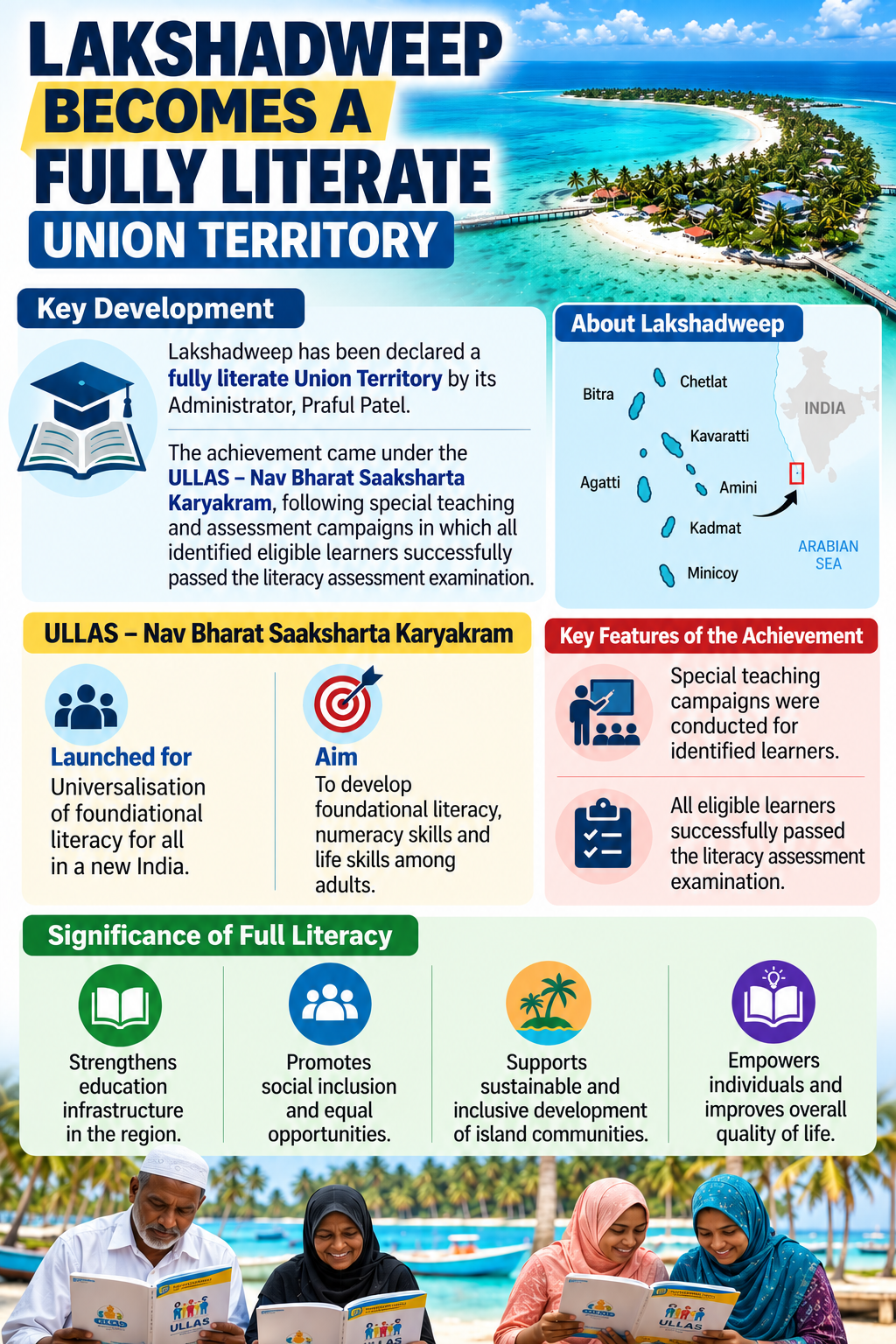
About ULLAS–Nav Bharat Saaksharta Karyakram:
ULLAS stands for Understanding of Lifelong Learning for All in Society. It is a Centrally Sponsored Scheme implemented by the Ministry of Education for non-literate persons aged 15 years and above.
Its major components include:
-
-
- Foundational literacy and numeracy.
- Critical life skills, including digital and financial literacy.
- Basic education.
- Vocational skills development.
- Continuing education.
- Foundational literacy and numeracy.
-
The scheme operates from 2022–23 to 2026–27 and promotes volunteerism, community participation and technology-enabled learning.
Literacy benchmark:
In August 2024, the Ministry of Education defined literacy as the ability to read, write and perform calculations with comprehension, alongside critical life skills such as digital and financial literacy. A literacy rate of 95% or above is considered equivalent to full literacy for a State or Union Territory under the national framework.
Significance of Lakshadweep’s Achievement:
-
-
- Social Empowerment: Literacy enables citizens to understand their rights and government schemes more effectively.
- Economic Development: Financial literacy and basic numeracy help people access employment and livelihood opportunities.
- Digital Inclusion: Digital literacy facilitates access to online services and digital payments.
- Inclusive Development: Adult education provides learning opportunities to people who were deprived of formal education during childhood.
- Sustainable Development Goals: This achievement aligns with Sustainable Development Goal 4 (SDG 4) of the United Nations, which focuses on inclusive and equitable quality education and lifelong learning opportunities.
- Social Empowerment: Literacy enables citizens to understand their rights and government schemes more effectively.
-
Challenges:
Maintaining literacy requires continued learning opportunities, digital access, vocational training and regular assessment. Special attention is also necessary for elderly persons, persons with disabilities and geographically isolated communities.
Conclusion:
Lakshadweep’s achievement of full literacy highlights the importance of adult education, community participation, and targeted learning campaigns. However, lasting success will depend on integrating literacy with digital and financial empowerment, livelihoods, and lifelong learning. This achievement represents an important step towards inclusive development in India and the goal of Viksit Bharat 2047.



