
Context:
Recently, Lieutenant Governor of Ladakh Vinai Kumar Saxena has approved the notification extending Ladakh Autonomous Hill Development Councils (LAHDCs) to all seven districts of the Union Territory. The move aims to strengthen decentralised, participatory and grassroots governance and make development more responsive to local needs.
Background:
-
-
- Ladakh became a Union Territory in 2019 after the reorganisation of the erstwhile State of Jammu and Kashmir. Earlier, elected Autonomous Hill Development Councils existed only in Leh and Kargil.
- In April 2026, five new districts- Sham, Nubra, Changthang, Zanskar and Drass were created. The latest notification extends the LAHDC framework to these new districts.
- Ladakh became a Union Territory in 2019 after the reorganisation of the erstwhile State of Jammu and Kashmir. Earlier, elected Autonomous Hill Development Councils existed only in Leh and Kargil.
-
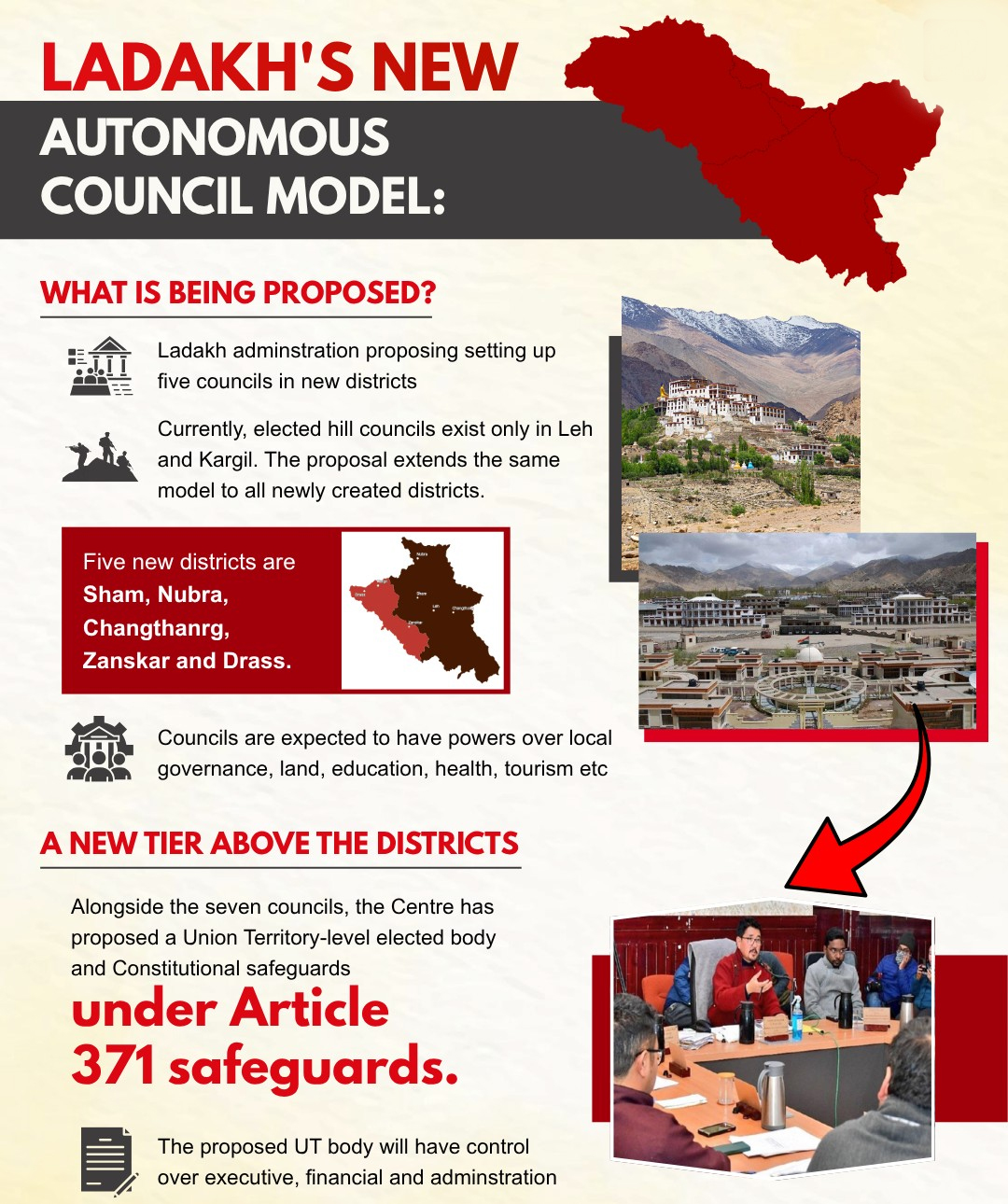
Seven LAHDCs in Ladakh:
Ladakh now has seven Autonomous Hill Development Councils, covering:
1. Leh
2. Kargil
3. Sham
4. Nubra
5. Changthang
6. Zanskar
7. Drass
Thus, the earlier two-council structure has been expanded to all seven districts to promote localised decision-making and decentralisation.
What are LAHDCs?
-
-
- LAHDCs are statutory institutions of local self-governance established to enable local communities to participate in district-level administration and development.
- The councils were created under the Ladakh Autonomous Hill Development Council Act, 1995 framework.
- LAHDCs are statutory institutions of local self-governance established to enable local communities to participate in district-level administration and development.
-
Powers and Functions:
The councils have responsibilities related to:
-
-
- Local and regional development planning
- Economic development and public works
- Education and healthcare
- Land use and certain aspects of land administration
- Public health and sanitation
- Local roads and transport
- Employment generation
- Formulation and implementation of development programmes
- Certain local taxation and revenue-related functions
- Local and regional development planning
-
The councils can therefore play an important role in aligning government programmes with local priorities and regional requirements.
Composition:
-
-
- The councils consist primarily of directly elected representatives, along with provisions for nominated representation, including representation of minority groups and women.
- The existing framework provides for 26 directly elected councillors in each council. The elected councillors choose a Chief Executive Councillor (CEC) from among themselves.
- The councils consist primarily of directly elected representatives, along with provisions for nominated representation, including representation of minority groups and women.
-
Why is it Important?
The expansion is significant because it can:
-
-
- Strengthen grassroots democracy.
- Bring administration closer to remote communities.
- Improve participation in development planning.
- Reflect local aspirations in government policies.
- Promote more inclusive and region-specific development.
- Improve governance in geographically difficult and border areas.
- Strengthen grassroots democracy.
-
Sixth Schedule vs LAHDC:
-
-
- The Sixth Schedule provides constitutional autonomy through Autonomous District and Regional Councils in Assam, Meghalaya, Tripura and Mizoram.
- In contrast, LAHDCs function under a statutory framework. Therefore, LAHDCs do not enjoy the same constitutional status as Sixth Schedule councils.
- The Sixth Schedule provides constitutional autonomy through Autonomous District and Regional Councils in Assam, Meghalaya, Tripura and Mizoram.
-
Challenges:
Key challenges include ensuring:
-
-
- Adequate financial and administrative powers
- Timely elections
- Protection of land and cultural identity
- Sustainable development
- Conservation of the fragile Himalayan ecosystem
- Greater democratic representation
- Adequate financial and administrative powers
-
Conclusion:
The creation of LAHDCs in all seven districts marks an important step towards decentralised and participatory governance in Ladakh. However, effective empowerment will depend on adequate powers, resources and timely elections, along with addressing concerns related to democratic representation, land, culture and environmental protection.



