
Context:
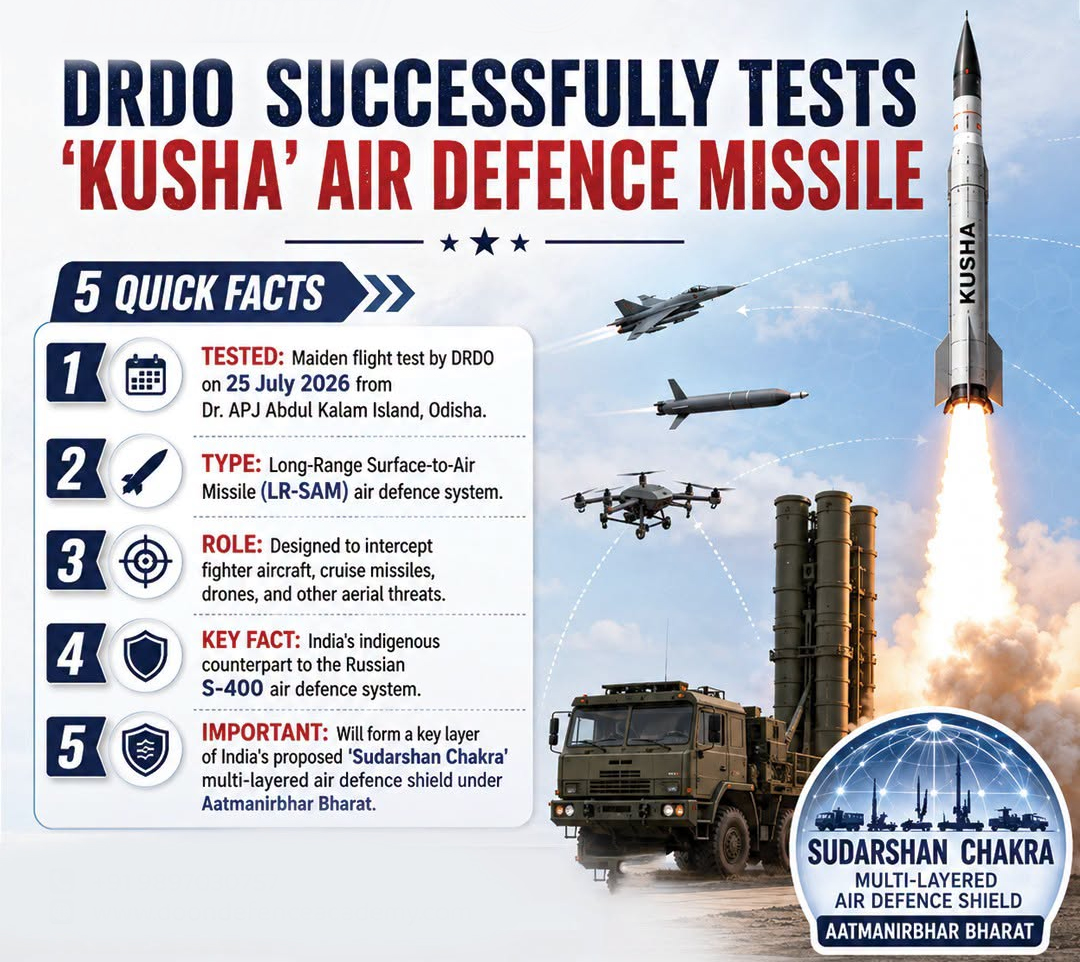
Recently, the Defence Research and Development Organisation (DRDO) successfully conducted the first flight test of the indigenous Kusha Long-Range Surface-to-Air Missile (LR-SAM) from Dr. A.P.J. Abdul Kalam Island, Odisha. The missile successfully intercepted a high-speed aerial target, validating its guidance system, radar integration, and interception capability. This achievement marks a significant milestone in India's indigenous long-range air defence programme under Project Kusha.
About Project Kusha:
-
-
- Project Kusha, also known as the Extended Range Air Defence System (ERADS), is an indigenous long-range Surface-to-Air Missile (SAM) programme being developed by DRDO.
- Its objective is to become the backbone of India's future long-range air defence system while reducing dependence on imported defence systems. Due to its long-range interception capability and multi-layered air defence architecture, it is often compared with Russia's S-400 air defence system.
- The system is designed to defend against the following aerial threats:
- Fighter aircraft
- Stealth aircraft
- Cruise missiles
- Helicopters
- Unmanned Aerial Vehicles (UAVs)/Drones
- Fighter aircraft
- Airborne Early Warning and Control (AEW&C) aircraft
- The system will work in conjunction with India's Ballistic Missile Defence (BMD) programme to provide comprehensive air and missile defence.
- Project Kusha, also known as the Extended Range Air Defence System (ERADS), is an indigenous long-range Surface-to-Air Missile (SAM) programme being developed by DRDO.
-
Key Features of Project Kusha:
-
-
- It includes three types of interceptor missiles:
- M1: Range of 150 km
- M2: Range of 250 km
- M3: Range of 350–400 km
- M1: Range of 150 km
- Provides a multi-layered air defence shield.
- Will be integrated with the Integrated Air Command and Control System (IACCS).
- Uses advanced radars, mobile launchers, and a network-centric command system for real-time target detection, tracking, and interception.
- It is also a key component of Mission Sudarshan Chakra and strengthens the vision of Atmanirbhar Bharat (Self-Reliant India) in the defence sector.
- It includes three types of interceptor missiles:
-
What is Mission Sudarshan Chakra?
-
-
- Project Kusha forms the foundation of Mission Sudarshan Chakra, India's ambitious initiative to establish a nationwide indigenous Air and Missile Defence Shield by 2035.
- The importance of this mission has increased significantly following Operation Sindoor and the recent conflicts in Ukraine and West Asia, which highlighted the growing threats posed by drones, cruise missiles, and ballistic missiles.
- Project Kusha forms the foundation of Mission Sudarshan Chakra, India's ambitious initiative to establish a nationwide indigenous Air and Missile Defence Shield by 2035.
-
Objectives of the Mission
-
-
- Protection of strategic military assets.
- Safeguarding critical civilian infrastructure.
- Establishment of an integrated, multi-layered air defence network.
- Protection of strategic military assets.
-
Difference between S-400 and Project Kusha:
-
-
- Unlike Russia's S-400 system, the primary focus of Project Kusha is to neutralize:
- Fighter aircraft
- Stealth aircraft
- Cruise missiles
- Drones
- Fighter aircraft
- Protection against ballistic missiles will be provided separately through India's Ballistic Missile Defence (BMD) programme.
- Together, the two systems will provide India with a comprehensive national air defence shield.
- Unlike Russia's S-400 system, the primary focus of Project Kusha is to neutralize:
-
Significance:
-
-
- Strengthens the Atmanirbhar Bharat initiative.
- Reduces dependence on imported air defence systems.
- Demonstrates India's capability to develop advanced missile technology and integrated defence networks.
- Promotes collaboration among DRDO, Public Sector Undertakings (PSUs), private industries, and research institutions.
- Strengthens India's Defence Industrial Ecosystem.
- Enhances India's long-term national security.
- Strengthens the Atmanirbhar Bharat initiative.
-
Conclusion:
The successful maiden flight test of the Kusha missile marks a historic milestone in India's journey towards self-reliance in defence technology. As a key pillar of Project Kusha and Mission Sudarshan Chakra, the system will significantly enhance India's multi-layered air defence capabilities and provide effective protection against evolving aerial threats. Its success will not only strengthen India's national security but also establish the country among the world's leading developers of advanced air defence systems.



